
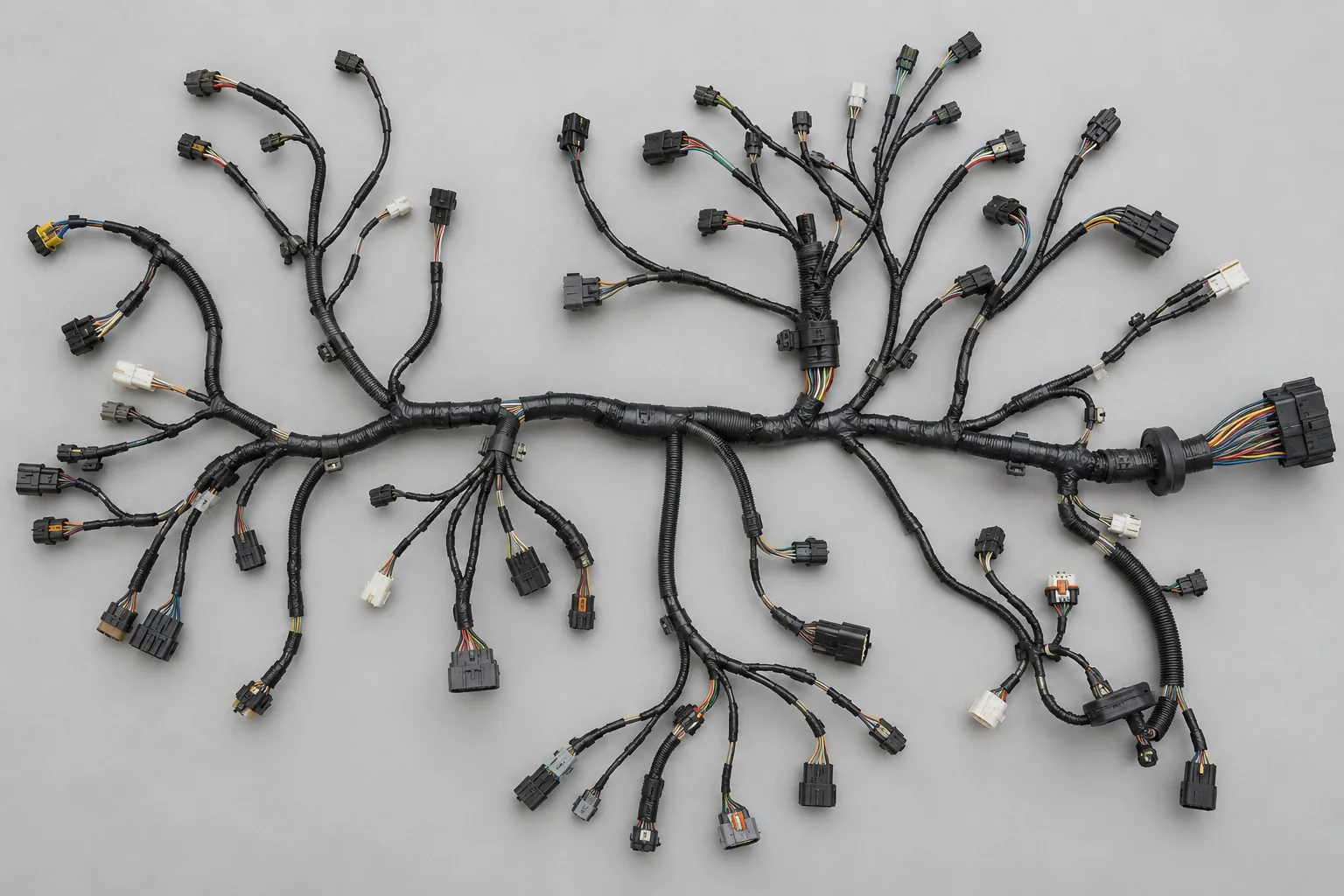
A wiring harness for a mid size car is about twenty pounds of copper and plastic, bundled into a shape that looks like a nervous system laid out flat. It has perhaps two thousand terminations. It is assembled largely by hand, because the geometry defeats machines, and it is one of the most border crossing objects in North American manufacturing: copper drawn in one country, insulated and cut in a second, hand assembled in a third, then shipped to a plant that may be back in the first.
Every one of those crossings is priced by a rule. On 1 July the rule that governs them was not renewed, and almost nothing happened to the harness.
What actually occurred
The United States, Mexico and Canada signed an agreement in 2020 with an unusual clause in it. Article 34.7 required the three governments to sit down after six years and decide whether to extend the thing for another sixteen. That meeting, the joint review, happened on 1 July.
The United States declined to agree the extension. Mexico and Canada both confirmed they wanted it. That is the entire event, and the headlines it produced were largely some version of the deal being dead.
The deal is not dead. It remains fully in force. Declining to extend does not terminate anything; it triggers a different clock. Under the same article the three parties now conduct a joint review annually instead of once a decade, and they keep doing that until either they agree an extension or the agreement reaches its own expiry date, which is 1 July 2036.
Ten years. And the sixteen year extension is not foreclosed by what happened this week. It remains available at any point along the way, under Article 34.7.4, by written confirmation from the three heads of government. There is no penalty clause, no reduced form of the agreement, no partial lapse. A decision not to extend in 2026 can be reversed in 2027 by three signatures.
The ledger, then
If nothing expires, it is fair to ask what the cost of this is and who carries it, because something clearly is being spent.
The first entry is certainty, and it is paid by anyone deciding where to put a factory. A plant is a fifteen to twenty year commitment against a tooling program that takes three to five years to recover. Until Wednesday, a firm making that decision could assume the tariff treatment of its cross border flows was fixed until 2042. It now has a horizon of 2036 with an annual review inside it, and an annual review is a recurring opportunity for the terms to change.
That does not stop investment. It reprices it. The capital does not become unavailable; it becomes more expensive, because the risk premium on a North American footprint goes up relative to a footprint that sits entirely inside one tariff wall. The firms that feel this first are not the largest ones. A company with its own trade counsel and its own government affairs staff can model an annual review. A supplier with sixty employees and a single customer cannot, and prices accordingly or does not bid.
The second entry is compliance work, and it is paid by everyone who moves goods. The rules of origin under this agreement are not simple. Automotive content has to clear regional value thresholds and a labor value content test that specifies a proportion of the vehicle be made where wages exceed a set floor. Demonstrating that for the harness means tracing the copper. Firms maintain that documentation continuously because the certification has to be available on demand.
An annual review does not change those rules. It does mean that the documentation system has to be maintained in a state where it could be adapted each year, which is a different and more expensive posture than maintaining it against a rule set assumed stable for sixteen years. Nobody sends an invoice for this. It shows up as headcount in trade compliance departments and in fees to customs brokers.
There is one more payer worth naming, because it is the one with no voice in any of this. A worker on a line that exists because of where a plant was sited does not read joint review communiques, and will not be told that the horizon on the investment behind the job shortened by six years this week. That information reaches them, if it ever does, as a decision about a future line that gets built somewhere else.
Who collects
The stated concern driving the American position is the trade deficit with the two partners. It is worth being precise about what an annual review does and does not do about that.
A review is a negotiating occasion. It creates a recurring moment at which the largest of the three economies can raise terms, with the other two arriving knowing that failure to agree eventually ends in expiry. That is pressure in the ordinary sense of the word: the same threat, made annually, is worth more than the same threat made once in a decade.
What it does not do is alter a tariff schedule, change a rule of origin, or move a single unit of trade this year. Nothing collected in 2026 changes. The thing being acquired is position in future negotiations, and the price of acquiring it is paid now, by the firms recalculating their horizons, while the return on it arrives later and is not guaranteed to arrive at all.
That asymmetry is the honest description of the transaction. It may still be a good trade. Positions in negotiations are worth something, and a country that never creates pressure points never uses them. But the cost is borne by a diffuse group in the present and the benefit accrues to a specific party in the future, which is the shape of most industrial policy and the reason most industrial policy is hard to evaluate.
What the harness does now
Between Wednesday and Thursday, the treatment of that twenty pounds of copper did not move. The certificate of origin that accompanies it says the same thing it said last month. The duty rate is unchanged. The plant that receives it has not altered its schedule.
The harness itself is unchanged. The sentence a chief financial officer has to write in a capital request is longer, and somebody will be writing it again every year between now and 2036. Twice a year those requests get reviewed. The review meeting that matters to the harness is not the one in Washington. It is the one where a company decides whether the next line is built in Hermosillo or in Alabama, and that meeting will now include a slide it did not include before, describing an annual review that runs until 2036 and is held against a deficit figure sitting outside everything the agreement actually governs.