
The headline is that Russian crude exports have reached their highest level since the invasion of Ukraine, and read as a statement about strength it is wrong in almost every particular.
It is a true figure. Seaborne crude shipments are running at a rate not seen since early 2022, and at current prices that is a great deal of money arriving in Moscow.
It is also, on the available evidence, a measurement of damage. Ukrainian long range drone strikes have knocked out a substantial share of Russia’s refining capacity, and a country that cannot refine its own oil has to sell it unrefined.
Two ways to sell the same barrel
Here is the comparison, and it is the whole of the argument.
A country with oil can export the crude, or it can refine the crude and export the products: petrol, diesel, jet fuel, fuel oil. Both start with the same barrel out of the same ground.
The second is worth substantially more, and the gap is the refining margin. Refining is where a low value commodity becomes a set of higher value specified products, and the country doing the refining captures that difference. It is why every significant oil producer builds refineries, and why refining capacity is a strategic asset rather than a cost center.
Russia has the third largest refining fleet in the world by capacity, which is not an accident. It was built precisely so that Russian barrels would leave the country as products rather than as crude.
What the strikes did to that
Drone attacks on refineries do not destroy a plant. They damage specific units, and a refinery is a sequence of units that have to work in order, so damage to one can idle the throughput of many.
The effect has been to force a large volume of crude that was meant to be processed domestically out onto the water instead. Exports of gasoline and jet fuel have been curtailed. The crude that would have become them is being sold as crude.
So the export record is not additional production. It is substantially the same oil, sold at an earlier stage, having lost the margin that the refineries existed to capture.
What the difference teaches
Three things, in ascending order of consequence.
The first is about how to read a volume figure. Barrels exported is an activity measure, not a profit measure, and in this case the activity went up because the value added went down. Anybody quoting the export number as evidence that sanctions have failed is measuring the wrong quantity, and so is anybody quoting it as evidence that the strikes have failed.
The second is about domestic supply. A country that cannot refine enough has to meet its own demand for petrol and diesel somehow, and the options are importing refined products, which is expensive and visible, or rationing, which is politically costly. Both show up at home rather than in an export statistic.
The third is the one to watch, and it is already visible in the shipping data. Oil sitting on the water has climbed by about a third from its low in April, with cargoes accumulating off Egypt and near Singapore.
Crude on a ship that is not moving toward a buyer is not a sale. It is inventory afloat, and it is a signal that the volume being pushed out has begun to exceed what the market will take at the price being asked.
Why a refinery is hard to hit and harder to fix
Worth a paragraph on the engineering, because it explains why this effect persists rather than being repaired in a fortnight.
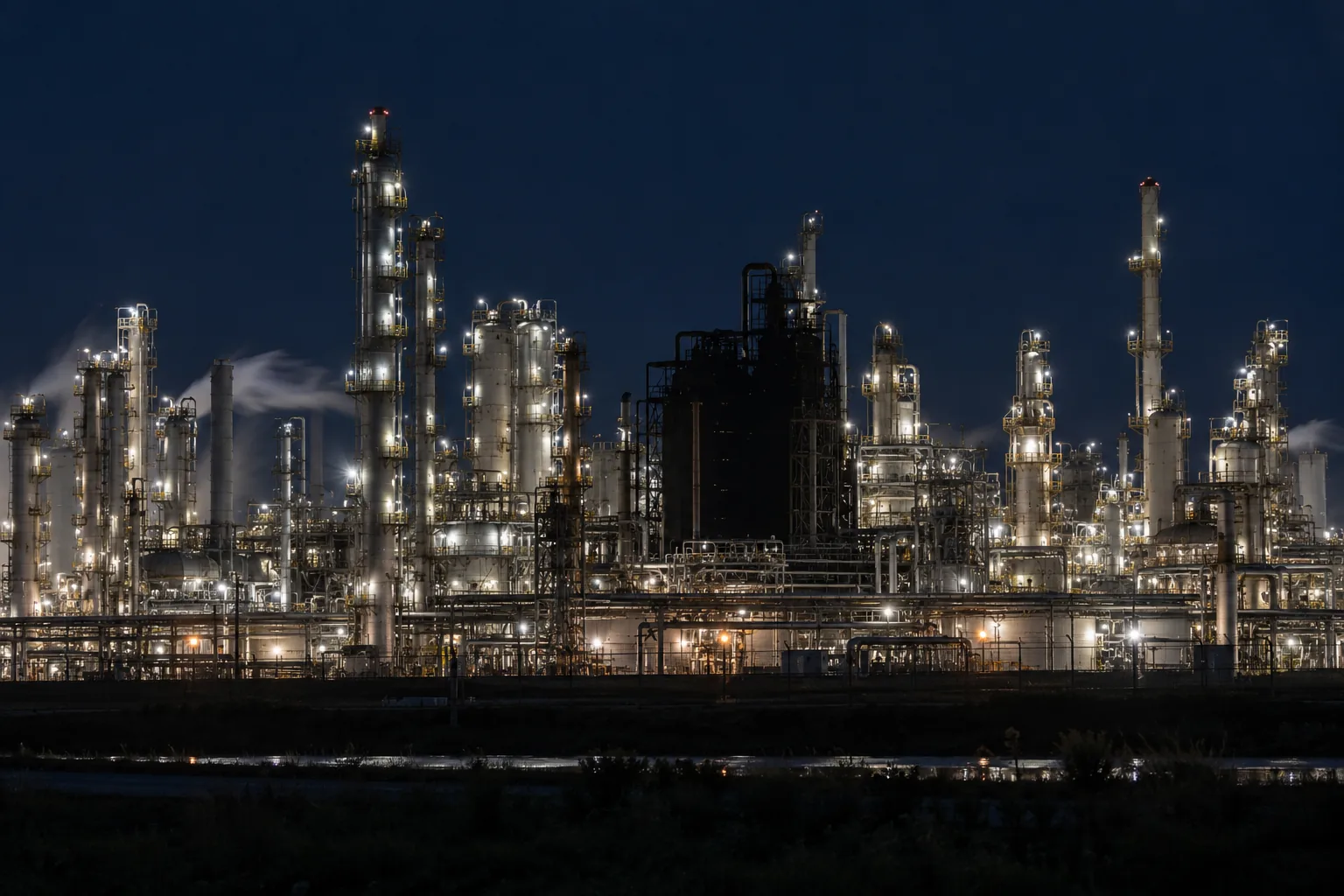
A refinery is not one machine. Crude arrives, is heated and separated in a distillation column into fractions by boiling point, and those fractions are then processed further in units that crack heavy molecules into lighter ones, remove sulfur, and reform the result into products that meet a specification. Each unit feeds the next.
That sequence is what makes the facility fragile in a specific way. Damage to a single unit does not reduce output proportionally; it can stop everything downstream of it, because the intermediate product has nowhere to go. A plant at eighty percent capacity is a plant with a functioning sequence. A plant missing one link is frequently a plant at zero.
And the components are not off the shelf. A catalytic cracker or a hydrotreater is built to order, with long lead times, from a small number of suppliers, most of whom are in countries that will not sell to Russia. Repair means fabricating domestically or cannibalizing another plant, and both are slow.
What the buyers are doing
The other half of this is on the demand side, and it explains why the cargoes are accumulating.
A refinery is configured for a particular grade of crude, and switching feedstock is not free: yields change, unit settings have to be retuned, and some grades simply cannot be run at all without modification. So a sudden increase in the availability of one country’s crude does not find a matching increase in willingness to buy it.
The buyers who can take it are the ones who have already adapted, and they know they are the only buyers, which is a position that produces a discount rather than a queue. The price a seller achieves in that situation is not the headline benchmark, and the gap between the two is where the actual loss sits.
The comparison nobody is making
It is worth setting this against the way the sanctions architecture was designed, because the two are not really engaging with each other.
The price cap regime was built to keep Russian oil flowing while limiting what Russia earns per barrel. It deliberately avoided an embargo, on the reasoning that removing several million barrels a day from the market would raise the price for everybody and hand Moscow a windfall on whatever it still sold.
That architecture targets the price. What is happening now targets the processing, and it is being done by drones rather than by regulation. The effect on Russian revenue per barrel is arguably larger than anything the cap achieved, and it was not produced by any sanctions body.
Which is an uncomfortable finding for both camps in the sanctions argument, and it is the reason the export figure is being cited approvingly by people who disagree about everything else.
Off Egypt
The physical form of all this is a tanker at anchor.
North of the Suez approaches, laden vessels are holding position with their engines idling and a cargo aboard that has been paid for by nobody. They are burning fuel to stay where they are, accruing demurrage against somebody’s account, waiting for a buyer or for an instruction to sail.
Each one is about a million barrels, sitting in the sun, in a market that is supposed to be short.