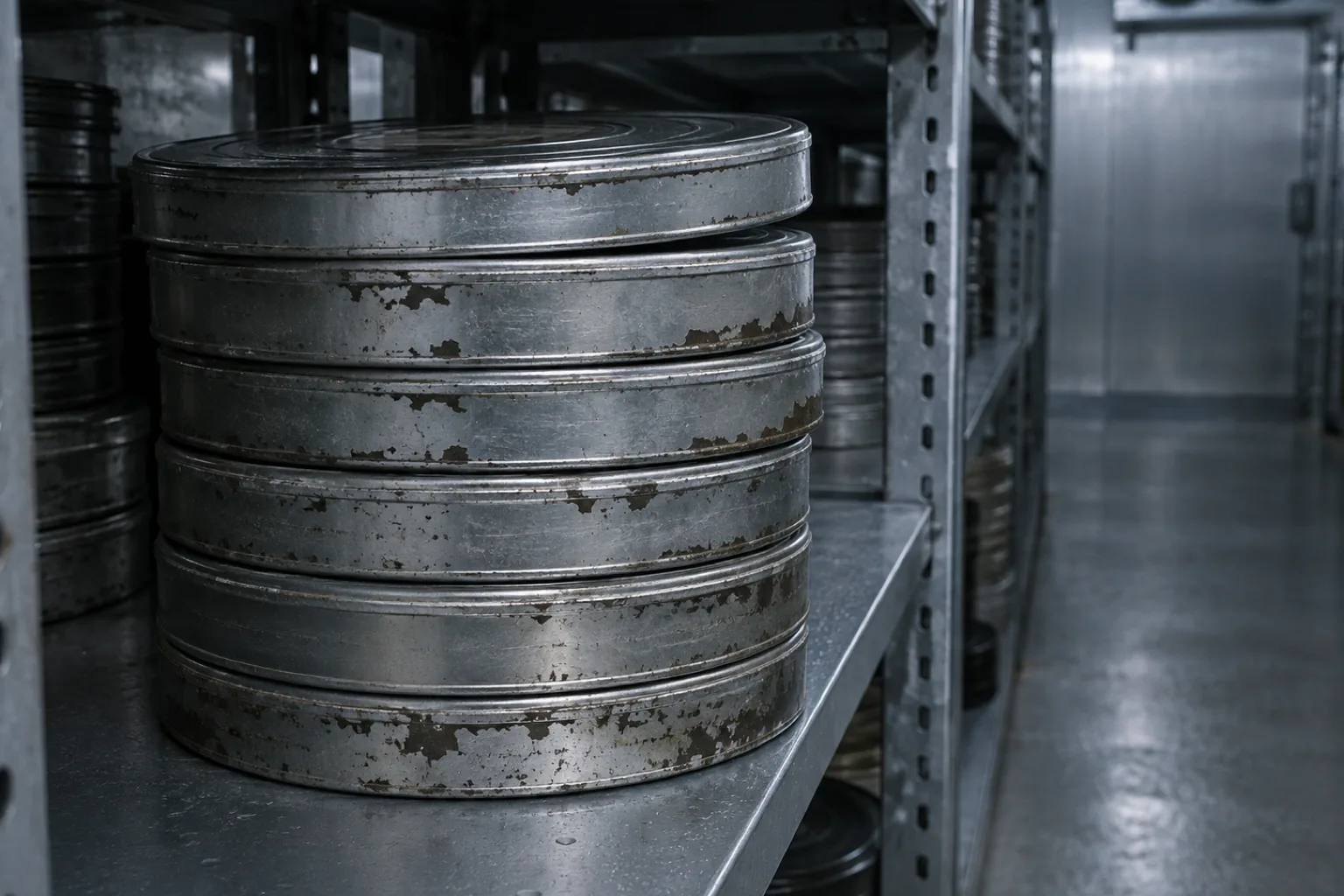
A 35mm print of a feature film is six or seven reels of acetate in flat metal cans, weighing perhaps twenty five kilograms in total, and for most of the history of cinema it was the only way a film existed. To withdraw a film meant collecting the cans. There were a countable number of them and somebody knew where they were.
This week the Wim Wenders Foundation announced that it is withdrawing the 1975 film Wrong Move from all current forms of distribution and exhibition, and that streaming services, broadcasters and distribution partners will be instructed to cease public access to it.
The reason is a scene involving Nastassja Kinski, who was thirteen when it was filmed. Kinski had been asking for the scene to be removed for more than a decade.
The date
1975, which is when the film was made and is a different country from this one in every respect that matters here.
The protections around a child performer on a European film set in the mid seventies were, by current standards, close to absent. There was no requirement for the kind of independent welfare presence that is now standard, no established practice around what a minor could be asked to do on camera, and no mechanism by which a thirteen year old’s agreement could be tested for whether it was meaningfully hers.
Those things have changed substantially, through a combination of national film industry rules, union agreements and, in several jurisdictions, criminal law. A production attempting this today would not get insurance, let alone a permit.
What it turned out to mean
That a film made under one set of norms keeps circulating under the next set, and the next, indefinitely, and that almost nobody has a mechanism to stop it.
Consider whose consent actually governs a finished film. The copyright sits with the producer or the production company, and in continental systems the director holds moral rights: the right to be identified, and the right to object to distortions of the work. Those are real and enforceable.
A performer has almost none of that. Having been paid and having signed a release at the time, an actor has no continuing veto over how the work is shown, no right to demand an edit, and no ability to withdraw a performance from circulation. That is the ordinary position and it exists for a good reason: a film with a hundred people in it cannot be hostage to any of them.
The consequence is that the only person who could act here was the director, and the only reason it happened is that he chose to.
The decade
Which is the part of this that should not be smoothed over, and the reporting has been clear about it: she asked for more than ten years.
Wenders’ statement is unusually direct for this genre. He said that as the only person responsible at the time who is still here, he recognizes that Kinski should have been better protected, and apologized unreservedly, with no ifs and buts. Kinski’s own response was that the decision was long overdue.
Both of those sentences are true at once and the second does not cancel the first. An apology that arrives after a decade of being asked is a better outcome than no apology, and it is also an apology that was available at any point in that decade.
The structural point is not about one director’s conscience. It is that a system in which the remedy depends entirely on a rights holder’s willingness will produce remedies at the speed of that willingness, and there is no appeal from it.
What withdrawal actually achieves now
Less than the cans of film would have, and more than people assume.
What it reaches: streaming catalogs, which can be delisted within days; broadcast licenses, which can be revoked; and distribution partners, who can be instructed. That is most of how anybody now encounters a fifty year old art film, and removing it genuinely removes it from ordinary circulation.
What it does not reach: physical media already sold, which is somebody else’s property; archival prints held by film institutes and cinematheques, which exist under preservation mandates that are deliberately insulated from rights holders’ wishes; and copies in private hands, which is the category that has grown most since 1975 and which nobody controls.
So the film is not destroyed and was never going to be. It becomes unavailable rather than nonexistent, which is a meaningful distinction and a genuine change: a thing you have to seek out is encountered by a tiny fraction of the people who encounter a thing that is simply there.
What it does not settle
The obvious question is what happens to the rest, because this is not one film.
The European art cinema of the sixties and seventies contains a number of works involving minors in scenes that would not be made now, and several have been argued about publicly for years. Each of them sits in the same structure: a performer who may object, a rights holder who may or may not act, and no third route.
Nothing about this week creates a route. It creates an example, which other performers will cite and other rights holders will be asked about, and that is how norms move in the absence of a mechanism. Slowly, unevenly, and one conscience at a time.
The cans
There are prints of this film in national film archives across Europe, cataloged, temperature controlled, on acetate or polyester, in flat metal cans on shelves.
They stay there. Archives preserve what was made rather than what should have been made, and a withdrawal by a rights holder does not reach a legal deposit copy.
So the film exists in two conditions at once. Unavailable, in the sense that nobody can now open an app and watch it. And perfectly intact, cataloged, temperature controlled, on a shelf, in a building whose entire purpose is to make sure that nothing anybody decides about a work ever destroys the copy of record.