
In the Sala Bianca of the Pitti Palace in Florence, in 1962, a designer who had been running his own house on the Via Condotti for two years showed a couture collection to the international buyers for the first time. It sold out. He had trained in Paris under Jean Dessès and Guy Laroche, and from that afternoon onward Valentino Garavani was a name rather than a young Italian with a salon.
He died on 19 January, aged ninety three. What follows is not about him. It is about one of the things he made, which outlived the collections and has been credited to him incorrectly for about forty years.
The thing
The thing is a red. Not red as a preference, a specific one, saturated and slightly hot, closer to a poppy than to a wine, and unmistakable next to the other reds on any carpet where several are present.
He arrived at it early, in the 1950s, and one of the first garments associated with it was a tulle dress. Then he did the part that matters, which was to put it in collection after collection for five decades, at a rate that made it a signature rather than a recurrence, and to withhold it often enough that its appearance still registered. The 1968 collection in which he showed almost nothing but white works because the red was the expectation being broken.
The claim everybody makes
Here is the sentence that appears in nearly every piece written about the color, including obituaries published this month. Valentino red is a registered Pantone. It has its own chip, its own number, its own entry in the book, secured by the house.
It appears in newspapers and in fashion histories and on the websites of people who sell fabric. It is often accompanied by a formula: a hundred percent magenta, a hundred percent yellow, ten percent black.
It is not true. Asked about it, the vice president of the Pantone Color Institute has said the company holds no record of ever creating a custom Valentino red. There is no chip. There never was one. The thing everybody knows about the color is a thing that did not happen.
Why the myth is a reasonable mistake
It is easy to be scornful about a fact that propagated because nobody checked, and in this case scorn is misplaced, because the claim is entirely plausible. Colors really do get registered, and the examples are famous.
Tiffany Blue is the cleanest one. It is Pantone 1837, the number chosen for the year the company was founded, standardized with Pantone in 2001, and protected as a trademark before that. It is precisely the arrangement everyone assumes Valentino had, and it exists.
Christian Louboutin was granted a trademark on the red sole in 2008 and then had to defend it against Yves Saint Laurent, and broadly won: the court accepted that the red sole had become distinctive of the brand, though the protection it emerged with was narrower than the one it went in with.
And Cadbury shows the other outcome. The company won protection for its purple and then lost it on appeal after Nestle challenged, which is a reminder that a color trademark is a claim that has to survive somebody with an interest in breaking it.
So the myth sits in a field of true things. Someone hearing that the most identifiable color in Italian couture was locked down the way Tiffany’s was would have no reason to doubt it.
What actually secured it
The reason the registration was unnecessary is that registration is not how the color came to be his.
A trademark on a color is a legal instrument for stopping a competitor using it in a defined commercial context. It is useful where the color does a job of identification that would otherwise be confused: a box in a shop window, a sole visible from behind, a wrapper on a shelf. It is enforceable, expensive and narrow.
What Valentino had instead was mnemonic. He used one red, consistently, for fifty years, on a class of garment that is photographed more than almost any other object, worn by people whose photographs are published everywhere. Nobody was ever going to be confused about whose red it was, because the association had been built in public at a rate of several hundred photographs a year for half a century.
That kind of ownership cannot be registered and cannot be infringed, exactly. Another house may use the same values and it will not become theirs. It also cannot be bought, transferred or defended, which is its weakness: it lives entirely in the memory of the people who saw it, and it lasts as long as they do.
Why a number would not have helped anyway
There is a practical reason the Pantone story never made sense to anyone who works with color, and it is the most interesting thing about the whole business.
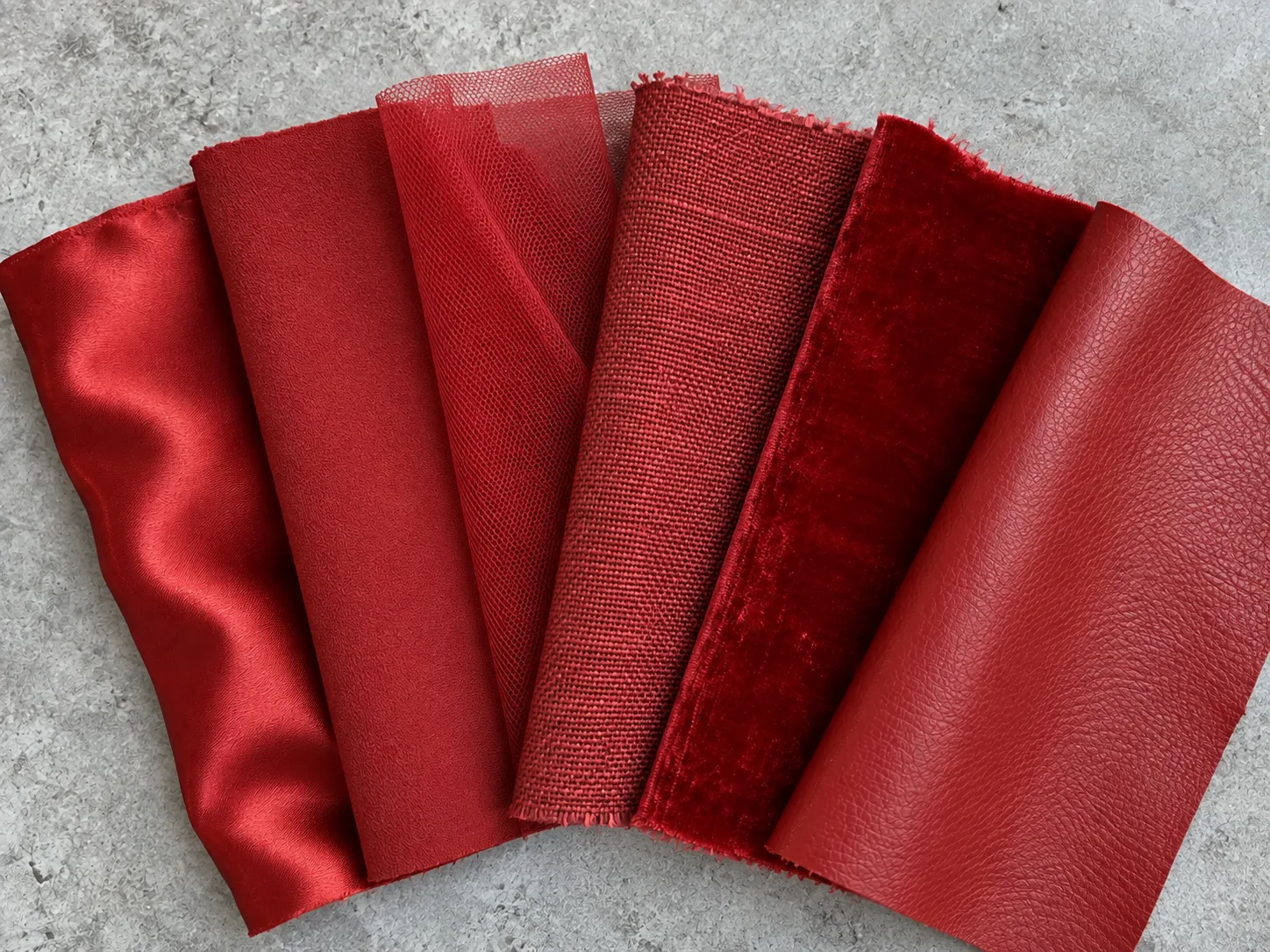
A single number cannot specify a color across materials. Dye chemistry does not transfer. Silk takes a dye differently from wool, wool differently from cotton, and none of them behave like pigment on paper or like finished leather. Pantone itself acknowledges this by running separate systems, with different books for coated and uncoated printing and different ones again for textiles, and the corresponding chips do not match each other exactly because they cannot.
So the house’s actual problem was never specification. It was matching: getting a gazar, a tulle, a wool crepe, a satin and a shoe to read as the same red under the same lights, when each substrate pulls the dye in its own direction. That is solved by a dye house, a technician, and somebody who will reject a batch, repeatedly, for decades.
Which is why the color survived and the paperwork never existed. It was not held in a book. It was held in the hands of whoever stood in a workroom in Rome holding a new length of tulle up against an old one, in daylight, and said no, that one is not it, run it again.