Here is a question worth sitting with before we answer it, because the answer is the least interesting part. If you had to fill a container with about two hundred objects, seal it, and hand the whole thing to people two hundred and fifty years from now, what instruction would you leave with it?
Not what would you put in. That is the fun version of the question and it is the version everybody plays. The harder one is procedural. Who do you tell, how do you tell them, and what makes them do it.
The object
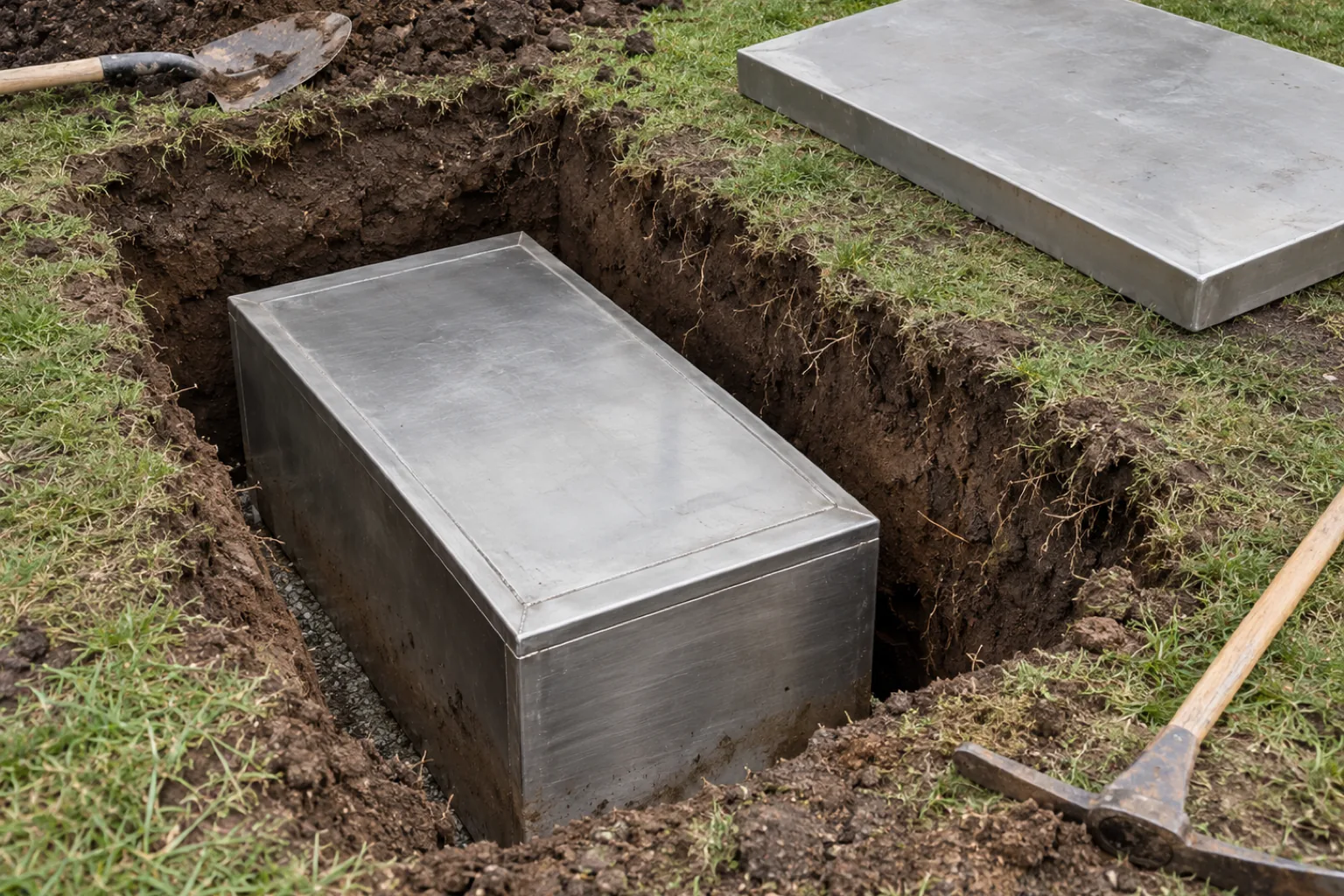
On Saturday, at Independence Mall in Philadelphia, inside the boundary of Independence National Historical Park, a stainless steel container weighing about nine hundred pounds was placed below grade and capped with a lid weighing about eleven hundred. Assembled, the thing comes to roughly a ton. It is described by its organizers as waterproof, which for a buried vessel means gasketed and sealed rather than merely covered.
Inside it are close to two hundred artifacts, contributed through all three branches of the federal government, all fifty states, five territories and the District of Columbia. The published inventory includes a signed pocket Constitution, an iPhone, a three dimensional rendering of Abraham Lincoln’s hand, a crystal from the ball that dropped in Times Square at the start of this year, a coin struck jointly with the National Football League, and a photograph of the Philadelphia Phillies lineup from their opening day this season.
Above it sits an installation derived from Benjamin Franklin’s segmented snake, the one captioned Join or Die, which was a printed argument for colonial union in 1754 and is now a marker telling anyone standing on that spot that something is underneath them.
The instruction attached is a single date. It is to be reopened in 2276.
The instruction is the weak part
A date is not a mechanism. Nothing in the arrangement obliges anyone to act on it, and the entities that would have to act do not have continuity of the required kind.
The National Park Service, which administers the site, is an agency of a government that funds it one appropriation at a time. It has existed for a hundred and ten years. The America250 Commission that assembled the capsule is a body created for an anniversary and is expected to wind down after it, which is the normal life of such a commission. The city of Philadelphia will presumably still be there, but the department that holds the record of what is buried where is not guaranteed to be.
None of this is negligence. It is the ordinary condition of any instruction that outruns the institutions available to carry it, and this country has a case study from the last anniversary, on the same holiday, in the same state.
On 4 July 1976 a capsule holding the signatures of twenty two million Americans was to be sealed at Valley Forge. Three hundred wagons and five thousand riders had brought them across the country. President Ford flew in that morning, signed Valley Forge into a national park, and accepted the signatures. At some point around the ceremony the capsule was taken from an unattended van, and it has never been recovered. Nobody knows who took it or where it went.
The International Time Capsule Society, which tracks these things, holds that most capsules buried in the last fifty years are lost, stolen or inaccessible. The Valley Forge capsule sits at the top of its list of the ones it would most like to find.
So the useful question about this object is not whether the contents are well chosen. It is what carries a date forward when no organization is under an obligation to carry it.
What actually carries it
Three things do the work, and only one of them is paperwork.
The first is location. Burying it inside a national park rather than under a municipal plaza puts it on land whose status is set by federal statute rather than by a zoning decision that can be revisited. Land inside the park system does not get sold to a developer in a budget year. It can be transferred, but transferring it requires an act that leaves a record.
The second is mass. A ton of sealed stainless steel is not something a contractor removes without noticing. The failure mode for small capsules is that somebody digs, hits a box, and either discards it or opens it. A one ton assembly with a separate eleven hundred pound lid stops an excavator and generates a phone call. The weight is not about protecting the contents from time. It is about protecting them from a backhoe.
The third is the marker, which is the part most people will read as decoration. An installation on the surface converts private knowledge into public knowledge. A buried object that nobody can see depends entirely on records surviving. A buried object with a permanent thing standing over it depends on somebody wondering what the thing is standing over, which is a much more durable mechanism because it does not require an institution at all. It requires only curiosity, which does not need to be appropriated.
Two hundred and fifty years is not a round number here
It is worth noticing what the date actually asks. 2276 is not a distant abstraction, it is a specific interval, and this country has already run it once. The distance from 2026 back to 1776 is exactly the distance from 2026 forward to 2276.
Run that backward and the scale becomes concrete. An object sealed in 1776 and handed to us would have been assembled by people for whom the federal government did not yet exist in its present form, whose country contained thirteen states, and whose technology for preserving an image of a person was a painter. Nothing they could have sealed would have been readable by a machine, because there were no machines to read it.
Which makes the iPhone in the container the most interesting object in it, and not for the reason it was probably included. It will be intact. It will be uncharged, its battery chemistry will have failed long before, its connector will match nothing, and the encryption on its storage will be either unbreakable or trivially broken depending on what 2276 has. It is the item most likely to survive physically and least likely to survive as information, and a pocket Constitution printed on paper will almost certainly outperform it.
The answer to the question
So, the instruction. What the organizers left is a date, a park, a ton of steel and a snake cut into segments on the surface.
That is a thinner instrument than a statute and a more durable one than a memorandum, and it is roughly what is available. There is no legal form that binds a government two and a half centuries out. There are only objects placed where removing them is harder than leaving them.
What is actually in the ground on Independence Mall, then, is not a message. It is a weight, set in protected soil, under a piece of eighteenth century political cartooning, arranged so that the cheapest thing any future person can do is nothing at all until the date arrives.