
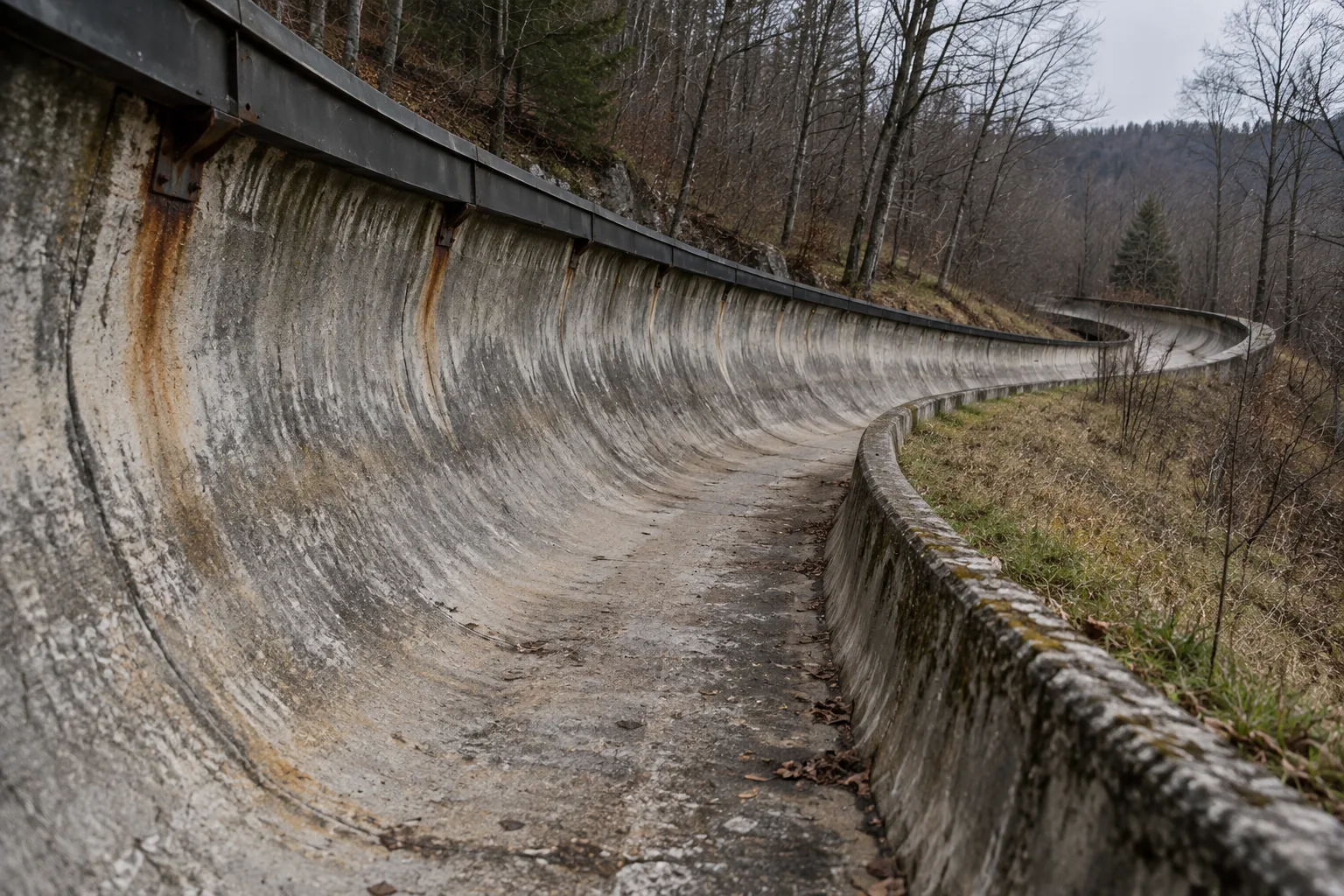
It is a ribbon of concrete about a mile and a half long, curved into banks that run up to vertical, with several miles of steel pipe cast into its underside. Ammonia circulates through the pipe. Ice technicians spray water onto the concrete in thin layers until a shell perhaps two inches thick has formed, then shave it flat with hand tools, then repair it after every run, because a sled with four people in it reaches around ninety miles an hour and takes some of the surface with it.
That is a sliding track, and there are sixteen of them in the world currently in competition use. Bobsleigh, luge and skeleton at these Games are all being held on one of them, in Cortina d’Ampezzo, and it is the most argued about object at this Olympics.
The thing that was there before
A track opened on that hillside in 1923. It hosted the sliding events at the 1956 Cortina Olympics, it was named for Eugenio Monti, the Cortina bobsledder who became the first athlete awarded the Pierre de Coubertin medal for sportsmanship, and in 1981 it appeared in a Bond film, which is the kind of thing a venue puts on a plaque.
It closed in January 2008.
The reasons were entirely mundane and are the whole point of this piece. Maintenance costs had risen past what the town could carry. Cortina had been due to host a world championship in 2007 and withdrew for financial reasons. The track could not obtain homologation for skeleton, meaning it no longer met the standard required to hold sanctioned races in one of the three sports it existed for. After a final bobsleigh event it was shut, and it sat.
An Olympic sliding venue did not close because the sport moved on or because anybody stopped loving it. It closed because keeping a mile and a half of refrigerated concrete in working order is expensive every single year, forever, and the money ran out.
The thing that is there now
The Cortina Sliding Centre stands on the same site. Similar length, the same number of curves, built to current design and safety standards. It broke ground in February 2024, which for a venue of this complexity is extraordinarily late, and it was finished at a cost of about 118 million euros.
The International Olympic Committee did not want it. That is not a matter of interpretation; the committee opposed the rebuild, and had for years been pressing host cities to use existing venues rather than construct new ones, which is the central promise of its own reform program. A fallback was kept live in which the sliding events would have been held at Lake Placid in New York, a functioning track on another continent, and the fact that such a plan existed tells you how seriously the alternative was taken.
Italy built it anyway, and once it was built the committee said it had surpassed expectations, which it may well have. Athletes have praised the ice. None of that speaks to the question the rebuild actually raises.
What a track costs after everyone leaves
Construction is the number that gets reported. Operation is the number that decides what happens to the object, and there is a record.
The track built for Turin in 2006 cost around a hundred million dollars and roughly a million dollars a year to maintain afterwards. The one built for Pyeongchang in 2018 cost about 114.5 million dollars, with annual maintenance estimated near 2.84 million. Those are not small sums for a facility used by a very small number of people.
And the users are genuinely few. Sliding sports have tiny participation bases by the standards of anything else at a Winter Games. A track needs a refrigeration plant, a crew who know how to build ice, and a competition calendar that brings teams in, and a country that does not have a strong national program in all three sports will struggle to fill it.
Which is precisely what happened to the last track on that hillside, for exactly those reasons, within living memory of everyone involved in commissioning this one.
The case for building it anyway
It deserves stating properly, because the easy version of this argument treats the decision as vanity and it is not that simple.
Sliding events at a Games in Italy held in New York would have been a strange thing, and not only symbolically. Athletes and equipment would have crossed an ocean mid Games; the events would have run in a different time zone from the rest of the Olympics; the host country would have had no sliding venue at all during its own Olympics. There is a reasonable position that this is not what hosting means.
There is also a local claim. Cortina had a track for eighty five years. It is a sliding town in the way that some towns are football towns, and being told your sport would be held three thousand miles away is a real loss to real people, whatever the accounting says.
And there is the Youth Olympic argument, which the organizers have made: northern Italy hosts the Winter Youth Olympic Games in 2028, which gives the venue at least one scheduled reason to exist after this month. That is a genuine answer, and it covers two years.
The plant
The events finish on the twenty second. The athletes leave, the timing equipment is packed, the grandstands come down.
The refrigeration plant does not come down. It sits at the bottom of the hill, and somebody has to decide, every autumn from now on, whether to start it. Starting it means ammonia, electricity, a crew, and an ice build that takes weeks before a single sled touches the surface. Not starting it means the concrete stands there through the winter, dry and gray, holding its curves.
That was the decision Cortina faced in 2007, with a smaller plant and a cheaper track, and the answer it gave then was no.