A question worth holding until the arithmetic has been laid out, because the answer is not available yet and the reason it is not available is the interesting part. Who is going to govern Saxony-Anhalt?
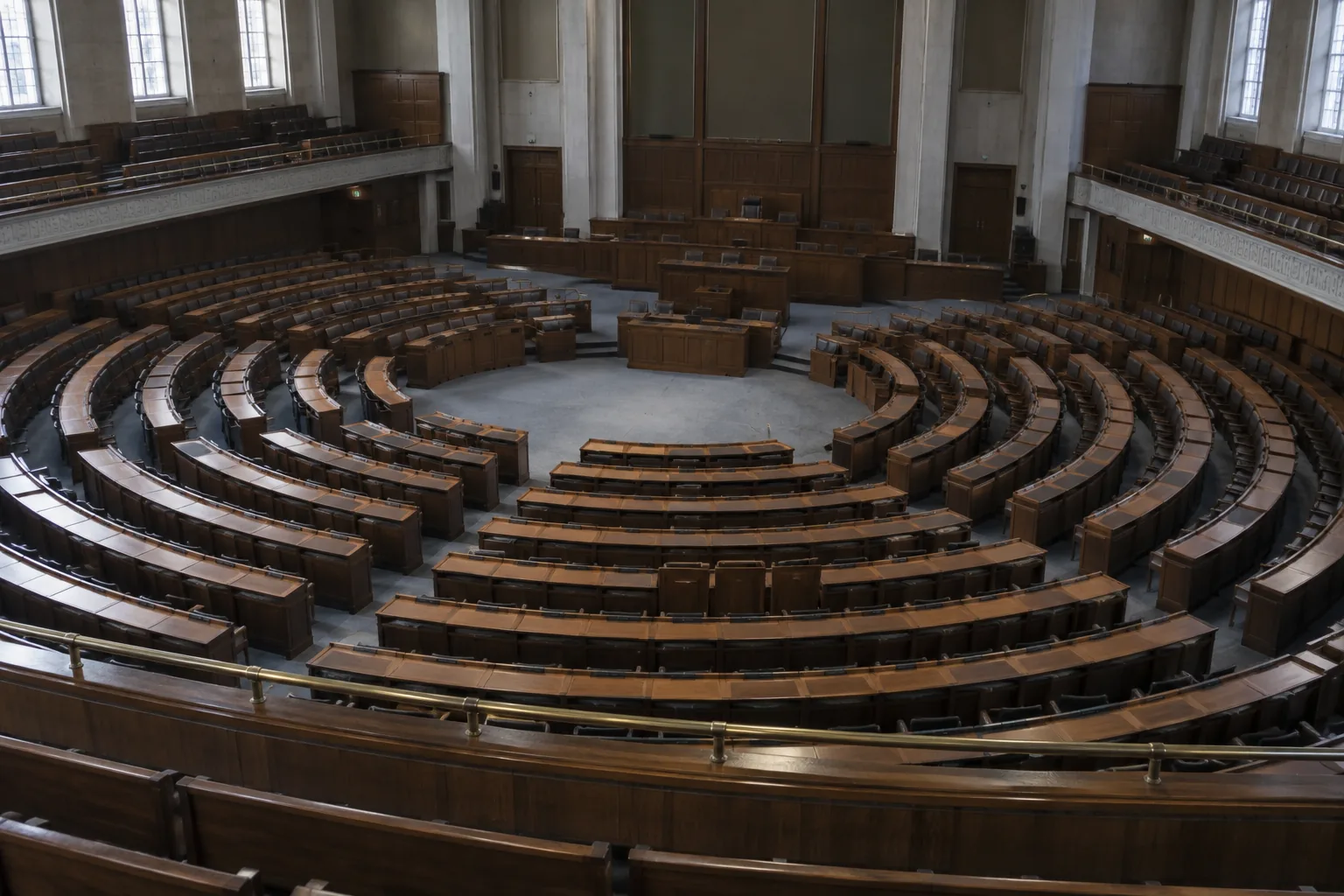
The state voted on 6 September. The Alternative for Germany took 43.8 percent, which is the largest share any party has taken in that state in the post war period and the largest the AfD has taken anywhere. It won 39 of the 83 seats in the state parliament. A majority requires 42.
Three seats. This is an explainer on where those three went, because the mechanism that produced the gap is the same mechanism that now decides what happens next.
How votes become seats here
German state parliaments use a mixed system. Voters cast two votes, one for a candidate in a constituency and one for a party list, and the party vote is what determines the overall composition. Constituency winners take their seats, and list seats are then allocated so that each party’s total matches its share of the party vote as closely as the arithmetic allows.
The effect is proportional representation with a local element bolted on, and it means the relationship between vote share and seat share is close but not exact.
One rule bends it. A party must clear five percent of the party vote to receive any list seats at all. Fall below and you get nothing, and the votes cast for you are not transferred anywhere. They are removed from the calculation, and every party above the threshold receives a slightly larger share of the seats than its share of the votes.
Where the three seats went
That threshold did most of the work on 6 September.
The Free Democrats lost their seats entirely, which means everyone who voted for them is unrepresented and their votes are gone from the seat calculation. The Christian Democrats took 17.2 percent, less than half what they held before. The Social Democrats took 9.3 percent, a slight improvement on a low base. The Greens took 8.9 percent, their best result in the state.
With those votes removed, the AfD’s 43.8 percent converted into about 47 percent of the seats. The threshold rule worked in its favor, as it always works in favor of large parties, and it was still not enough.
This is worth stating plainly because it is counter intuitive. The rule that is most often criticized for helping big parties handed the AfD a bonus of several seats, and the party still finished three short of governing alone. Its result was extraordinary and the system was not the thing that stopped it.
What stops it is an agreement
The 44 seats that are not AfD are held by four parties with very little in common. Christian Democrats, Social Democrats, Greens and the Left disagree with each other about most of what a state government does: budgets, policing, energy, schools.
Forty four is two more than a majority. So a government can be formed without the AfD, and only just, and only if all four agree to sit in it together.
Holding them together is a convention rather than a law. German parties have maintained, with occasional local exceptions that have caused enormous argument, a refusal to govern with or depend on the AfD. It has no statutory force. It is a commitment each party renews by declining to break it.
A convention of that kind is strong until the arithmetic makes it expensive, and the arithmetic here is about as expensive as it gets. A four party coalition with a margin of two is an unstable object. Any two members of the smallest partner can bring it down by voting against a budget, and every one of those four parties will be asked by its own members why it is in a government it did not want, propping up policies it campaigned against, with an opposition of 39 pointing at the contradiction daily.
One more feature of the result deserves attention, because it will shape the negotiation. The Christian Democrats did not merely lose. They more than halved, from a position of governing the state, and a party in that condition is a difficult coalition partner: it has lost the authority that comes from being the obvious anchor, and its remaining members have every incentive to argue that the strategy which produced 17.2 percent should not be repeated.
The Greens, meanwhile, recorded their best result here on 8.9 percent, and the Social Democrats improved slightly. Neither is large, and both will be indispensable to any arithmetic that excludes the AfD, which gives two small parties a degree of influence over a state government that their vote share would not ordinarily carry.
The comparison
Two other cases show the range of what happens next, and they went opposite ways.
In France in 2024, parties that agreed on very little coordinated to keep the National Rally from a majority, first by standing down candidates and then by arranging a parliament in which no bloc could govern comfortably. The exclusion held. The cost was a legislature that struggled to pass budgets and a sequence of short lived governments, and the party excluded went into the next cycle able to say it had been kept from power by an arrangement among everyone else.
In the Netherlands, the cordon around the Party for Freedom held for years and then did not, and the party entered government. What followed was neither the catastrophe its opponents predicted nor the vindication its supporters expected: it governed, it was constrained by coalition partners and by the machinery of the state, and it became subject to the ordinary judgment that attaches to incumbency.
Those are the two available futures, and the parties in Magdeburg will be weighing both. Excluding a party that took 43.8 percent has a democratic cost that is real and that its opponents tend to understate. Including it has a cost those same opponents consider unacceptable. There is no option without one.
The answer, which is that there is not one
So: who governs Saxony-Anhalt.
As things stand, nobody has said. A four party coalition is arithmetically possible and politically difficult. A minority government is possible and would require case by case support from a parliament in which the largest party is the one being kept out. Fresh elections are possible and would be held in a state where the AfD has just taken its best result anywhere, which makes them a risk for everybody except the AfD.
What is settled is the number, and it is the number that will be quoted for years in both directions. Forty three point eight percent, 39 seats, three short. Large enough that excluding it requires everybody else to act together, and small enough that they can.