The number that will be reported is 1,386. That is the confirmed death toll in Nepal from Wednesday morning, alongside 43 in the Tibet Autonomous Region.
It is the wrong number, and everyone using it knows so. Alongside it sit 5,130 people missing in Nepal and 519 in Tibet. In a debris flow, missing is not a category that resolves. Bodies were carried two hundred and forty kilometers, across an international border, into India. The confirmed figure counts recoveries, and recovery is a function of where a river chose to put someone.
What follows is an accounting: what was known, what was recorded, what was transmitted, and what arrived in time to be of use to anybody.
What happened, physically
On Wednesday morning a section of glacier on Langtang Lirung, in the Himalaya north of Kathmandu, gave way.
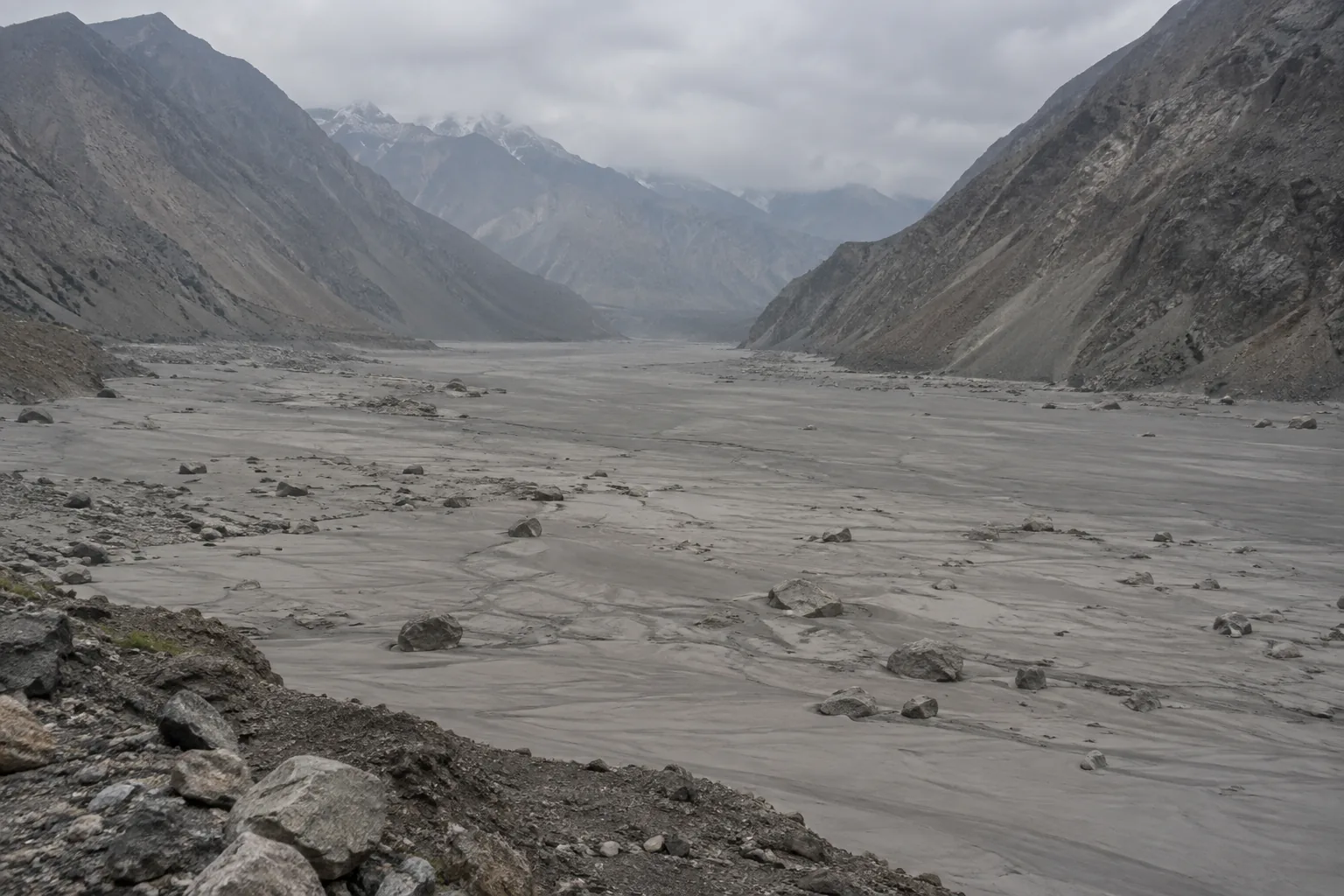
A collapse of that kind does not stay ice. It entrains rock, sediment and meltwater as it descends, and the resulting mass behaves less like a flood than like wet concrete moving at speed. It went into the Trishuli, and the Trishuli carried it through a chain of settlements along seventy two kilometers of valley.
Two measurements describe what that meant. In the upper gorges the river rose at least seventy meters above its normal level, which is a number that stops being intuitive: it is higher than most buildings anyone in those valleys has ever seen. Further downstream, where the valley opens and the water spreads, it rose about nine meters in thirty minutes.
Nine meters in half an hour is the figure that decides how many people lived. It is fast enough that the only people who moved in time were people who were already moving.
What the instruments knew
Here is the entry in this ledger that is hardest to sit with.
The collapse was recorded by seismometers around the world, at magnitudes reaching Ms 5.2. A mass of ice and rock leaving a mountain is a seismic event, and the global network that exists to detect earthquakes detected it, as it detects everything of that size, within seconds.
That network is extraordinary and it was built for a different purpose. Its readings go to seismological data centers, are processed to locate and characterize events, and are published for scientific use. The processing is fast by scientific standards and not fast by the standards of a wall of debris moving down a valley.
More to the point, a seismometer records that something large happened at a location. It does not know that the something was a glacier rather than an earthquake, and it does not know what is downstream. Turning a seismic signal into a warning that a specific village should move requires an interpretation, a decision, a communications path and a person at the other end of it, and each of those is a separate system that has to already exist.
So the event was detected globally and instantly, and that detection was of no use to anyone in the valley, because detection and warning are different things and only the first of them had been built.
What a warning system would have required
It is worth being concrete about the cost side of this ledger, because glacial hazard warning is not hypothetical. It exists in several countries and it works.
The components are known. Instrumentation on the lakes and glaciers that have been identified as dangerous, which requires that somebody has surveyed and ranked them. Automated processing that can distinguish a collapse from background noise without a human in the loop, because a human in the loop costs more minutes than the flow allows. Sirens in the settlements, physically installed, with power and maintenance. And drills, because a siren that people have not practiced responding to buys very little.
Each of those is a capital cost followed by a permanent operating cost, in a country that is poor, for a hazard that materializes rarely and unpredictably. The honest accounting is that the money spent per life saved is impossible to calculate in advance, because the denominator is an event that may not happen for decades and may happen next week.
This is not a story about negligence. It is a story about a category of expenditure that is very hard for any government to justify and that is only ever obviously correct in retrospect.
Who pays
The costs fall almost entirely on people who had no part in the decisions that produced the hazard.
Scientists have said climate change likely contributed to the collapse. That is a statement about a mechanism rather than an attribution of a single event, and it should be read carefully: warming destabilizes ice, destabilized ice fails more often, and this particular failure sits inside that pattern without any individual emission being traceable to it.
Nepal’s contribution to the accumulated stock of atmospheric carbon is negligible by any measure. The valley communities along the Trishuli had no input into the industrial history that changed the temperature of the mountains above them. They carry the entire cost of it, in a single morning, and the mechanism by which anyone else would carry any part of it does not exist in any enforceable form.
One further cost belongs in this ledger, because it is already being paid and will not appear in any toll. The Trishuli valley carries a road, and the road carries everything: supplies upward, produce downward, and the movement of anyone who needs a hospital. Seventy two kilometers of it is now under sediment. Rebuilding a mountain road is measured in seasons rather than weeks, and until it is done the settlements above the worst of the damage are reachable on foot and by helicopter and not otherwise.
The entry that stays open
The thing this ledger cannot close is the 5,130.
In most disasters the missing become the dead over weeks, as recovery proceeds and identification catches up. That will happen here to some degree, and the confirmed total will rise for a while and then stop rising, well short of the number of people who are gone.
It stops because a debris flow does not leave bodies where people were. It leaves them distributed along a river for hundreds of kilometers, buried under sediment that is now several meters deep across the valley floor, and across a border into a country with no obligation to search. Some proportion of those five thousand will never be found, and their families will hold a legal status of absence rather than death, which affects inheritance, remarriage, insurance and the ability to close an estate, for years.
So the final figure, whatever is eventually published, will be a count of recoveries presented as a count of deaths. It will be cited in every retrospective. And the difference between it and the real number will be a permanent feature of the record, produced not by anybody’s dishonesty but by the physical fact of what happened to a valley on Wednesday morning.