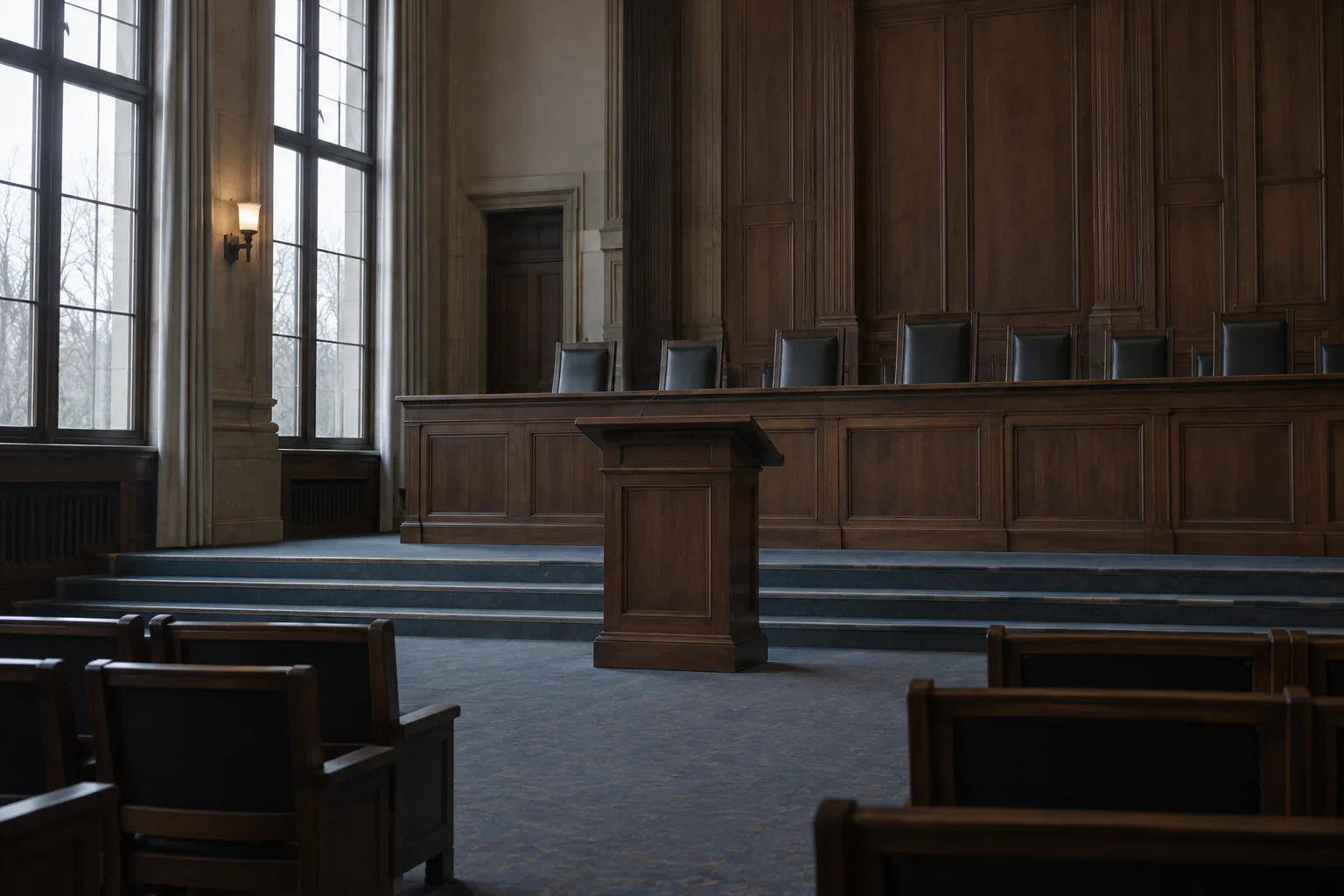
Shortly after one o’clock on Friday afternoon, in the Great Hall of Justice at the Peace Palace in The Hague, the president of the International Court of Justice began reading an order aloud. It took some time. The reading is the moment an order of the court exists, and it is done in public, in full, because the court has no other instrument.
What was read was a set of provisional measures in the case South Africa has brought against Israel under the Genocide Convention. The date is worth marking, because the court has issued an order of this shape once before, and what that one turned out to mean is the most useful guide available to what this one will.
What was actually ordered
Precision first, because the order has been described in the days since as both more and less than it is.
The court ordered Israel to take all measures within its power to prevent acts falling within the Genocide Convention; to ensure its forces do not commit such acts; to prevent and punish public incitement to commit genocide; to enable the provision of basic services and humanitarian assistance; to prevent the destruction of and ensure the preservation of evidence relevant to the case; and to report to the court within one month on what it has done.
It did not order a ceasefire. South Africa had asked for one, and the court declined to indicate it.
The legal basis is narrower than the headlines suggest and more consequential than dismissals of it allow. At this stage the court is not deciding whether genocide has occurred. It found that at least some of the rights South Africa asserts are plausible, which is the threshold for provisional measures, and it named among them the right of Palestinians in Gaza to be protected from acts of genocide.
Provisional measures are binding. The order goes onto the court’s record and is transmitted to the Security Council.
The date to look back at
On 8 April 1993, the same court issued provisional measures in a case Bosnia and Herzegovina had brought against what was then Yugoslavia, under the same convention.
The order was similar in shape. It required the respondent to take all measures within its power to prevent the commission of genocide, and to ensure that any military or paramilitary units it might direct or support did not commit genocidal acts. The court reinforced it with a second order in September of that year, after Bosnia returned to say the first had not been complied with.
In July 1995, more than two years after the first order and nearly two after the second, around eight thousand Bosniak men and boys were killed at Srebrenica.
That is what an order of this kind did not prevent, and it is the honest starting point for assessing what Friday’s will do.
What the 1993 order did do
It would be wrong to conclude from that sequence that the order was worthless, and the reason is visible only much later.
In 2007 the court delivered its judgment on the merits in that case. It found that genocide had been committed at Srebrenica, that Serbia had not committed it and had not been complicit in it, and that Serbia had violated its obligation under the convention to prevent genocide. It found that Serbia had known of the serious risk and had had means of influence over those carrying it out, and had not used them.
The provisional measures order was part of the architecture of that finding. It had put the respondent on formal notice, in 1993, of exactly the obligation it was later found to have breached. A state that has been told by the court what it must do cannot afterwards say it did not know.
So the order functioned, fourteen years late, as a fact in a judgment rather than as a constraint on conduct. That is a real function and it is not the one people expect from a court order.
What is different this time
Two things, and they point in opposite directions.
The reporting requirement is one. Israel is required to report within a month on the measures it has taken. The 1993 order carried no such obligation, and Bosnia had to return to the court to say nothing had happened. A reporting deadline creates a document, on the record, on a date, which is a more efficient way of generating the evidence that a later merits judgment would need.
The other is the position of the respondent’s principal ally, which in this case holds a veto in the Security Council, the only body with the power to enforce. That was substantially true in 1993 as well, with different actors, and it is why the court’s orders in cases of this kind have historically been enforced by nothing but their own authority.
It is worth adding what the order does for the party that brought it, because that is a separate question from what it does on the ground. A state that obtains provisional measures has converted its allegation from a political claim into a matter formally before the principal judicial organ of the United Nations, with a timetable and a docket number. Every subsequent diplomatic exchange takes place with that fact in the room. Whether that is worth much depends entirely on who is in the room.
What is not resolved
The question the order leaves open is the one it cannot reach, and the 1993 case is the reason to state it plainly rather than hopefully.
An order to prevent is an order to a government about its own conduct and about its influence over others. Compliance is not observable in the way a ceasefire would be. There is no line on a map that either is or is not crossed, and no date on which anybody can say the order was obeyed or was not.
What there will be is a report, filed at the end of February, and a case that will run for years after that. Bosnia filed in 1993 and received judgment in 2007. By then the men at Srebrenica had been dead for twelve years, the state that had been the respondent no longer existed in the form it had been sued in, and the finding, when it came, was that the obligation had been breached and that nothing followed from the breach except the finding itself.
That is the precedent. It is the only one there is, and the court that issued Friday’s order is the same court that issued that one, with the same instrument, and the same absence of anything behind it.