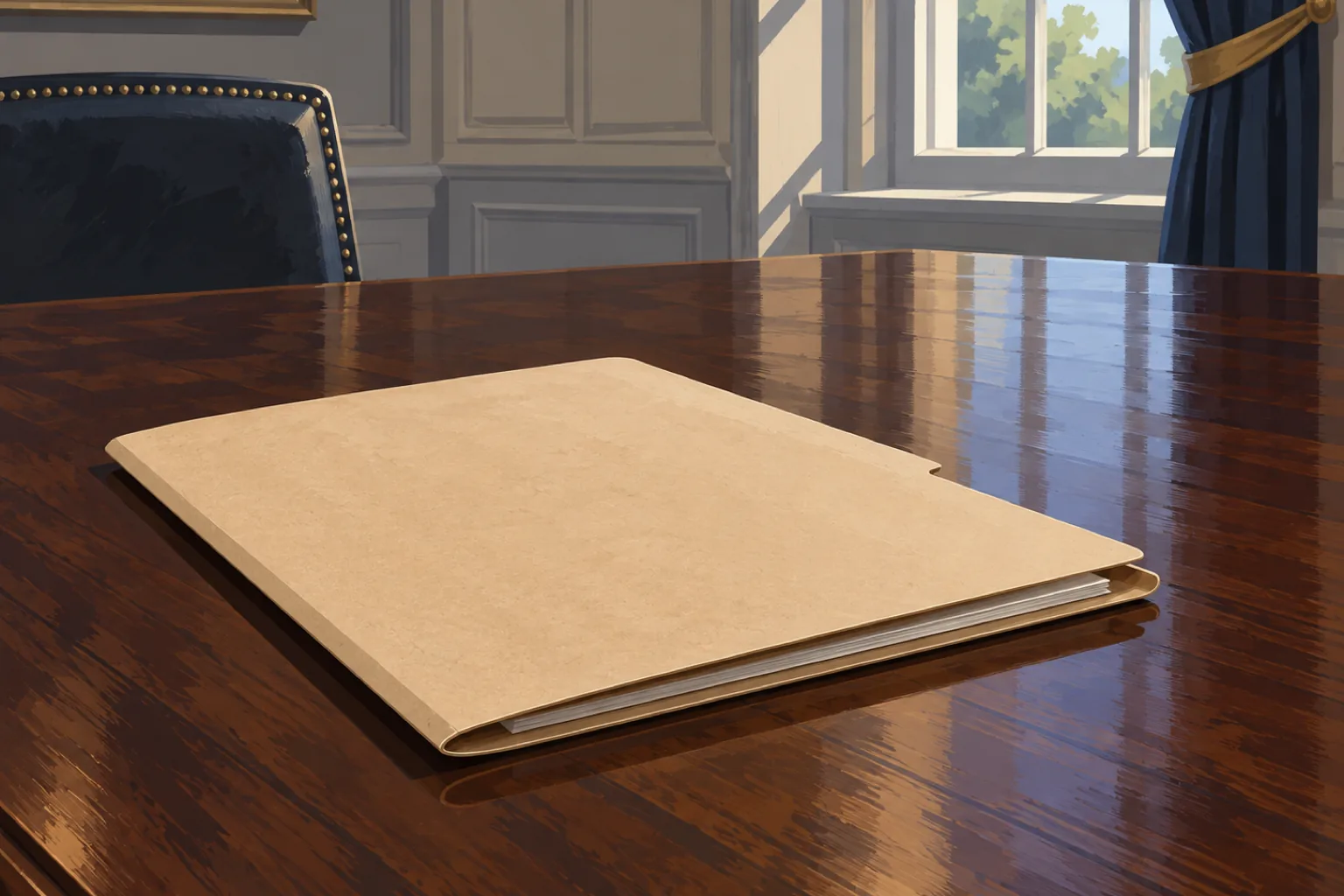
In a room at the State Department in Washington on Thursday afternoon, Sweden’s prime minister handed over a folder of papers, and an American official accepted it. That was the whole ceremony, and that was the whole legal event.
Sweden became NATO’s thirty-second member at that moment, ending more than two hundred years in which it had stayed out of other people’s alliances. This is an explanation of why the moment is a folder and not a vote, because the mechanism explains most of what people find confusing about the two years that preceded it.
The instrument, and why it is the thing that matters
What changed hands is called an instrument of accession. It is a document by which a state declares, formally and in writing, that it accedes to a treaty.
Under the North Atlantic Treaty, that instrument is deposited with the government of the United States, which acts as depositary. A depositary is a clerk with a very specific job: it holds the authoritative copies, records what has been deposited and when, and notifies the other parties. It does not decide anything.
Membership begins on deposit. Not on signature, not on the summit photograph, not on the day the last parliament votes. The reason for that design is practical. A treaty with many parties needs one unambiguous moment and one place where the record of it lives, or every party ends up with its own view of when somebody joined.
So the ceremony people watched was not symbolic of the accession. It was the accession.
What had to happen first
Everything difficult about the last two years sits upstream of that folder.
The treaty allows the existing members to invite a European state to accede, and the invitation must be unanimous. Each member then ratifies the accession protocol according to its own constitutional arrangements, which in most cases means a parliamentary vote, and each deposits its own instrument recording that ratification.
Thirty-one separate domestic processes, each with its own timetable, its own politics and its own capacity to stop. The applicant has no power over any of them.
That is why the delay took the shape it did. The negotiations conducted in public over those two years were not about whether Sweden qualified. They were about what two particular governments wanted in exchange for scheduling a vote, which is a different kind of negotiation and one the treaty makes available by requiring unanimity.
Why the last step is deposit rather than the last vote
Here is the part that is genuinely counterintuitive.
Once the final member ratifies, the applicant is still not a member. The applicant must then deposit its own instrument of accession, which is an act it performs itself, at a time it chooses, in Washington.
That ordering is deliberate. Ratification by the members is an offer completed; accession by the applicant is acceptance. Requiring a final affirmative act by the joining state means nobody can be made a party to a treaty by other people’s votes, which sounds like a technicality until you consider a government that ratified under one administration and changed its mind under the next.
It also means the date is, within a narrow window, chosen. Sweden’s parliament and government had decided long before; the folder traveled to Washington when it was ready to travel.
What changes on the day, and what does not
What changes is Article 5, and it changes completely and instantly. An armed attack against Sweden is now, by the terms of the treaty, an attack against all parties, with each obliged to take the action it deems necessary. There is no transition period and no probationary status.
What does not change on the day is everything practical. Command arrangements, force integration, air policing, the planning that assigns which units defend which ground: all of that is worked out over years, and much of it had already been worked out informally because Sweden had been operating alongside the alliance for a long time.
The legal change is instantaneous and the military change is a program. People routinely expect the opposite, which is why coverage of accessions tends to describe capabilities arriving on a Thursday.
The comparison sitting right beside it
The clearest way to see what the mechanism does is that the other applicant went through it first and finished eleven months earlier.
Finland and Sweden applied together in May 2022, for the same reason, under the same procedure. Finland deposited its instrument in April 2023 and Sweden did not, and nothing about the difference concerned either country’s suitability.
What separated them was that unanimity applies to each accession separately. Two applicants processed in parallel are two independent sets of thirty-one ratifications, and a government withholding a vote can withhold it from one and grant it to the other. Which is what happened, and which is the strongest available illustration that the delay was a function of the procedure rather than of the applicant.
A joint application, it turns out, is not a joint anything. It is two applications submitted on the same day.
The two hundred years, and what they actually were
Sweden’s long non-alignment is often described as neutrality, and the word is imprecise in a way worth correcting.
The policy was non-participation in alliances in peacetime, aiming at neutrality in war. That is a posture, maintained by choice and adjusted repeatedly, not a legal status conferred by anybody. It survived two world wars and the Cold War, and it coexisted for decades with close practical cooperation with Western militaries.
What ended on Thursday was therefore a policy rather than a condition, and it ended because the calculation underneath it changed, which is what policies do.
One consequence of that is worth drawing out. A policy of non-alignment has to be maintained continuously, by every government in turn, and it can be abandoned by one of them in an afternoon. A treaty commitment is the opposite: it takes two years and thirty-one parliaments to acquire, and leaving requires its own formal act. Sweden has exchanged something reversible at will for something reversible only with effort, and that exchange is most of what joining an alliance actually is.
Where the folder is now
The instrument is filed in Washington with the rest of them, in the depositary’s archive, alongside the originals of everything deposited since 1949.
It is a small stack of paper with signatures on it. Nothing in the building it sits in can defend Sweden, and the document does not become more or less binding depending on what anybody does about it later. It simply records, in a drawer, the afternoon on which a country that had spent two centuries declining to be in an alliance stopped declining.