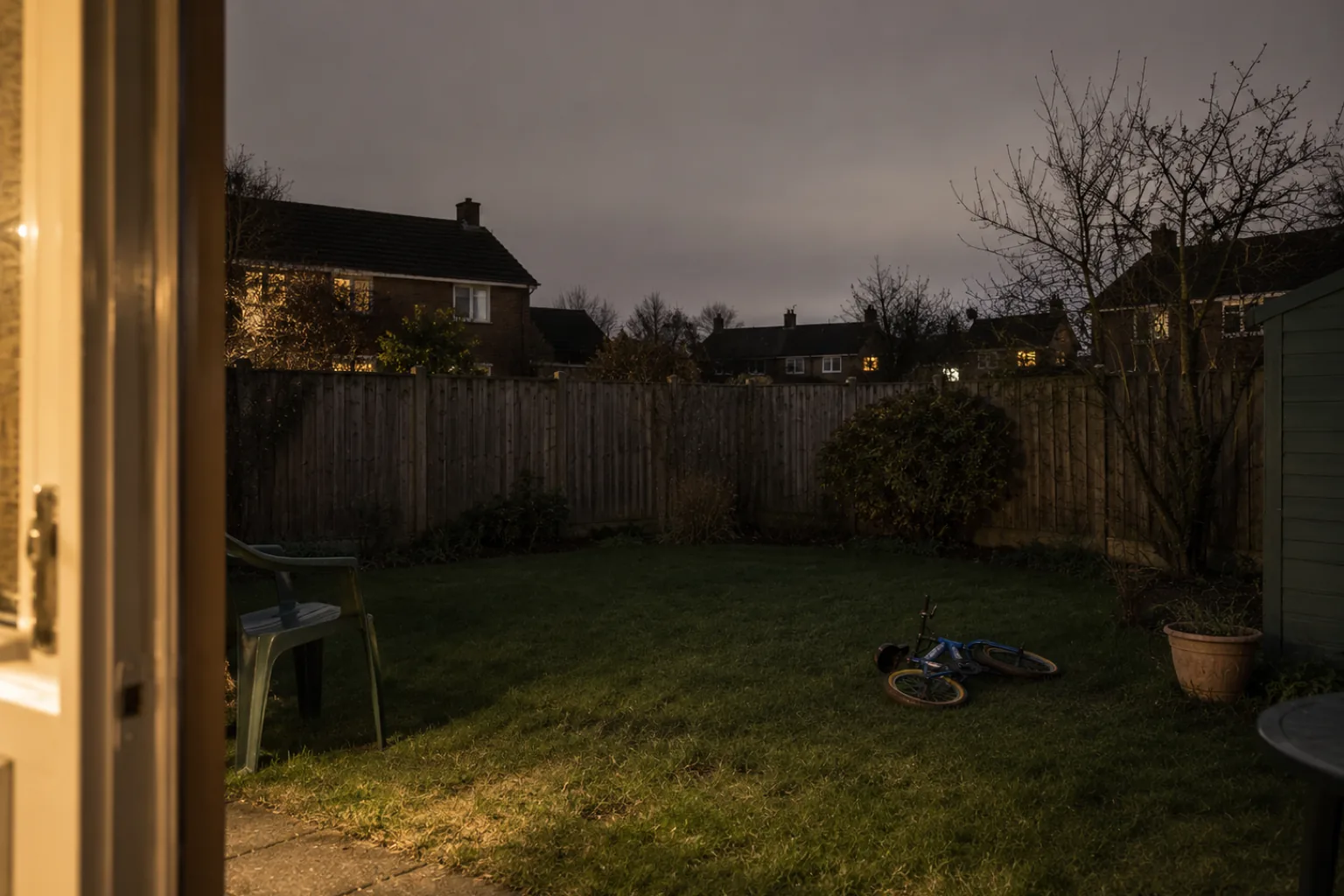
At about half past ten on Friday night, in a back garden in Alabama, somebody held up a phone and the screen showed a sky full of red.
Not to the eye. To the eye it was a faint gray wash that might have been cloud. But the phone, with its long exposure and its willingness to stack several seconds of photons into one frame, saw what was actually there, and what was actually there was the aurora, at thirty-something degrees north, over Alabama.
The thing everybody knows about the northern lights is that you have to travel to see them. Iceland, Tromso, Fairbanks, Yellowknife: a trip, booked in advance, in winter, with a tour guide and a reasonable chance of seeing nothing. That is the standing arrangement and it has been true for as long as anybody reading this has been alive.
On Friday and Saturday it was not true, and the reversal is worth understanding because it says something about how the sky actually works.
What normally limits it
The aurora happens where charged particles from the sun are funnelled into the atmosphere by the Earth’s magnetic field, and the field funnels them toward the poles. That is why the lights live at high latitude: not because it is cold, and not because it is dark, but because that is where the magnetic geometry puts them.
The region where they occur is a ring around each magnetic pole, and in ordinary conditions that ring sits over northern Canada, Alaska, Iceland, northern Scandinavia and Siberia. To be under it, you go to it.
What happened instead
A series of coronal mass ejections arrived at Earth on 10 May, several of them, in quick succession, from the same active region on the sun. The result was rated G5, the top of the scale, and the first storm of that severity in more than twenty years.
What a storm of that size does is push the ring outward. Energy pouring into the magnetosphere expands the region where particles come down, and the auroral oval stretches away from the pole and toward the equator.
It stretched a long way. Reports came in from Florida, from Mexico, and from parts of the southern hemisphere at equivalent latitudes. The lights did not travel; the boundary moved over the people.
The second reversal, which is about the photographs
Here is the part that caused a certain amount of quiet disappointment in a lot of back gardens, and it is worth being straightforward about.
The images that circulated all weekend were mostly more vivid than what anybody saw. That is not deception and it is not filtering. It is the difference between a human eye and a camera sensor.
In low light the eye switches to rod cells, which are far more sensitive than cone cells and are effectively color blind. A faint aurora genuinely is gray to a person standing under it, because the light is below the threshold at which color vision operates. A camera has no such threshold; it accumulates light over several seconds and records the color that was always present.
So both are accurate. The phone is not lying about the sky and your eyes are not failing. They are two instruments with different sensitivities looking at the same faint thing.
Nearer the middle of the storm, and further north, people did see color directly, and the difference between their accounts and everybody else’s produced a weekend of mild mutual disbelief.
What it did to a Friday night
What I keep thinking about is how domestic it all was.
No trip, no booking, no guide. People went into the yard in whatever they were wearing, or stood in a supermarket car park because it was darker than the street, or drove ten minutes to get away from a security light. Group chats filled up with the same photograph taken from four gardens on one street. Parents got children out of bed, which is the part that will actually be remembered in those houses.
None of it required anybody to have known anything in advance, which is unusual for an astronomical event. There was no ticket and no optimal viewing window published a year out. There was a warning on Thursday, a lot of people ignoring it, and then a Friday night on which the thing was simply overhead.
The part that is not free
A storm large enough to do that is a storm large enough to matter to machinery, and the weekend had a second story running underneath the photographs.
Geomagnetic storms induce currents in long conductors. Power grids, pipelines and railway signaling are all long conductors. Operators had warning and took precautions, and the grid came through it, which is the outcome of decades of unglamorous engineering rather than of luck.
Precision farming was the surprise. High-accuracy satellite positioning, which a great many tractors now steer by, degrades badly in a disturbed ionosphere, and it degraded across a weekend in the middle of planting season in the American midwest. Some farmers simply stopped, because a tractor that thinks it is twenty feet from where it is cannot plant a straight row.
What is in the camera roll
Several hundred photographs per person, most of them nearly identical, taken over about ninety minutes, and almost all of them of the same patch of sky above the same fence.
They will not get deleted, because nobody deletes those, and they will not get looked at either. In about four years one of them will surface in a memories notification on a Friday in May, and somebody standing in a kitchen will say, out loud, to nobody, that they remember that.