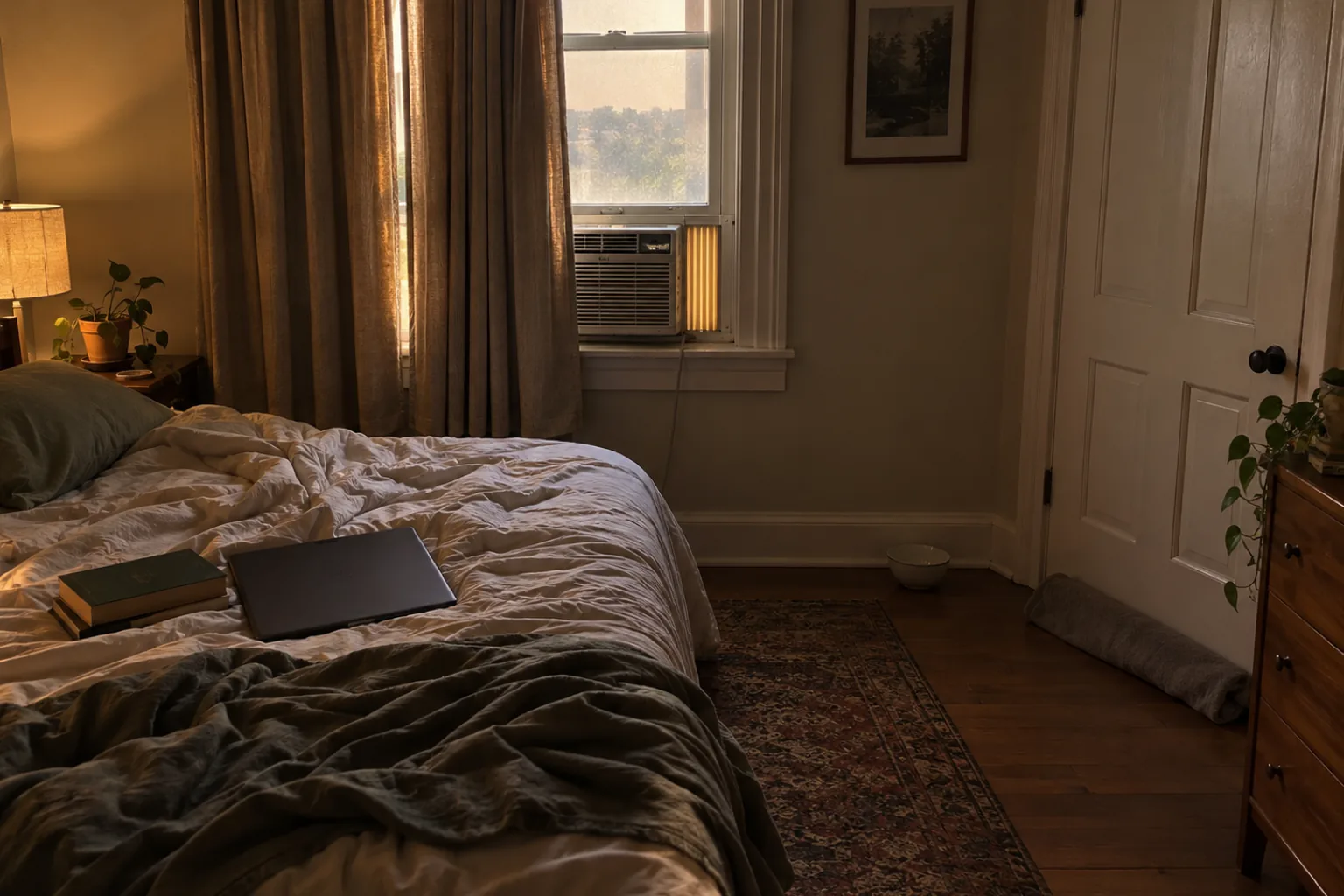
A window air conditioner of the ordinary kind, the sort that sits in a sash with a concertina of plastic on either side, draws somewhere around a thousand watts. Run it twelve hours and you have used twelve kilowatt hours, which at the sort of rate most American households pay comes to roughly two dollars. Two dollars a day. Sixty a month, give or take, for one cool room in a house where the other rooms are whatever the day is.
That is the number a great many people were doing in their heads on the Fourth of July, and it is worth holding onto, because nine days later it is the part of that weekend that has not been reported anywhere.
What the day was
Saturday the fourth was the two hundred and fiftieth anniversary of the Declaration, and it was also a day on which more than a hundred and eighty million people in this country were inside a zone of major or extreme heat risk at the same time.
Those two facts sat on top of each other all day. The bunting was out. So was the heat dome, a great lid of high pressure that had settled from the Midwest to the coast and would not move. Atlantic City reached a hundred and six. Reagan National, in Washington, reached a hundred and three, which was a record for the date.
Between the first of July and the fourth, at least forty four people died of the heat. Twenty nine of them in New Jersey. Seven in Pennsylvania, four in Illinois, three in New York, one in Mississippi. Those are the confirmed ones, and confirmed heat deaths are always an undercount, because heat mostly kills people who were already ill and the certificate records what it finished rather than what it was.
The room
Here is the thing that gets missed about a heat wave in a rich country. It is not mainly about being outdoors. Most of the people who die are indoors, alone, in a room with a window that does not help.
So households do a piece of arithmetic that nobody writes down. You have one unit, or two. You have a house with four or five rooms in it. You cannot cool all of them and you were never going to try, so you pick one, and the picking is the whole thing.
Usually it is a bedroom, because the night is what matters. Overnight temperature is the variable that does most of the damage in a heat wave, more than the afternoon peak, because a body that does not get a cool stretch to recover in accumulates strain day on day. A house that comes down to seventy five at three in the morning is a different proposition from one that does not come down at all.
Then there is a door. You close it, and you put a towel along the bottom, and the room becomes an appliance rather than a room. Everyone ends up in it. The dog is in it. Somebody has brought a laptop and somebody else has brought the cat, who has chosen the floor by the vent and is not negotiating. The television is on in the other room to nobody.
By the second day of a heat wave that room has developed a smell of its own, and somebody has started eating in there, and the bed has become a sofa, and the household has quietly reorganized itself around a single two dollar a day machine.
The part the price does not cover
Two dollars a day is a number that sounds manageable and is not, for the households where it decides things.
Sixty dollars on a summer bill is a rounding error in one budget and a genuine decision in another, and the people for whom it is a decision are disproportionately old, which is also the group heat kills. That is the cruelty of the arithmetic rather than of anyone in it. An eighty year old on a fixed income, in an apartment on a top floor, with a unit in one window, is doing a calculation in which the cost is certain and immediate and the risk is invisible and deferred. Nearly everyone gets that calculation wrong in the same direction.
Cooling centers exist for exactly this and they are chronically underused, for reasons that are obvious once you say them out loud. Getting to one means going outside, in the heat, on public transport, to sit in a municipal building among strangers for the afternoon, and then coming home at five to a flat that has been baking all day. The intervention asks the most of the people least able to do it.
What the ninth day looks like
The dome that sat over the Fourth did not stay. It shifted west, and yesterday Billings, in Montana, recorded a hundred and eleven degrees, which is the highest temperature ever measured there.
So it is still going on, somewhere else, for somebody else, and the households under it are doing the same arithmetic with a different unit price and a different number of rooms.
Back east the dome has gone and the ordinary summer has come back, and the room has been put away. The towel is off the door. The door is open again. There is a rectangle of paler carpet where the fan stood for eight days, and a faint outline of dust on the sill where the unit’s plastic flanges were pressed against the frame, and until somebody vacuums, that is the only evidence in the house that any of it happened.