“A major problem.” That is the phrase, offered as one of the options on a survey, that seventy two percent of American high school teachers selected when asked about cellphone distraction in their classrooms. Not a complaint anyone volunteered. A box, on a form, chosen by nearly three quarters of the people in the room with the children.
Thirty one states now ban or restrict phones in school. Which means that in the last two weeks, in a great many houses, a new object has entered the morning.
What it costs to set up
Start with the ledger, because a policy like this is usually discussed as an argument and is experienced as a logistics problem.
The pouch systems cost money. A lockable fabric sleeve, one per student, plus the magnetic release stations by the doors, plus replacements for the ones that get lost or cut open, comes to a real line in a school budget that did not have one last year. Districts that have gone the other way, with lockers or a box at the front of each classroom, have spent less and bought themselves a different problem, which is that a box of forty phones is a box of forty expensive objects that somebody is now responsible for.
Then there is staffing. Somebody has to run the collection, chase the student who says they forgot theirs, manage the ones that are genuinely forgotten, and handle the exceptions. Medical exceptions are real and common: a child managing diabetes with a continuous glucose monitor that reports to a phone is not a child you can put a phone in a pouch.
None of that is an argument against doing it. It is the part that does not appear in the announcement.
What the house pays
The cost that lands at home is not money and it arrives on the first day.
You cannot reach them. Between eight and three, whatever happens, you cannot reach them, and they cannot reach you. The office can, and the office will, and that is the arrangement schools have run on for most of a century. It is also an arrangement that a generation of parents has never actually used, because for fifteen years the answer to needing your child has been to text them.
The first week of this is genuinely hard. Not for the child, who adapts inside about three days, but for the adult who has to sit with the fact that the pickup change or the dentist appointment now goes through a receptionist, and that a school shooting on the news is a thing you will hear about before you can confirm anything.
That last one is the argument that has done most of the work against these policies, and it deserves to be met honestly rather than dismissed. It is also, according to most people who plan for these events, backward: a corridor full of children on phones during an emergency is harder to move and harder to account for, not easier.
What gets collected
The return shows up in a place nobody puts on the list, which is lunch.
Researchers have started studying the use of food delivery apps during school hours, which is now common enough to be a subject. Enough children were ordering enough lunches to their own schools that it registers as a dietary pattern worth measuring.
It is worth being careful here, because two separate things are easy to merge. Nobody has shown that phone restrictions improved anyone’s diet. What is true is narrower and funnier: a policy introduced because of attention has, as a side effect, removed the mechanism by which a fourteen year old ordered a burrito to the front office at eleven forty.
The other return is quieter and every teacher describes it the same way. The room is different. Not better behaved necessarily, and not more studious, but louder between activities, because thirty people with nothing in their hands talk to each other.
The hour that changed
Here is the part that surprised people, and it is the reason this belongs in a section about living rather than about schools.
The phone comes out at three. It has been in a pouch for seven hours and there is a great deal in it, and the walk home or the bus ride is now the hour when all of that arrives at once.
Households that expected the afternoon to be calmer have found the opposite: a denser, more concentrated version of the same thing, compressed into the period between the last bell and dinner. The total does not fall. It moves.
Which is a thing worth knowing before you decide whether the policy is working in your house, because the measure most parents reach for is how much time the phone is in their hand, and that number was never the one the school was trying to change.
The object on the counter
There is a version of this that has settled in a lot of kitchens by now, about two weeks in.
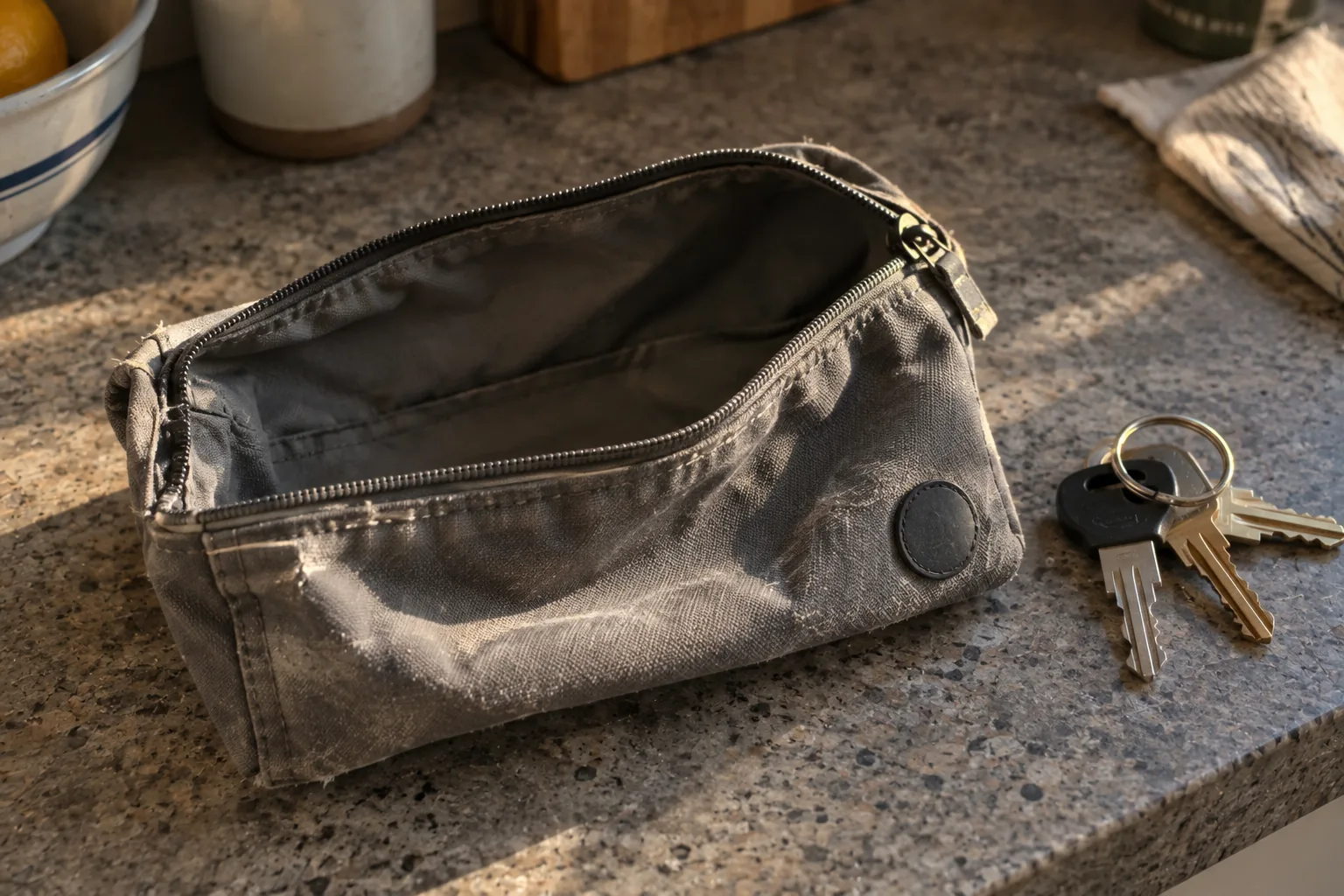
The pouch lives by the door with the bag, because it has to go back. It is gray, or navy, with a school crest printed slightly off center and a magnetic disc sewn into the bottom corner that catches on things. It is already scuffed. Somebody has written a name on the back of it in marker, and somebody else has picked at the corner of the label.
At three fifteen it comes back through the door, unlocked and empty, and gets put down on the counter next to the keys, and the phone that was inside it is already somewhere else in the house, face up, going.