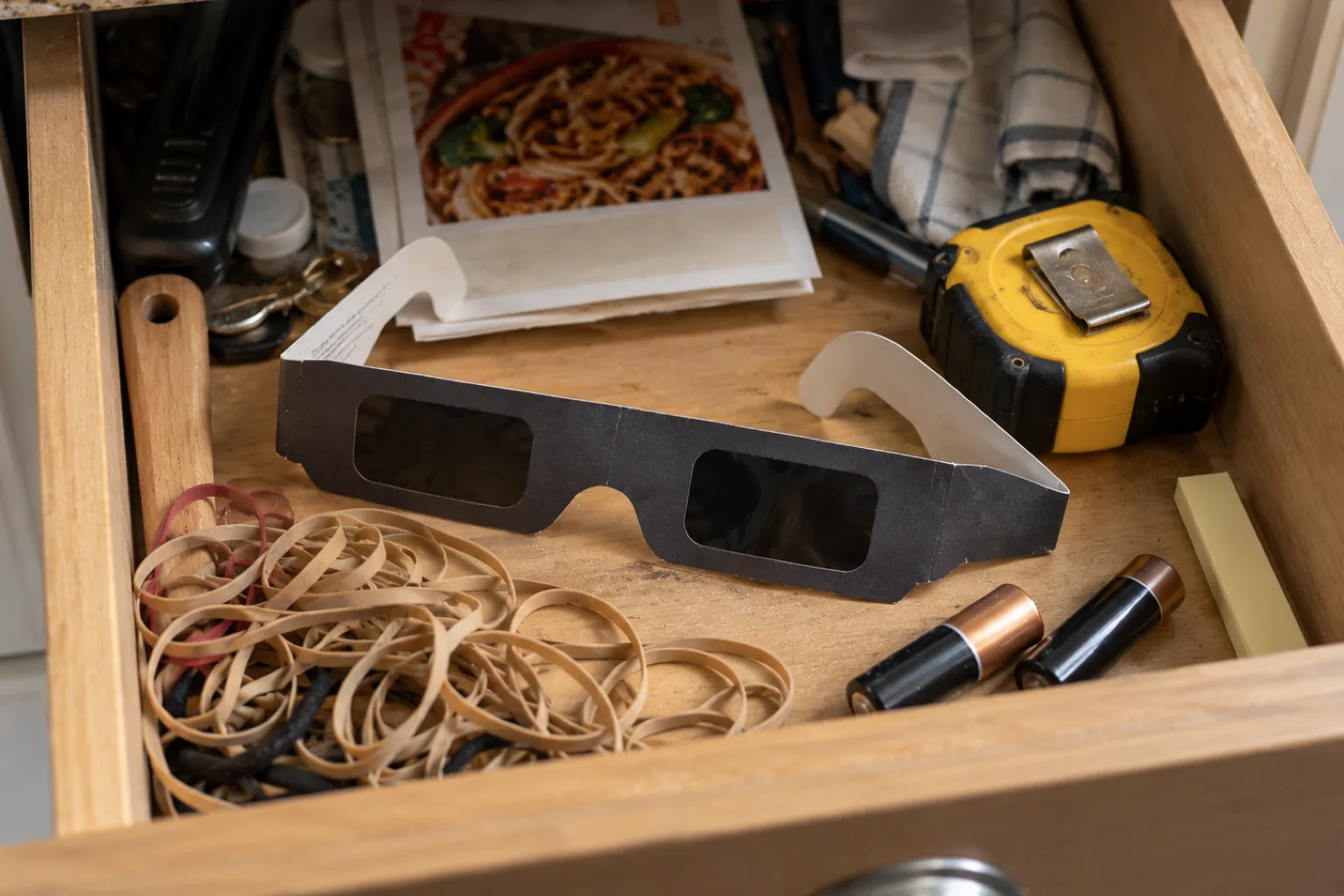
A rectangle of card, a fold at each end for the arms, and a strip of black polymer film across the middle that looks like nothing at all until you put it on, at which point the entire world disappears except for one small orange disc. They cost very little and libraries were handing them out for nothing.
Tens of millions of them were bought in the fortnight before Monday, and most of them are now in a drawer.
The shadow made landfall on the Pacific coast of Mexico in the late morning, local time, and crossed the country toward Torreón. Where it passed, for a few minutes at a time, the temperature dropped, the light went a color nobody has a good word for, and everybody who had bought a rectangle of card put it down and looked up without it.
Where it went
The path of totality was a band about 115 miles wide, running from the Pacific coast of Mexico through Sinaloa and Coahuila, into Texas, then diagonally across fifteen states to Maine, and out through Ontario, Quebec and Newfoundland to the Atlantic.
It moved at a speed that varied across the ground but was always faster than anything could follow. From landfall in Mexico to the coast of Newfoundland took a little under two hours.
Roughly forty four million people live inside that band. Something like thirty two million of them in the United States, six million in Canada, six million in Mexico. A great many more traveled into it: an estimated twenty million people moved to be in the path in the United States alone, which is one of the largest short-notice domestic migrations the country arranges for any reason.
The longest totality anywhere was four minutes and twenty eight seconds, near Torreón. Most places got somewhere between three and a half and four.
What four minutes does to a Monday
Widen out from the path and the interesting thing is not the astronomy, which was entirely predictable and had been printed in almanacs for decades. It is what a predictable four minutes does to the arrangements everybody else has made.
School districts across the path closed or shortened the day, on the reasoning that several hundred thousand children being dismissed into a traffic event is worse than a day off. Employers in a band fifteen states wide dealt with a workforce that had, in many cases, decided some weeks earlier that Monday afternoon was spoken for.
Towns of a few thousand people in the path prepared for tens of thousands of visitors, which is a water, toilet and road problem rather than a hospitality one. Hotels along the line had been booked out for a year or more. Highways in rural counties carried metropolitan volumes for about six hours in one direction and then, later, in the other.
All of that was organized around an event whose timing was known to the second, years in advance, which makes it almost unique. Nothing else that disrupts a working day on that scale can be diarized.
The part that is not about logistics
Here is what I think is worth saying about it, and I will try to say it without reaching.
A partial eclipse and a total eclipse are not the same event with different intensities. At ninety-nine percent the sky is odd and the light is strange and it is, in the end, a peculiar afternoon. At totality the thing goes out. People who have seen both describe the difference not as a matter of degree but as a change of category, and the consistency with which they say so, in the same slightly embarrassed way, is the most interesting data in this whole subject.
Which is why twenty million people got in cars. Not for a better view of something they could see from home, but because the thing available at home was a different thing.
What it costs to be in the path
Being under totality is almost entirely a matter of where you happen to live and whether you can leave.
A four minute event on a Monday afternoon requires a day off work, a vehicle, somewhere to stay if the drive is long, and the ability to absorb the possibility that it will be cloudy and none of it will have been worth anything. That is a real filter, and it sorted who was standing in the shadow and who watched a livestream from an office.
Some of it was solved generously. Schools in the path took children outside rather than sending them home. Small towns put up signs directing strangers to park in fields, and nobody charged for the field.
What is in the drawer
The glasses are still good, which is the part almost nobody knows. Many pairs are printed with a warning to discard them after three years, and that warning is out of date for anything made to the safety standard adopted in 2015. If the filter is not scratched, punctured or torn, it works indefinitely.
The next total eclipse over the lower forty eight is 23 August 2044, and it crosses Montana and the Dakotas and not much else. The one on this scale, California to Florida, is 12 August 2045.
So the rectangle of card in the kitchen drawer, under the takeout menus and the spare batteries, is working equipment for an appointment twenty years out. It will almost certainly be thrown away long before then, in a clear-out, by somebody who picks it up and cannot think what it was for.