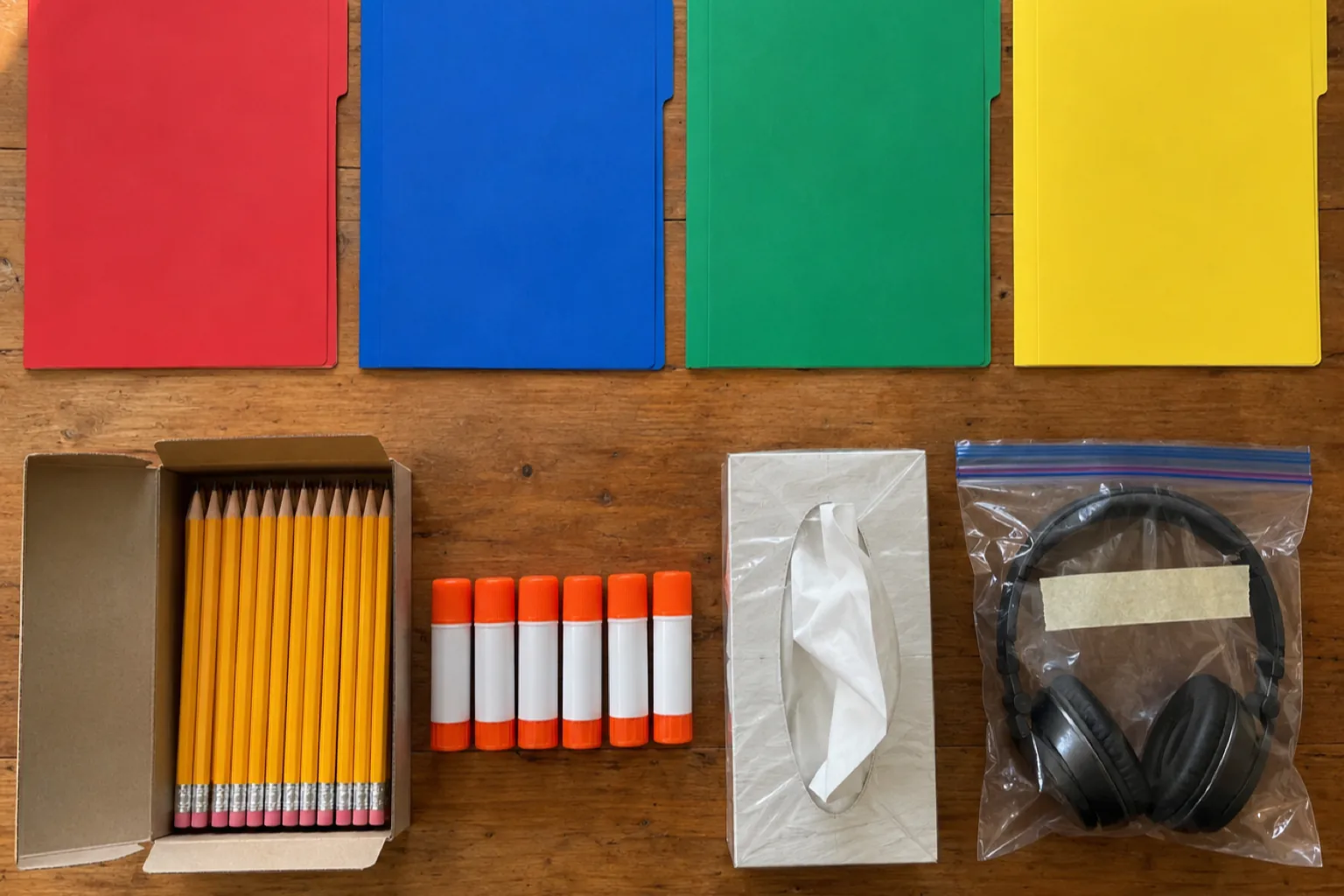
One list, identical for every child in the year group. That is the rule. It comes home in a folder or arrives as a PDF in the last week of July, it is the same list for every child in the grade, and that is the point of it. Two dozen pencils. Four folders, and the colors are specified. A box of tissues. Headphones. Glue sticks, and the number is not negotiable because the teacher has done this before.
The exception is that a list which is identical for everyone does not cost everyone the same, and the reason is not on the list.
What the list is actually for
It is worth being clear that the standardization is deliberate and kind. A teacher who specifies a red folder and a blue folder is making sure that at nine on a Tuesday morning every child can find the right one, which is a small piece of engineering aimed at a room with twenty six people in it.
Specifying quantities does the same job. The glue sticks are communal in most classrooms, and the number exists so that the room has enough, not so that your child has enough. A list is a quiet piece of redistribution: everybody contributes the same, and the supplies are pooled.
That works when everybody can contribute the same. The interesting part is what the list does not say.
The three numbers
Here is where it gets confusing, and the confusion is not accidental.
One figure says parents expect to spend about five hundred and fifty seven dollars per child on back to school shopping, essentially unchanged from last year in cash, which after inflation is about a six percent decline in what that money buys.
Another, from a consumer poll this summer, puts the average at nine hundred and twenty two dollars.
A third says the 2026-27 school year will cost close to four thousand dollars per child, up about ten point seven percent on last year.
Those are not three estimates of one thing. Five hundred and fifty seven is a survey of what people expect to spend on supplies and clothes in the weeks around the start of term. Nine hundred and twenty two is a different survey of a broader basket including electronics. Four thousand is the whole school year: the supplies and the clothes, then the field trips, the sports fees, the instrument rental, the yearbook, the class photographs, the lunch account, the spirit week shirt, the fundraiser you were not going to say no to, and the shoes in February when the first pair gave out.
The gap between the first number and the third is the part nobody budgets for, because it does not arrive as a bill. It arrives as eleven things across ten months, each individually small enough that saying no to it feels disproportionate.
What the numbers underneath them say
The spending figures are the calm part of this. The rest is not.
A third of parents say they cannot afford back to school shopping at all. Nearly half say they expect to give something up for it, and the things named are groceries and bills. Forty five percent say they plan to take on debt to cover it.
The same proportion, forty five percent, expect to use buy now pay later, up from thirty nine percent a year ago, and nearly one in three expect it to cover more than half of what they spend.
Buy now pay later is worth pausing on, because it is doing something specific here. It converts an eighty dollar purchase in August into four payments of twenty, which moves the problem from a month where the money is not there into months where it might be. That is genuinely useful and it is also the mechanism by which a one time expense becomes a payment that is still arriving at Halloween, arriving alongside the field trip and the sports fee, which are themselves new.
And a survey of two thousand parents in July found that seventy percent felt pressure to buy what other families were buying. Which is a finding about the list too, in a way, because the list specifies a red folder and does not specify whose red folder, and a room full of children can tell the difference between the one from the drugstore and the one from the place with the characters on it.
The two aisles
If you have been in a store in the last three weeks you have seen the shape of this without anyone explaining it.
There is the endcap with the branded backpacks and the labeled bins of character folders, priced as a bundle, positioned at eye level. And there is the other aisle, three rows over, with the same items in plain colors, in larger packs, with worse signage, where the pencils are two dollars less for twice as many.
Both aisles satisfy the list completely. A teacher checking a bag on the first morning cannot tell and would not care. The difference between them is somewhere around forty dollars a child, which is not nothing and is also not the four thousand, and both facts are true.
What ends up in the bag
By the last week of August the bag is packed and standing by the door, where it has been standing for four days because somebody wanted it ready.
Inside: twenty four pencils in a cardboard box, sharpened, which was not on the list but seemed like the right thing to do. Four folders in the specified colors, plain ones. The glue sticks, all eight. A box of tissues, still shrink wrapped. Headphones in a ziploc bag with a name written on masking tape across the front, because the ones from last year were lost in November and these need to survive longer than that.
It weighs about nine pounds. It cost whatever it cost, on whichever of the three numbers you use, and on Monday morning somebody five feet tall is going to carry it four blocks.