“The COVID-19 pandemic was one of the most consequential events of our lifetime,” the chairman said, opening the hearing, “and to this day, the American people have never received a full accounting of where it came from, what our government knew, or why they had to fight their own government to find out.”
This account is written from the committee’s published transcript and the recording of the proceeding, both of which are public. Nobody from this paper was in the room. Every statement below is described as what a named person said at a hearing, and nothing here is a finding about whether any of it is true.
Ten o’clock
The Senate Homeland Security and Governmental Affairs Committee convened on Wednesday 13 May in room SD-342 of the Dirksen building. Senator Rand Paul of Kentucky chaired. There was one witness.
His name is James E. Erdman III. He is an officer of the Central Intelligence Agency, and the chairman’s opening described him as a decorated officer with decades of intelligence and national security experience who had recently completed a joint duty assignment with the Office of the Director of National Intelligence.
He was there under a subpoena the committee had issued eight days earlier.
What the chairman said the hearing was for
Paul framed it in his opening as an inquiry into what he called a multi agency cover up, and put the witness’s presence in terms of personal cost. Erdman, he said, had chosen to testify at great personal risk, because government secrecy cannot become government impunity.
That is a characterization offered by the chairman about his own witness, in an opening statement, and it is worth marking as such. Opening statements are advocacy. They are also, at a hearing of this kind, the only account of the witness the room has before he speaks.
What the witness testified
Erdman’s evidence, as recorded, was that scientific analysts within the agency repeatedly assessed that a laboratory origin was the most likely explanation for the emergence of the virus, and that those assessments were altered on their way upward.
His account, as given, was that internal intelligence products were influenced, softened, buried, or in some instances rewritten anonymously, and that the effect was to reduce the prominence of the laboratory hypothesis in what reached policymakers and Congress.
Paul asked him directly whether the agency had purposefully downplayed the likelihood of a laboratory release.
“It was significantly influenced,” Erdman answered, “by Anthony Fauci, injecting himself into the IC.”
IC is the intelligence community. Anthony Fauci is the former director of the National Institute of Allergy and Infectious Diseases, and he has denied allegations of this general character consistently and on the record over several years. He was not present, was not a witness, and had no opportunity within the proceeding to respond to what was said about him in it.
The subpoena
A detail from the record that is easy to pass over: the witness did not volunteer. The committee issued a subpoena on 5 May and he appeared under it eight days later.
That is not necessarily a sign of reluctance, and in the intelligence context it is frequently the opposite. A serving officer is bound by non disclosure agreements and by classification rules, and speaking publicly about internal work is a serious matter regardless of what he believes about it. A subpoena changes his position: he is no longer choosing to disclose, he is complying with a lawful compulsion, and that distinction matters a great deal to his employer, to his clearance, and to any subsequent proceeding.
So the instrument can protect the witness as much as it compels him, and witnesses in this position sometimes ask to be subpoenaed. Nothing in the public record says whether that happened here.
The word whistleblower was used throughout the hearing and it has a specific meaning in this field that is worth separating from the general one.
There is a statutory route by which a member of the intelligence community can raise a concern of urgent concern: a disclosure made to an agency inspector general, who assesses it and may transmit it to the congressional intelligence committees. That route is confidential, it carries legal protection against retaliation, and it does not involve a public hearing.
Testifying in open session before a different committee is not that process. It may follow an attempt at that process, it may be what happens when somebody concludes that process has failed, and it may be both. The protections that attach are correspondingly different, and the record of this hearing does not establish which route was taken first.
What a hearing is and is not
It is worth stopping on the form of this, because the form determines what the four hours can establish.
A congressional hearing is not a trial. There is no judge, no rules of evidence, and no cross examination in the legal sense; there are members with allotted minutes who may ask what they choose. A witness is under oath, and lying to Congress is a criminal offense, so the testimony carries real weight and real jeopardy. But a single witness’s account, however senior and however sincerely given, is an account. It is the beginning of an inquiry rather than the conclusion of one.
What a hearing does exceptionally well is put something on the record in a form that cannot subsequently be denied to have been said. What it cannot do is determine whether it was so.
The hearing did not occur in isolation and the committee did not pretend otherwise. It was scheduled against the background of a federal indictment of Dr David Morens, formerly a senior adviser to Fauci at the institute, on matters arising from the same broad subject.
An indictment is an allegation and nothing more, and Morens is entitled to the presumption of innocence in the ordinary way. Its relevance here is procedural: a criminal process moving in parallel changes what witnesses will say, what committees will ask, and what agencies will release, and everybody in the room on Wednesday knew it was there.
What happens next, procedurally
The committee has written to the director of the agency requesting information on the allegations. That is the ordinary next step and its outcome is the thing to follow, because a request of that kind is answered in one of three ways: with documents, with a briefing in closed session, or with a refusal on classification grounds.
Which of those arrives will tell a reader considerably more than four hours of testimony did, and it will be reported far less.
The room
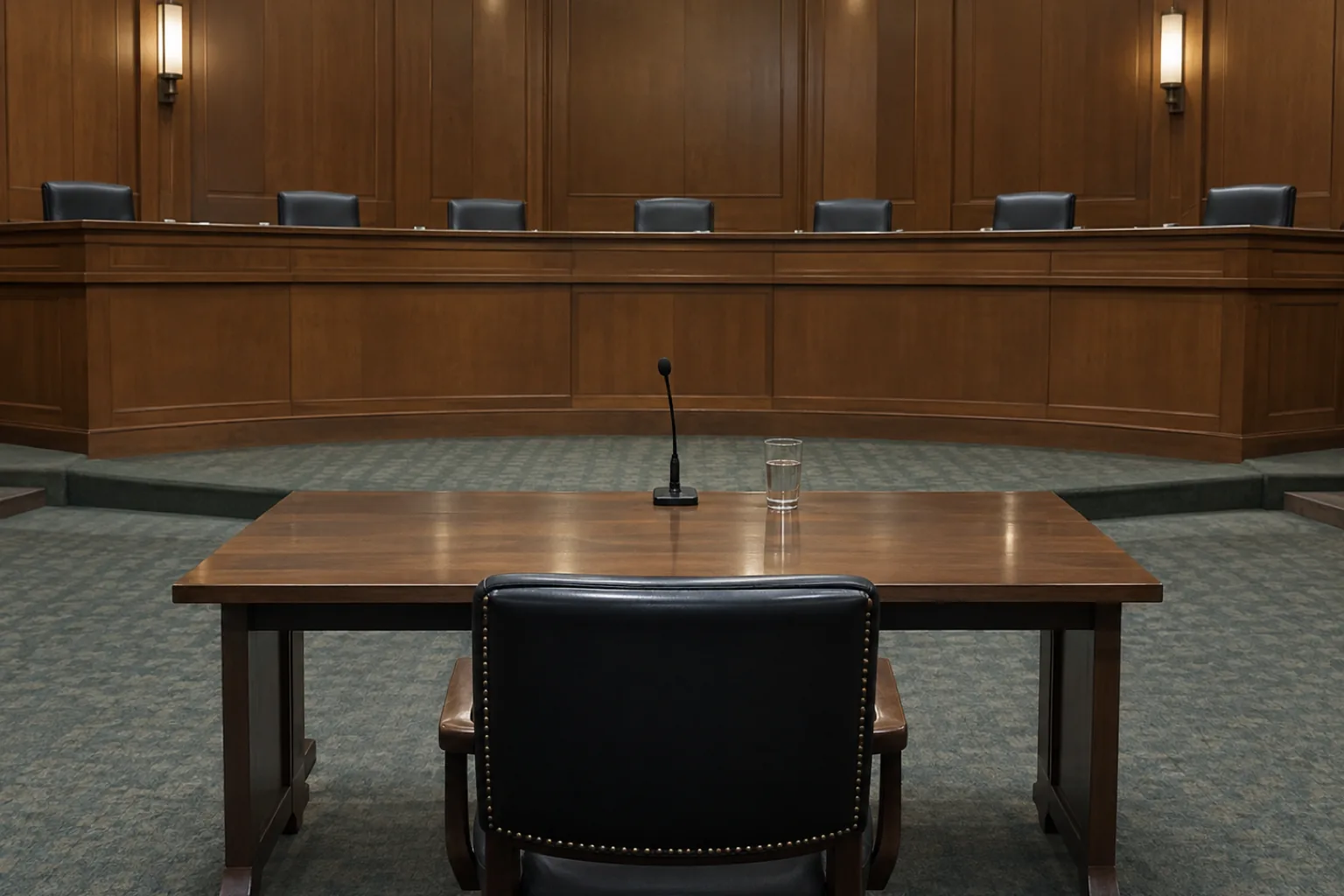
SD-342 is the committee’s regular hearing room and it is not large. A raised horseshoe of members’ seats faces a single witness table with a microphone and a glass of water on it. Behind the table are five rows of public seating, and behind those a wall of cameras on tripods.
A witness at that table sits alone, below the members, looking up. The room is arranged so that everyone in it can see his face and he can see about a dozen of theirs.
Nothing on the walls indicates what the room is for. It is panelled, carpeted and lit from a ceiling grid, and it looks like a large meeting room in an old office building, which is what it is.
The recording runs for a little over four hours. For most of the second and third of them, the public rows behind him are visibly half empty.