
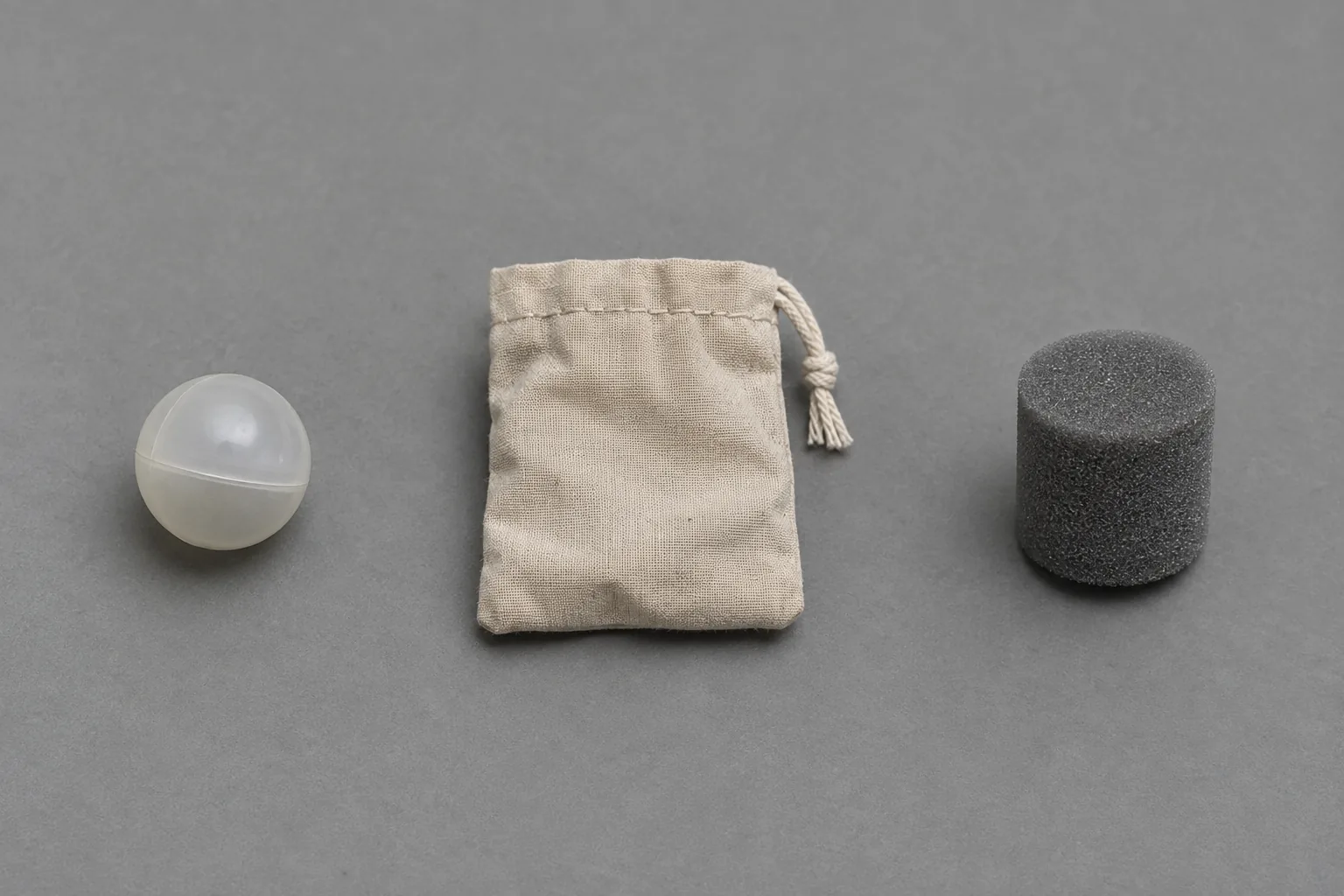
It is a hollow sphere of hard plastic, .68 of an inch across, which is the same caliber as a paintball and not a coincidence: the launchers grew out of paintball equipment and several of them still look it. It weighs about three grams. Inside is a powder, a synthetic capsaicinoid called PAVA, at a concentration of two or five percent depending on the variant. The shell is designed to be brittle. It is meant to break on contact rather than bounce, because the powder is the point and the powder only works if the sphere fails.
Pepper balls were used this week in Minneapolis, during clashes that followed the fatal shooting of a thirty seven year old woman by an immigration enforcement agent on Wednesday. They are used most weeks somewhere. They are among the most widely deployed items in a category of equipment that American police departments have been buying for thirty years under a label that does a great deal of work and carries almost no information.
This is a profile of the object and of the label.
What the thing does
The manufacturer describes three effects acting together. There is the kinetic impact, which hurts. There is the chemical irritant, which produces burning, streaming eyes, coughing and shortness of breath, with onset described as rapid and resolution in five to ten minutes. And there is what the company calls psychological shock, the surprise of being struck at all.
The physical numbers are published and they are modest. Muzzle velocity is given as 280 to 350 feet per second, and kinetic energy as 12 to 15 joules. For scale, a paintball fired at tournament limits carries roughly the same. This is genuinely at the low end of what gets fired at people.
The company also states that more than twenty million projectiles have been deployed worldwide with no fatalities. That figure comes from the manufacturer and has not, as far as the public record shows, been independently audited. It is not obviously wrong, and it is the kind of claim that is very hard to verify in either direction, because it requires knowing about deaths that were never attributed to the cause.
The label covers a range of about twenty to one
Here is where the category stops being useful.
A pepper ball delivers 12 to 15 joules. A twelve gauge bean bag round, which is a fabric pouch of lead shot fired from a shotgun, delivers roughly 98 to 145 joules depending on the load and the measurement point. A 40mm sponge round, fired from a dedicated launcher, is generally put at 150 to 250 joules at operational range.
All three are less lethal. The term is not a rating, a certification or a threshold. It is a comparison, and the thing it compares against is a bullet. Anything that is expected to kill less often than a firearm qualifies, which means the category admits a plastic marble and a projectile carrying twenty times its energy on equal terms.
A city council authorizing the purchase of less lethal equipment, or a police policy permitting its use at a given level of resistance, is therefore authorizing something with a range of possible meanings that the words do not narrow. The narrowing has to be done in the procurement documents and the use of force policy, item by item, and where it is not done the label supplies a reassurance the equipment has not earned.
What the certifications certify
PepperBall projectiles are advertised as certified to ISO 9001:2015 and ISO 14001:2015. Both are real standards and both are correctly cited. Neither is about safety.
ISO 9001 is a quality management standard. It says an organization has documented processes, follows them, and can demonstrate consistency: that the projectile you buy this year matches the one you bought last year. ISO 14001 is an environmental management standard, concerning how a company handles its environmental obligations.
Both are worth having. A munition that varies unpredictably between batches is more dangerous than one that does not, so consistency has real safety value. But a reader who sees two ISO numbers in a product description and infers that an independent body has assessed how the thing injures people has inferred something that is not there. There is no equivalent American standard that does that, and the absence is the reason the marketing has to reach for the standards that exist.
What the evidence base says, and about what
The most cited study in this area is a systematic review published in BMJ Open in 2017, which examined the literature on crowd control projectiles from 1990 to 2017. Of more than three thousand articles screened, twenty six met its criteria, covering 1,984 injured people. Fifty three of them died. Three hundred were left permanently disabled. Strikes to the head and neck accounted for 49.1 percent of the deaths and 82.6 percent of the permanent disabilities. The authors concluded that projectiles of this kind are not appropriate for crowd control.
That review needs to be read for what it covers. Its subject is kinetic impact projectiles generally: rubber and plastic bullets, bean bag rounds, shot pellets and similar. It is not a study of pepper balls, and its findings cannot be transferred to a 13 joule projectile as though the energies were comparable. Anyone citing those fifty three deaths in an argument about pepper balls specifically is citing the wrong evidence.
What does transfer is the finding about anatomy. The injuries that ended in death or permanent disability were overwhelmingly to the head and neck, and that pattern holds across energies, because the eye does not require much energy to be destroyed. Every manufacturer instruction and every competent departmental policy says the same thing in consequence: do not aim at the head. The published guidance for these launchers directs users to the torso or to the ground in front of a subject.
Which is an instruction to a person, not a property of a device. It holds exactly as well as training, distance, stress and line of sight allow, and those are the variables that a certification cannot reach and a category cannot describe.
The residue
After a deployment the pavement tells you what happened for a while. The spheres do what they were designed to do and break, and what is left is fragments of hard plastic, mostly in pieces large enough to see, and a fine pale powder that settles and then lifts again when people walk through it. Crews sweep it. The plastic goes in a bin.
They are sold by the case.