Thirty-four counts of falsifying business records. That figure leads every account of this trial, and read as a count of events it is simply wrong.
It describes one thing entered thirty-four times: a series of ledger entries, invoices and checks recorded in a particular way, each charged separately because that is how the statute counts. A jury will not weigh thirty-four events. It will weigh one scheme, described thirty-four times.
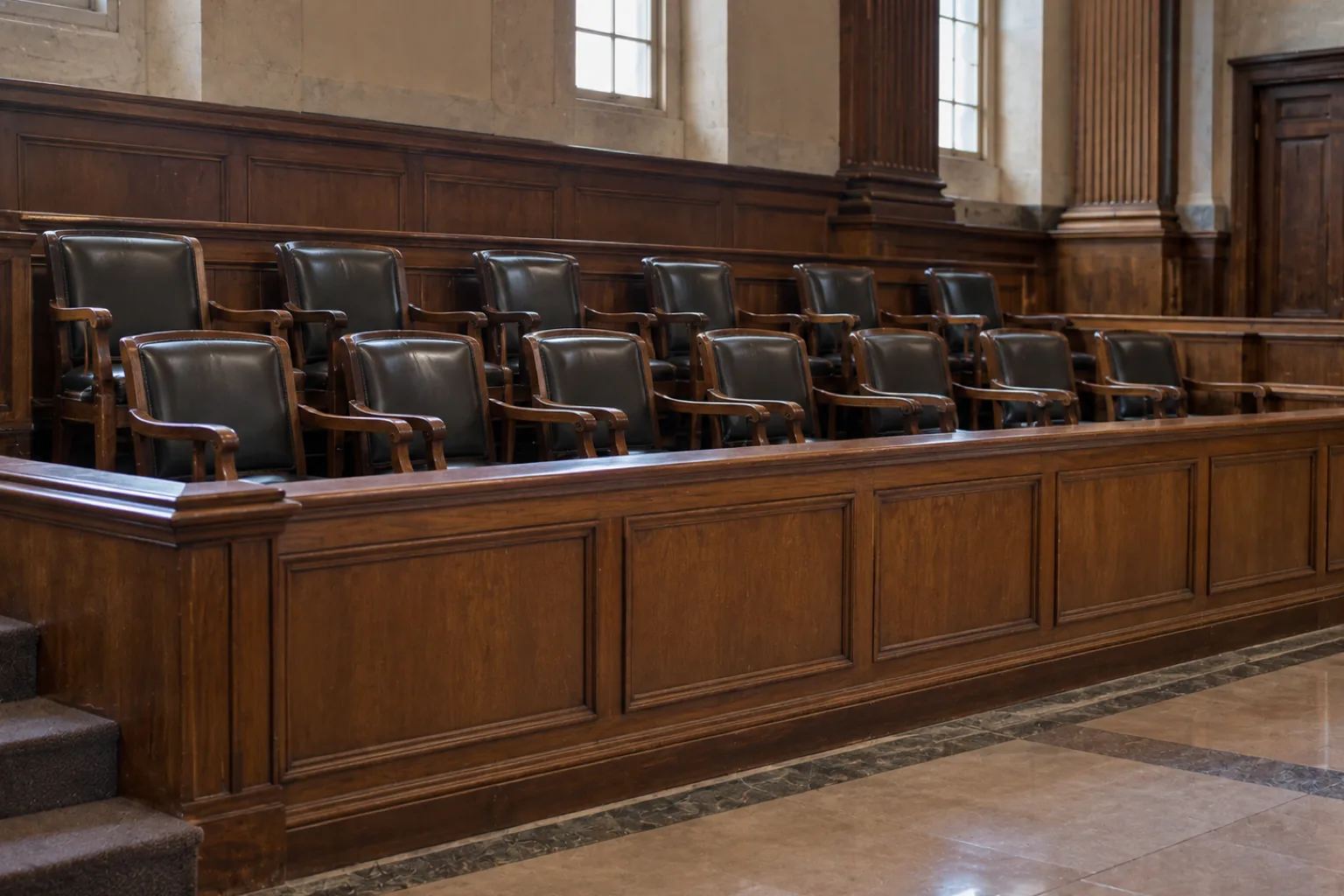
The number that will actually decide the next six weeks is twelve, and this is a profile of how a court gets to it.
What a jury is, as an object
A jury is not a sample of the public. It is the residue of a filtering process, and the filters are the design.
The court begins with a summons list drawn from the county. In Manhattan that means a pool drawn from the borough’s residents, which is a specific and much-discussed fact about this trial and is also simply where the alleged conduct occurred.
From that pool, prospective jurors are brought into the courtroom in panels. Each is asked a standard set of questions. Some are excused because serving would cause hardship. Some are excused for cause, meaning they have said something that indicates they could not decide impartially. And each side is given a limited number of peremptory challenges, which allow a juror to be removed without a stated reason.
The twelve who remain, plus alternates, are the ones nobody successfully removed. That is a different thing from the ones both sides wanted, and it is worth holding onto, because it explains most of what looks strange about the process.
The question the questionnaire cannot ask
The test is not whether a juror has opinions. Everybody has opinions, and a court that required jurors to have none would be selecting for people who do not follow the news.
The test is whether a juror can set opinions aside and decide on the evidence and the judge’s instructions. That is a question about a person’s capacity for a particular kind of discipline, and it is asked in open court, of a stranger, under oath, in a few minutes.
It is answered by the juror. There is no instrument for checking. Which means the process is not really detecting impartiality; it is detecting people who say, credibly, that they can do it, and excluding those who say they cannot or whose answers suggest otherwise.
That sounds like a weakness and it is close to the strongest part of the design. A juror who states on the record that they will decide on the evidence has made a commitment in front of a judge, eleven others and their own sense of themselves. The oath is not a detection mechanism. It is an obligation mechanism.
What is different about this one
Three things, and none of them is the defendant’s politics.
The first is that nobody in the pool is unaware of the defendant. In an ordinary case, jury selection can hope for people who have not heard of the matter. Here that population does not exist, so the question shifts from exposure to whether exposure has produced a fixed conclusion.
The second is safety. Jurors in a case of this profile have reason to be concerned about identification, which affects who is willing to serve and therefore who is available to be selected. A court managing that is managing the composition of the jury whether it intends to or not.
The third is duration. This is the first criminal trial of a former president in American history, and it is expected to run for weeks. A six week commitment is a filter with a strong economic bias: people with salaried employment and stable childcare can absorb it, and a great many people cannot.
How it is going
Seven jurors were seated on Tuesday, the second day, with the judge indicating he expects opening statements early next week. Selection is continuing.
Seven in two days is neither fast nor slow. It is roughly what a case of this size produces, and the number by itself tells you very little, because the difficult part is usually the last few seats and the alternates rather than the first several.
What the peremptory challenge is doing
The challenge without a stated reason deserves its own paragraph, because it is the part of the process with the least public justification and the most practical effect.
Each side gets a fixed number and may use them on jurors who have said nothing disqualifying. In practice they are spent on inference: an occupation, a neighborhood, a hesitation, a way of answering. Both sides employ people who do nothing else, and both sides are guessing.
The rules do constrain it. A challenge may not be used to strike jurors on the basis of race or sex, and an opponent can require the striking party to give a neutral explanation. That constraint is real and it is famously difficult to enforce, because a plausible neutral reason is rarely hard to state.
So the final composition is shaped substantially by a mechanism that operates on intuition, subject to a rule that is easy to comply with in form.
Why this is the part to watch
Once twelve people are sworn, the trial becomes a machine with well-understood parts: openings, the prosecution case, cross-examination, the defense, closings, instructions, deliberation. All of that is heavily proceduralized and most of it is appealable.
Jury selection is the stage with the widest discretion and the least visibility. A judge’s rulings on challenges for cause are made quickly, on the spot, on the basis of a few answers, and they are extremely difficult to overturn later. The composition of the jury is settled in a room over a few days and is effectively final.
Everything downstream runs on that. A verdict, whichever way it goes, will be attributed to the evidence, and the evidence will be presented to twelve people who were chosen this week by a process almost nobody is watching.
What to watch for next
Not the verdict, which is months of argument away, and not the daily coverage of testimony, which will be abundant.
Watch the alternates. A trial of this length with a jury under this much scrutiny is a trial where jurors are lost, to illness, to hardship, to something said outside court. Alternates are the reason a six week trial does not collapse in week four, and the number of them seated is the court’s own estimate of how likely that is.
And watch what happens to the schedule. A judge who says openings will begin Monday and means it is a judge who intends to run this like any other case on the calendar, which is the only posture available and the hardest one to hold.