
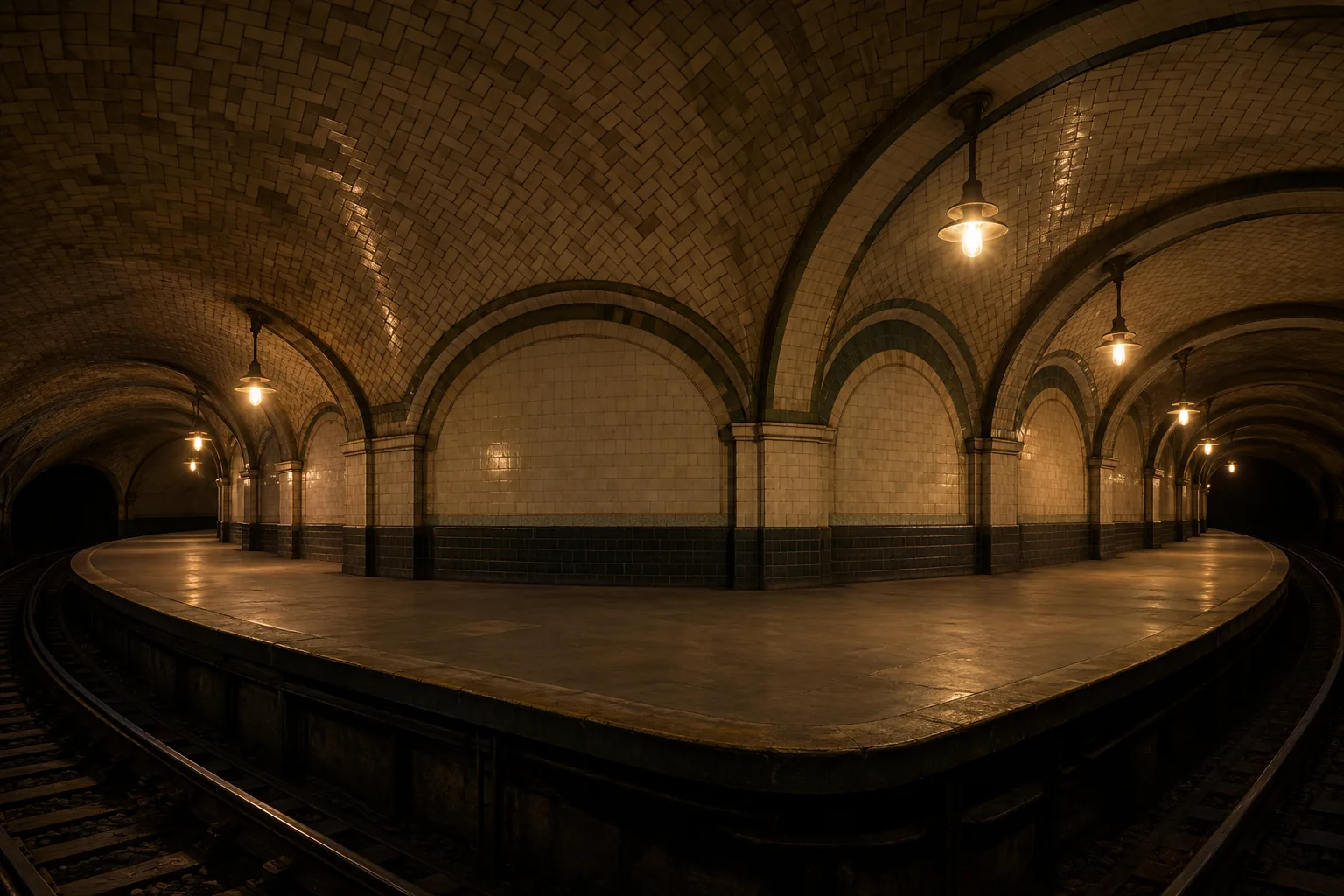
A few minutes after midnight on 1 January, in a subway station where no train has stopped since 1945, Zohran Mamdani put his hand on a Quran and was sworn in as mayor of New York. The room was the original City Hall station, closed to passengers for eighty years, with its Guastavino tile vaults overhead and its skylights long since covered from the street. The oath was administered by the state attorney general, Letitia James. Almost nobody was there.
Thirteen hours later he did it again, in daylight, on the steps at City Hall, with Senator Bernie Sanders administering the oath and roughly four thousand people in the park and screens set up along Broadway for everyone who could not get in. That is the ceremony that will be in the archives. It is also the one that changed nothing, because the term had already begun at midnight and the man on the steps had been mayor since before dawn.
Two oaths is not unusual. Mayors and presidents have taken a private one on the legal deadline and a public one when the crowd could assemble, and the practice is old enough to be unremarkable. What is worth pausing on is the shape of it: a legally operative act performed in private, in a room no longer connected to the system it belongs to, followed by a public act that carries the meaning and none of the force.
The new administration is going to spend a great deal of 2026 on that distinction.
What the office actually holds
The mayoralty of New York is a strong office by American standards. It controls a budget larger than most states’, it appoints agency heads without confirmation hearings, and it runs a police department of more than thirty thousand uniformed officers. On the things that sit wholly inside the city’s charter, a mayor who knows what he wants can move quickly.
The clearest example in the incoming program is the rent freeze. New York has about a million rent stabilized apartments, and the annual decision on what landlords may charge for them is made by the Rent Guidelines Board, a nine member body. The mayor does not set the rate. The mayor appoints every member of the board that sets it.
That is a real power and it is worth being precise about its shape. It is an appointment power exercised once, producing a body that then votes on its own schedule, in public, after hearings, subject to the ordinary risk that an appointee does something other than what the appointer expected. It is slower than an order and less certain. It is also, in practice, decisive, and there is no plausible reading of the charter under which Albany gets a say in it.
City owned grocery stores fall on the same side of the line. A pilot store is a capital appropriation and an operating subsidy, which means a budget the council has to pass and a mayor has to sign, and after that it is a question of site, staffing and whether anyone shops there. Nothing about it requires a state law. It can fail on its own merits, which is a different thing from being blocked.
What it does not hold
Fare free buses are the promise that most clearly sits outside the building. The buses are not the city’s. They belong to the Metropolitan Transportation Authority, a state public authority whose seventeen voting board members are all nominated by the governor, four of them on the recommendation of the city’s mayor, and whose funding runs through the legislature in Albany. A mayor of New York can fund a fare subsidy, argue for one, or embarrass the state into considering one. A mayor cannot abolish a fare he does not set on a system he does not run.
Universal childcare has the same problem for a less obvious reason. The program itself is administrable at city level. The money is not. New York City’s taxing authority is delegated by the state, and the specific proposals that were supposed to pay for this, a higher corporate rate and a surcharge on high incomes, are state tax changes. They require the legislature and a governor who has declined to raise income tax rates through several budget cycles and who faces re-election in November.
So the agenda splits cleanly. The things the charter already permits can begin now. The things that need revenue, or that touch a state authority, begin in Albany in the session that opens this month, and they begin as requests.
Why the split matters more than usual this year
Every incoming mayor discovers this boundary. What makes it sharper here is that the campaign ran on the items that sit on the far side of it. Fare free buses and universal childcare were the two proposals that did the most work in November, and they are the two that a mayor cannot deliver alone. The rent freeze, which is the one he can effectively deliver, was the quieter promise.
That is not a gotcha. It is the ordinary condition of city government in a state that treats its largest city as a subdivision, and it has constrained every mayor since the charter was written. But it sets up a specific kind of year. The administration’s early record will be made of the things inside the charter, and the fights that define it will be about the things outside, conducted a hundred and fifty miles up the Hudson, in a chamber where the city holds a minority of seats and no veto.
The measure to watch is not whether the agenda passes. It is whether the mayor spends his first six months on the part he controls or the part he does not.
The room
The station he was sworn in under is worth one more sentence, because it is not simply a handsome backdrop.
City Hall opened on 27 October 1904 as one of the first twenty eight stations on the system, and it was the showpiece: vaulted, chandeliered, daylit from above. It closed on 31 December 1945, eighty years to the day before the oath taken inside it, and it did not close because anyone disliked it. It closed because the platform sat on a curve too tight to lengthen for ten car trains, and the gap between the doors and the platform edge had become dangerous. The constraint was geometric. No amount of wanting the station open could move the wall it was built against.
Downtown 6 trains still run through it. They do not stop. Passengers who stay aboard past Brooklyn Bridge get perhaps fifteen seconds of it through the window as the train takes the loop and heads back uptown: tile, ironwork, the curve, and then the tunnel again.