The figure in circulation is about 250,000 employees affected, and the number is accurate. What almost everyone does with it is not.
Say a quarter of a million federal workers are affected by a shutdown and a reader pictures a quarter of a million people at home, not working, waiting. That picture is close to the opposite of what is happening at the Department of Homeland Security, which has been without appropriations since 14 February.
In the thirty five day lapse of 2018 and 2019, 88 percent of DHS employees were required to keep working. Twelve percent were furloughed. Roughly 53,000 at the Transportation Security Administration, 54,000 at Customs and Border Protection and 42,000 in the Coast Guard stayed on the job and were not paid for it.
There is no reason to expect this one to break differently, and the early reporting says it has not.
What everyone believes about a shutdown
The standing assumption, and it is a reasonable one drawn from every previous episode, is that a narrower shutdown is a milder shutdown. Fewer departments, fewer people, less disruption, less harm. On that reading the two week gap that produced this one was a success of sorts: the fight was contained to a single agency while everything else got full year funding.
Underneath that sits a second assumption about how these things end. A shutdown is painful, the pain is visible, the visibility produces pressure, and the pressure produces a deal. Closed parks, delayed passports, a growing pile of ordinary inconvenience distributed across every congressional district in the country.
Both assumptions are load bearing and both fail here.
What the record shows
Take the first. A shutdown at DHS is not a milder version of a general one, because of what DHS is. Its workforce is overwhelmingly made up of people whose jobs meet the standard for excepted work: necessary for the safety of human life or the protection of property. Screening passengers. Staffing ports of entry. Search and rescue.
So the mechanism that makes a shutdown visible elsewhere, an office that closes, does not operate. Nothing closes. Airports run. Borders are staffed. Cutters go out. The department continues to do essentially everything it did a fortnight ago, and the people doing it stop receiving money.
That is not a smaller version of a shutdown. It is a different instrument, and it falls on a workforce that is disproportionately young, disproportionately hourly, and not in a position to absorb a missed pay cycle. In the last long lapse Coast Guard families were using food pantries, and the Coast Guard is the part of the armed forces that reports to this department and therefore stops being paid when it loses its appropriation, which no other service does.
Now the second assumption, which is the more consequential one. Pressure ends shutdowns because pressure is broad. When half the government lapses, every member of Congress hears from constituents in a dozen unrelated capacities within days.
Concentrate the lapse in one department and that mechanism largely switches off. The public does not experience a DHS shutdown, at least not immediately, precisely because the excepted staff are holding the visible functions together for free. The flights still leave. The harm is real and it is private: it is in a bank balance, in a difficult conversation at home, in a decision about which bill to skip. Private harm does not generate the kind of noise that moves a negotiation.
Which produces the reversal. The shutdown that affects the fewest departments is the one with the weakest built in mechanism for ending itself, and the one whose costs are most easily left running.
The quiet part: money moves
One thing complicates the picture and is worth reporting honestly, because it cuts against the bleakest reading.
Agencies are not entirely without options. Customs and Border Protection has moved to divert other funding to pay at least some of its staff, which is possible because parts of the agency run on fee income and other balances that are not inside the lapsed appropriation. Different components have different room to do this, which means the experience of this shutdown varies enormously depending on which badge someone carries.
That relief is real and it is uneven, and unevenness has its own cost. A department in which some colleagues are paid and others doing similar work are not is a harder place to manage than one where everybody is in the same position.
The route that is not blocked
One more thing belongs in this account, because it explains why the deadlock can persist without immigration policy standing still.
This month the Justice Department published an interim final rule changing how the Board of Immigration Appeals handles cases, effective 9 March. Two changes matter. The deadline to file an appeal from an immigration judge’s decision drops from thirty days to ten. And appeals will be dismissed unless a majority of the Board’s members vote to accept them, rather than being reviewed on their merits as a matter of course.
Set aside what you think of the policy. Note the instrument. That is a substantial change to how a system of adjudication works, made by rule rather than by statute, published while the legislative branch is locked in a funding dispute over the same subject and unable to move.
This is the ordinary condition of American immigration policy and has been for a long time. The legislative route is closed, so the work is done administratively, by rulemaking and by enforcement priority, which is faster, requires no votes, and can be reversed by the next administration on the same terms. Every participant understands this, which is part of why the funding fight is so hard to settle: a statute would bind, and nobody is confident enough of the terms to want one.
What is unresolved
The thing I cannot get past is that the usual stopping condition is missing and nothing has replaced it.
A general shutdown ends because it becomes intolerable to the public, and that threshold arrives on a fairly predictable schedule. This one does not have that clock. The functions the public notices are staffed. The people bearing the cost are a defined group with no broad constituency, and their most powerful lever, which would be to stop working, is one that most of them regard as unavailable on principle and which is in any case not legally theirs to pull.
So the honest answer to how long this lasts is that nobody knows, and the reason nobody knows is that it will not end from exhaustion the way the others did. It will end when the underlying disagreement is settled, on its own timetable, and the disagreement is about immigration policy, which has not been settled by any Congress in thirty years.
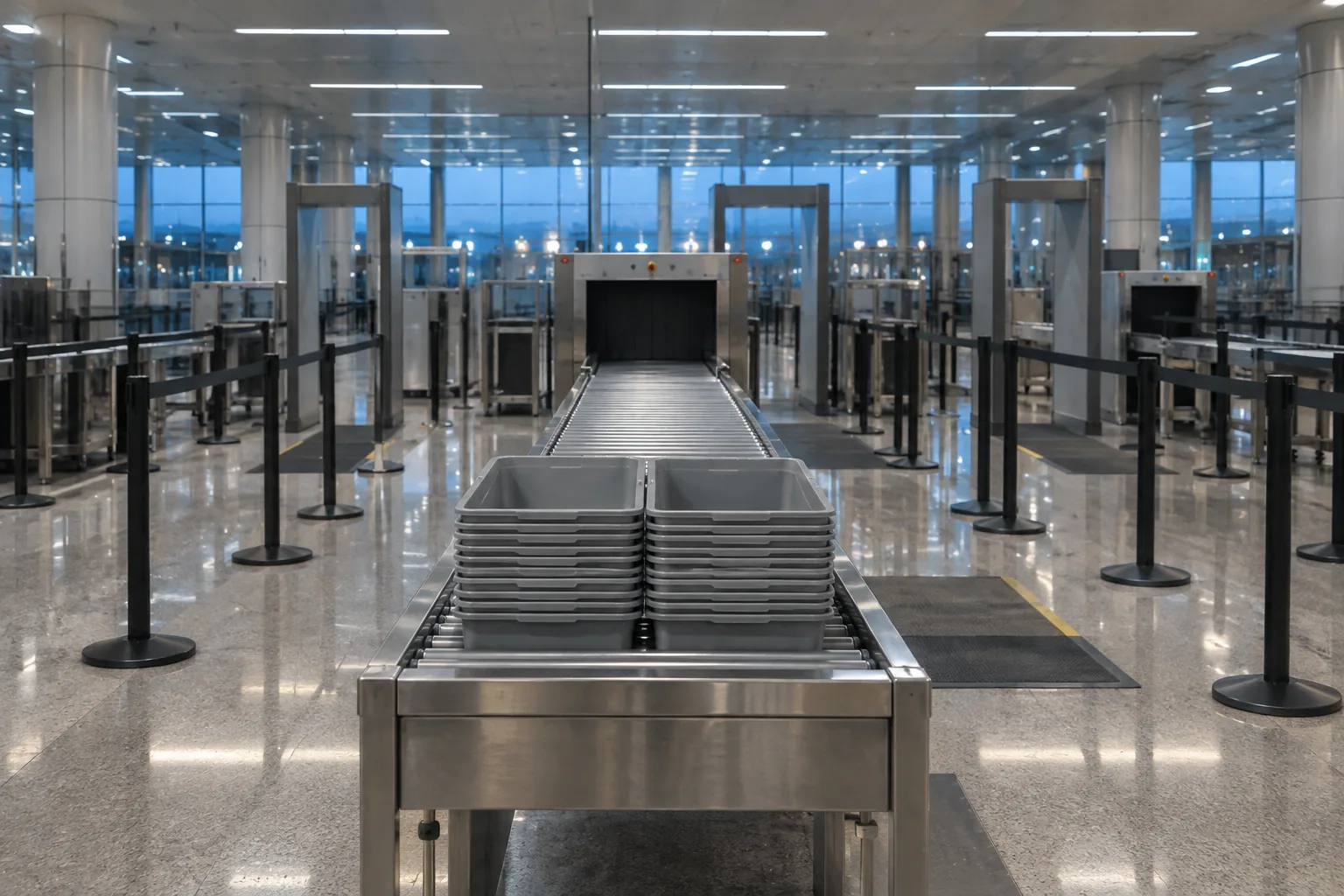
In the meantime the screening lines will keep moving, on time, staffed by people who are not being paid to stand there, and almost nobody passing through will have any way of knowing.