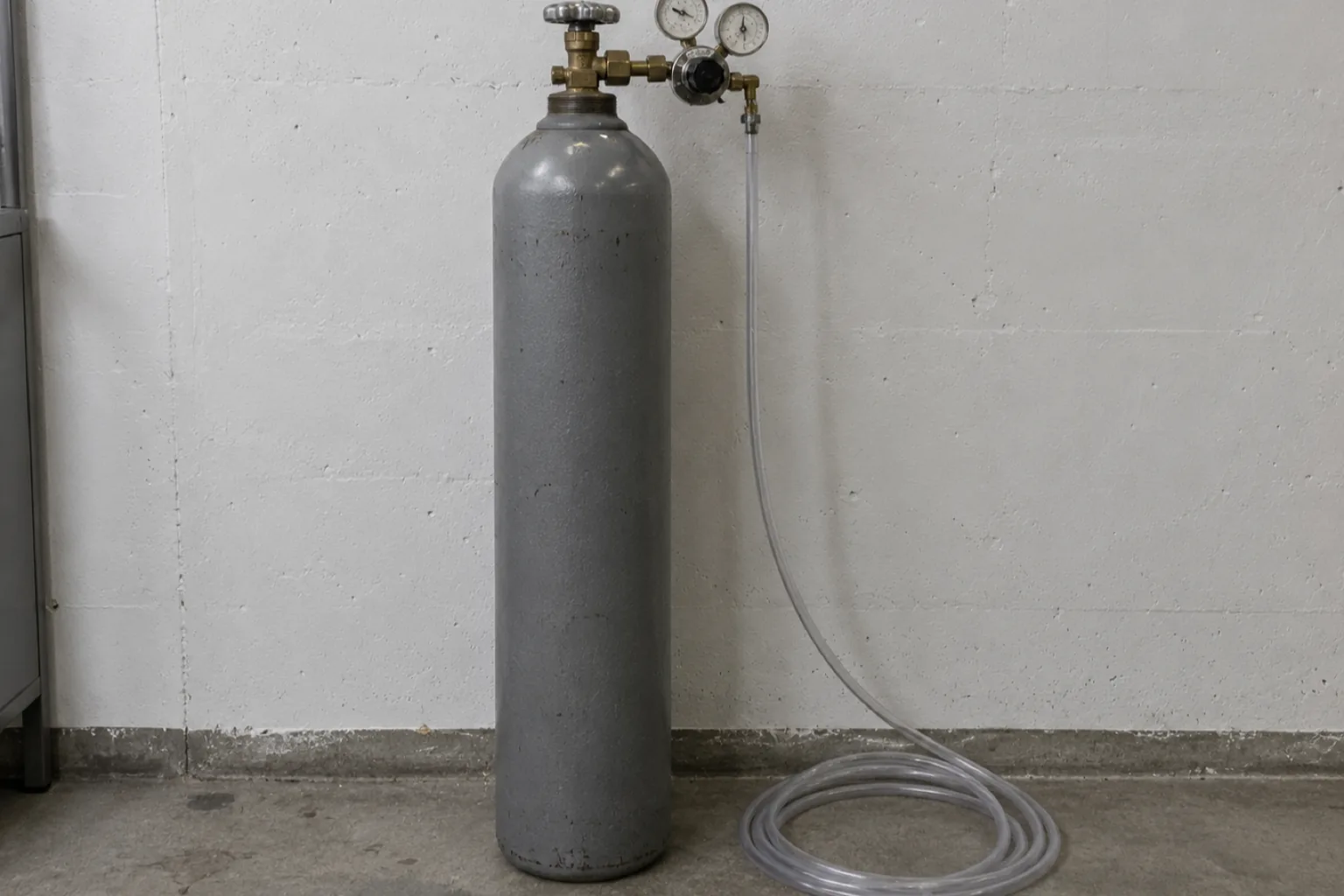
The apparatus is a mask. It fits over the face, it is sealed at the edges, and a line runs from it to a cylinder of nitrogen. Nitrogen is not a poison. It makes up about four fifths of ordinary air and does nothing to the body at all. The method works by supplying nothing else, so that each breath removes carbon dioxide and returns no oxygen, and the person breathes normally until there is not enough oxygen left to stay conscious.
That is the whole design, and its simplicity was the argument for it. Alabama told courts that the method would produce unconsciousness within seconds.
On Thursday evening the state used it on Kenneth Eugene Smith, and the accounts filed by the people required to watch do not describe seconds.
How the method was authorized
Start with the procedure, because the sequence explains how a state arrives at using something nobody has used.
Alabama wrote nitrogen hypoxia into its statutes as a permitted method of execution in 2018. Writing a method into law does not require demonstrating it. The legislature authorized a category, and the department of corrections was left to develop a protocol for carrying it out.
No jurisdiction anywhere had executed anybody this way. There was no body of prior practice to draw on, no clinical literature on deliberate nitrogen asphyxiation in restrained conscious humans, and no other state’s protocol to copy. What existed was industrial safety data on accidental nitrogen deaths, which describes people who did not know they were in danger and were not restrained.
So when the courts came to review the method, as they did repeatedly, what they were reviewing was a set of representations by the state about what would happen. Not evidence of what had happened, because there was none.
The man, and the first attempt
Smith was convicted in 1988 of the contract killing of Elizabeth Sennett, who was beaten and stabbed in her home in Colbert County. He was paid for it, and the case has been through the courts for more than thirty years since.
In November 2022 the state attempted to execute him by lethal injection and could not. Staff worked for hours and failed to establish an intravenous line. The warrant expired and he was returned to his cell, having been strapped to a gurney for much of the night.
That failure is why the nitrogen protocol had a candidate. A state that cannot reliably find a vein has a practical problem, and the new method was presented in part as the answer to it.
What the record says happened
The execution began at 7.53 in the evening. Smith was pronounced dead at 8.25.
Between those times, according to the accounts of witnesses present, he remained conscious for some minutes after the gas began flowing, then shook and writhed against the restraints for at least four minutes, then breathed heavily for several minutes more.
Lee Hedgepeth, a journalist who was one of the media witnesses, said afterwards that it was the fifth execution he had watched in Alabama and that he had never seen such a violent reaction to one.
Before it started, Smith used sign language to say I love you to the people who had come to watch on his behalf. His last statement was that Alabama had caused humanity to take a step backward.
The reversal, stated precisely
The gap here is not between what the state hoped and what occurred. Hope is not what was offered to the courts.
What was offered was a description: that the method would render a person unconscious within seconds, and that what followed would therefore be involuntary and unperceived. Judges weighed the constitutional question against that description, because a description was the only thing available to weigh.
The record filed by the witnesses is not consistent with it. Whether Smith was conscious through the four minutes is not something any observer can establish from outside, and it is fair to say so. What is established is that the state’s account of the timeline was wrong, and that the discrepancy was visible to everyone in the room.
That matters procedurally more than it matters rhetorically. A court that approves a method on the strength of a representation has no mechanism for revisiting the approval when the representation turns out to be inaccurate, unless somebody brings a new case, and the person best placed to bring it is dead.
What happens to a protocol after it is used
There is a structural problem underneath all of this that the outcome makes visible.
An execution method cannot be tested before use. There is no trial, no pilot, no reversible first attempt. The first time it is done is the first time anybody knows what it does, and the person it is done to cannot report on it.
Every other regulated procedure that carries a risk of suffering is validated before it is authorized, through animal work, through clinical trials, through staged approval. This category is the only one where the validating event and the irreversible event are the same event.
Which means the information the state now has about nitrogen hypoxia, and which it did not have on Wednesday, was purchased in the only currency available.
Alabama has other men under sentence of death who have elected nitrogen as their method, which they did when it was an abstraction and the alternative was a needle that had already failed once.
There is one more procedural asymmetry worth naming. The state chooses the method and writes the protocol, the state selects and briefs the witnesses, and the state keeps the official time. Every instrument by which the public learns what a method does is held by the party with the strongest interest in the answer being unremarkable. That the accounts filed on Thursday were not unremarkable is therefore worth more than it would be from any other source.
What exists now that did not exist on Wednesday
The mask, the hose and the cylinder were, until Thursday, objects described in filings. A court could read about them and a judge could reason about what they would do.
They are now equipment with an operating history. That history is one use, lasting thirty two minutes by the clock the state itself kept, recorded by the witnesses the state itself required to attend, and written down by them afterwards in terms the state had not used.
A mask, a line, a cylinder, and a stack of reporters’ notebooks that do not match the filing. That is the whole of what Thursday added to the record, and the notebooks are the one part of it the state did not produce itself.