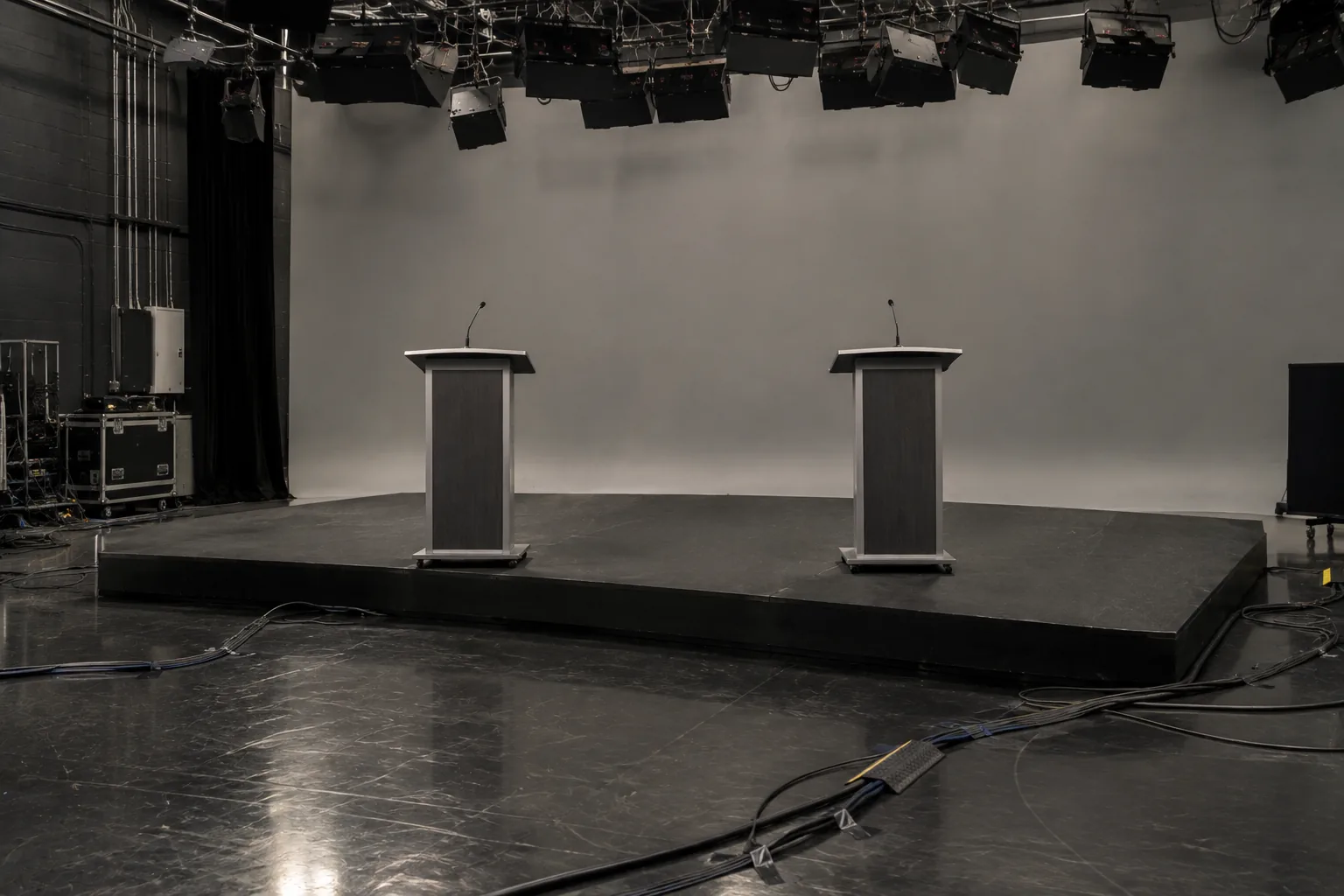
The rules were published by the broadcaster a fortnight in advance and they run to a short document: ninety minutes, two commercial breaks, two moderators, no studio audience, no props or prewritten notes, a pen and a pad and a bottle of water, and microphones muted except for the candidate whose turn it is.
The first debate of the 2024 general election was held on Thursday night in Atlanta under those terms. Setting them beside the format they replaced is the useful exercise, because nearly every element was a deliberate reversal of something.
The format that was replaced
From 1988 until this cycle, general election debates were organized by a bipartisan commission established for the purpose. It set a calendar years ahead, negotiated terms with both campaigns, selected moderators, and held the events on university campuses in front of live audiences.
The commission’s value was not the individual rules. It was that the rules existed before anybody knew who the candidates would be. A body setting a format in advance is setting it behind a veil: nobody knows yet whose interest each provision serves.
That is the thing the commission did that a network negotiation cannot do, and it is worth naming precisely because the commission had become unpopular with both parties and its defenders rarely articulated what it was for.
The format that replaced it
This debate was arranged directly between the two campaigns and a broadcaster, some months out, with both candidates already known.
Every rule in it was therefore agreed by two parties who could calculate exactly whom it favored. That does not make any individual rule wrong. It does mean the resulting document is a negotiated settlement rather than a neutral framework, and it will be renegotiated from scratch next time by whoever is then in a position to insist.
What each change was for
Take them in turn, because each has an identifiable purpose.
No audience. Applause and reaction had become a substantial part of the event, and a candidate playing to a room is performing to several hundred people rather than to several tens of millions. Removing it removes a feedback loop that rewarded lines over answers.
Muted microphones. The 2020 first debate was substantially unwatchable because of interruption, and muting is the only mechanism that reliably stops it. It converts a debate from something closer to an argument into something closer to alternating statements.
No notes. An old commission rule, retained, and the reasoning has always been that a debate tests recall and composure rather than preparation.
Commercial breaks. New, and the only provision with no defensible purpose beyond the broadcaster’s. Breaks give campaigns the chance to reset a candidate mid-event, which is precisely what a continuous format was designed to prevent.
Why the commission collapsed
It is worth being fair to the complaints, because they were not frivolous.
One party had objected for years to moderator selection and to the commission’s membership, arguing both tilted against it. The other had objected to the scheduling, which put debates after early voting had begun in several states. Both objections were about the same underlying fact: an institution setting terms without either campaign’s consent.
What replaced it was agreement between the campaigns, and this debate happened in June, months earlier than any general election debate in the modern era, because both sides wanted it then for their own reasons.
That is the trade. The commission’s terms were imposed and predictable. The new arrangement’s terms are consented to and exist only for one night.
What the difference teaches
That format is not neutral, and that everybody involved knows it.
A debate with muted microphones and no audience is a better test of some things and a worse test of others. It shows composure, recall and the ability to construct an answer alone. It cannot show how somebody handles interruption, hostility or a room, which are also part of the job.
Neither format is more honest than the other. What changed is who chooses, and choosing now happens after everybody knows what they are choosing between.
There is an unusual property of this particular set of rules, and it was not anticipated by anybody who agreed them.
A muted microphone means the camera holds on a candidate who is not speaking and cannot speak. No audience means no reaction to cut away to. No notes means nothing to look down at. The result is ninety minutes of sustained, uninterrupted visual scrutiny of two men in their late seventies and early eighties, with none of the ordinary cover a live event provides.
Rules written to prevent one candidate’s interruptions produced a format that exposed the other’s delivery, and the record of Thursday night is substantially a record of that, rather than of anything either of them said.
What both formats have never tested
Neither arrangement has ever produced an event that does what debates are supposed to do, which is let a voter compare two people’s reasoning at length.
Ninety minutes divided between two candidates, across a dozen topics, with commercial breaks, allows each person about two minutes per subject. Two minutes is enough to state a position and not enough to defend one, which is why every debate in living memory has been decided by a moment rather than by an argument.
That constraint is common to both formats and neither side has ever proposed removing it, because a long-form format would be watched by fewer people and would expose both participants to a kind of examination that no campaign wants.
None of which is an argument that the old body should be restored. It is an argument that something has to supply a schedule, and that campaigns negotiating with broadcasters will never supply one, because a schedule is precisely the thing a campaign wants to keep contingent.
What is not settled
Whether there is a second debate, and under what terms.
Without a commission there is no calendar, no default, and no institution able to say that a debate will occur on a particular date whether or not both parties find it convenient. A second event happens if and only if both campaigns conclude separately that it helps them, which is a condition that is rarely satisfied by both at once.
That is the structural change underneath the evening, and it will outlast this election. The old arrangement was criticized for years, much of it deserved, and what it supplied was a schedule that existed independently of anybody’s interest.
Nothing supplies that now. The next set of rules will be written by whoever has the leverage, at a time of their choosing, with full knowledge of who benefits.