The rule is that we know exactly when it happens. The total solar eclipse that crosses Siberia, eastern Greenland, western Iceland and northern Spain this evening has been computed to the second for every point along its track, and the same computation runs forward for centuries and backward into antiquity with the same confidence.
The exception is that none of that tells anybody whether they will see it. That gap, between a prediction of extraordinary precision and a question nobody can answer, is the most interesting thing about today, and it is worth understanding before the sky does anything.
Why the timing is so exact
Eclipse prediction is arguably the most thoroughly verified calculation in science, and the reason is that the system doing the moving is unusually simple.
Three bodies, all large, all far apart relative to their sizes, all moving under gravity with no significant friction and no significant outside influence. There is no atmosphere to complicate anything, no chemistry, no biology, no feedback. The positions of the Earth, Moon and Sun are a solved problem to a precision far beyond what any observer needs.
The result is that the moment of totality at a given point is known to a fraction of a second, and the edges of the path are known to within a few hundred meters. The only ingredient that meaningfully limits the accuracy is the shape of the lunar limb, because the Moon’s edge is mountainous and totality begins when the last sliver of sun disappears behind a specific ridge. Spacecraft mapping of that edge has now made even this a solved problem.
So: two minutes and eighteen seconds at maximum, at a known instant, on a track that can be drawn on a map with a fine pen. That is the rule.
The first test: the thing that actually decides it
Set beside that the prediction that governs whether anyone sees anything, which is cloud.
Weather forecasting operates on an atmosphere that is turbulent, coupled to oceans and land, and sensitive to initial conditions in a way that puts a hard ceiling on how far ahead it can be useful. That ceiling is a fundamental property of the system rather than a limitation of the models, and increasing computing power moves it very little.
For a specific question at a specific point, useful skill runs to a few days. A month out, the honest answer for any location is the climatological average and nothing more, which is a statement about Augusts in general rather than about today.
This produces the situation the eclipse community lives with. People who booked accommodation in Iceland or northern Spain did so years ago, on a prediction good to the second, for an event whose visibility was fundamentally unknowable at the time they committed.
The second test: this particular eclipse makes it worse
The geometry today adds a complication that most eclipses do not have.
In Spain the sun is not fully eclipsed until late in the evening, shortly before it sets. Totality there happens with the sun very low, which means the light is traveling through a great deal more atmosphere than it would at noon, and it means the view requires a clear horizon in the right direction rather than merely a clear sky overhead.
A low sun is also the case where local topography decides things. A ridge, a building, a line of trees in the wrong place removes the event entirely for somebody standing in an otherwise perfect location, and none of that is in any forecast.
Against that, a low sun during totality is genuinely spectacular when it works, because the darkened sun sits among sunset colors rather than in the middle of a blue sky. The distribution of outcomes is therefore unusually wide today: the good version is better than average and the bad version is total.
The third test: what people do with an unanswerable question
The behavioral response to this is the part I find most telling, because it is entirely rational and looks like the opposite.
Experienced eclipse observers do not pick the place with the best climatology and stay there. They pick a region, arrive with transport, and then move on the morning of, sometimes hundreds of kilometers, on the basis of forecasts that have finally become informative.
That is the correct strategy given the structure of the problem. The expensive, long lead decisions have to be made against a prediction that cannot help, so the useful thing is to keep the final decision as late as possible and preserve the ability to act on it. Mobility is worth more than the best guess made in advance.
It is also a reasonable description of how to handle any forecast with a short skill horizon and a long commitment window, which is most of them.
There is a further wrinkle worth naming, which is that the two predictions are not independent of each other in practice. Cloud forecasts for a specific valley in northern Spain are better than cloud forecasts in general, because terrain drives local cloud and terrain does not move. A forecaster who knows which slopes hold morning cloud in August is applying something closer to a rule than a prediction. That knowledge is local, unevenly distributed, and largely absent from the apps most people will check this afternoon.
The verdict
Both predictions in this story are excellent. That is the thing worth holding onto, because the obvious reading is that astronomy is a real science and meteorology is not, and that reading is wrong.
A weather model that gives useful guidance three days out for a specific point is an extraordinary technical achievement working against a system that is chaotic by nature. An eclipse computation good for a thousand years is an extraordinary achievement working against a system that is not. The difference in output is a property of the two systems, not a difference in the quality of the work.
What today demonstrates, for anyone who watches it or fails to, is that precision and usefulness are separate things. A number can be exact and answer the wrong question. The eclipse time is exact. Whether the event happens for you is decided by something nobody could have told you, at any price, more than a few days ago.
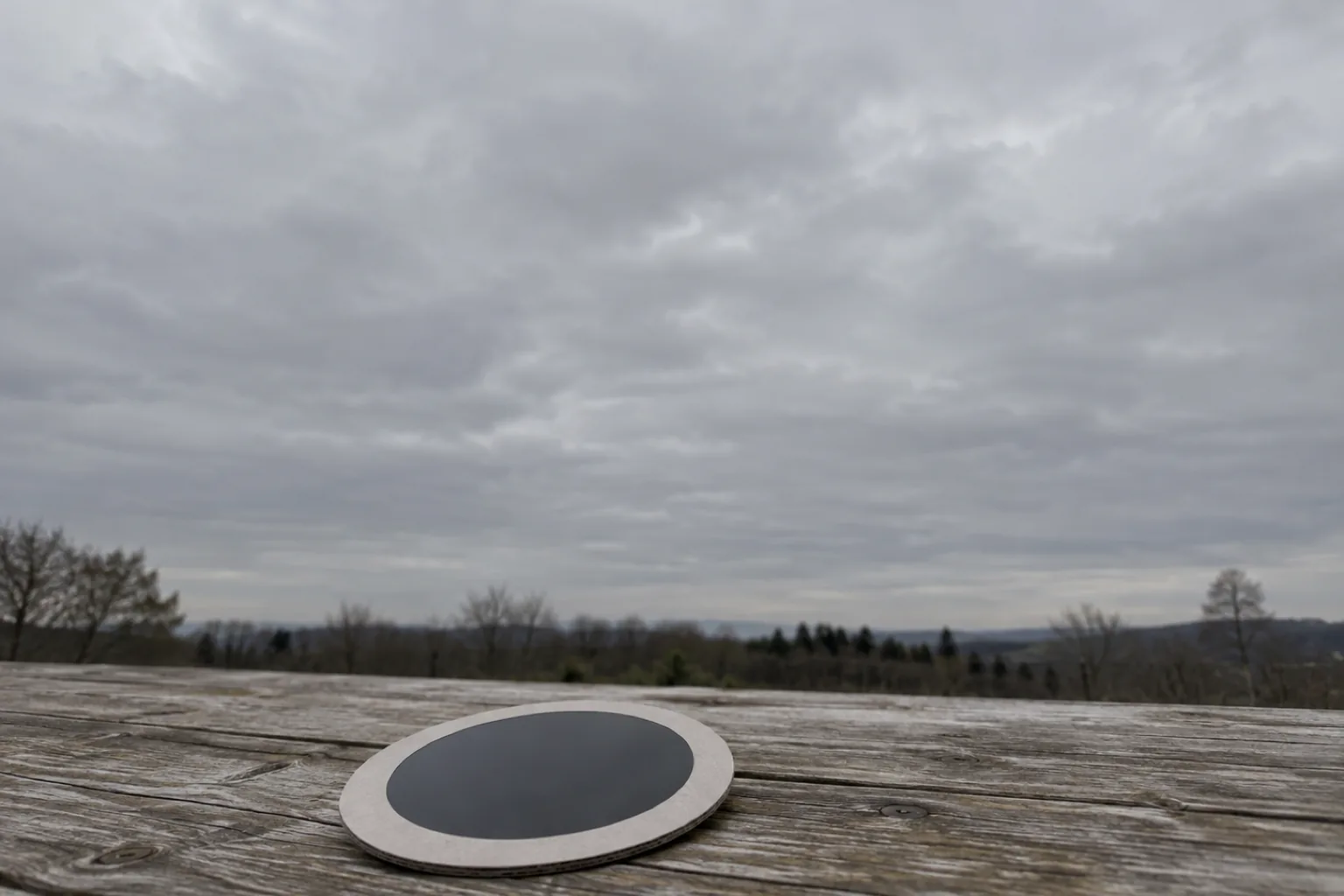
For those in the path, the practical position this morning is simple and unglamorous. In northern Spain a filter the size of a coaster is sitting on a table somewhere, rated to block all but a hundred thousandth of the sun, that somebody bought online in March. It will either be held up to a clear patch of sky this evening for a hundred and thirty eight seconds, or it will be in a pocket, and which of those happens is being decided today by something nobody has any control over at all.