A free return is not a route. It is a description of what happens to an object released at the right speed in the right direction: it falls toward the Moon, the Moon’s gravity bends its path around the far side, and the same gravity throws it back toward the Earth it came from. No engine is required for the return. The motion completes itself.
NASA began the countdown today for an Artemis II launch on Wednesday. Four people will be aboard Orion: Reid Wiseman commanding, Victor Glover as pilot, Christina Koch and, for the Canadian Space Agency, Jeremy Hansen. The flight lasts about ten days and ends with a splashdown in the Pacific off San Diego.
What follows is what the mission is actually for, because the framing everywhere is that this is the return to the Moon, and that is not what is being tested.
Why the trajectory is shaped that way
Start with the choice that defines the flight plan, because it is the clearest statement of what NASA is worried about.
There were two ways to arrange a lunar loop. The spacecraft could fire its engine while passing behind the Moon, which is the efficient option and which places the critical burn at the point where the vehicle is out of radio contact with Earth. Or it could commit to the path with a burn performed earlier, nearer home, where the crew and the ground are in contact and the Earth is close enough to return to quickly.
They chose the second. The consequence is that once that burn is done, the trajectory is passive: if the main engine failed completely from that moment on, the spacecraft would still come home, because the shape of the path is doing the work rather than the propulsion.
That is a mission designed around the assumption that something might not work, and it tells you the flight is a test rather than a journey.
The shape is not new either, which is worth knowing. Apollo 8 flew a free return on the first crewed lunar flight, for the same reason: on a first attempt you want the physics to bring the crew home if the hardware declines to. And when Apollo 13 lost an oxygen tank on the way out, the recovery began by putting the spacecraft back onto a free return, because it was the one path that did not depend on the systems that had just failed.
So the trajectory chosen for Wednesday is the one the program reaches for when it is least willing to rely on its own machinery. That is not a criticism. It is the correct choice on a first crewed flight, and it is also a piece of information about how the mission is regarded by the people flying it.
What is genuinely unproven
Three systems, and only three, are being exercised in a way they have not been before.
The first is life support with people inside it, in deep space, for ten days. Orion flew uncrewed on Artemis I. Air revitalization, carbon dioxide removal, thermal control and water management have been run on the ground and in low Earth orbit on other vehicles, and have not been run in this vehicle with a crew metabolizing in it beyond the magnetosphere.
The second is the crew interface in the broad sense: communications at lunar distance, navigation with people in the loop, manual handling qualities, and the accumulated small frictions that only appear when humans operate a system for days rather than minutes.
The third is the heat shield, and it is the one that deserves the rest of this piece.
The heat shield, precisely
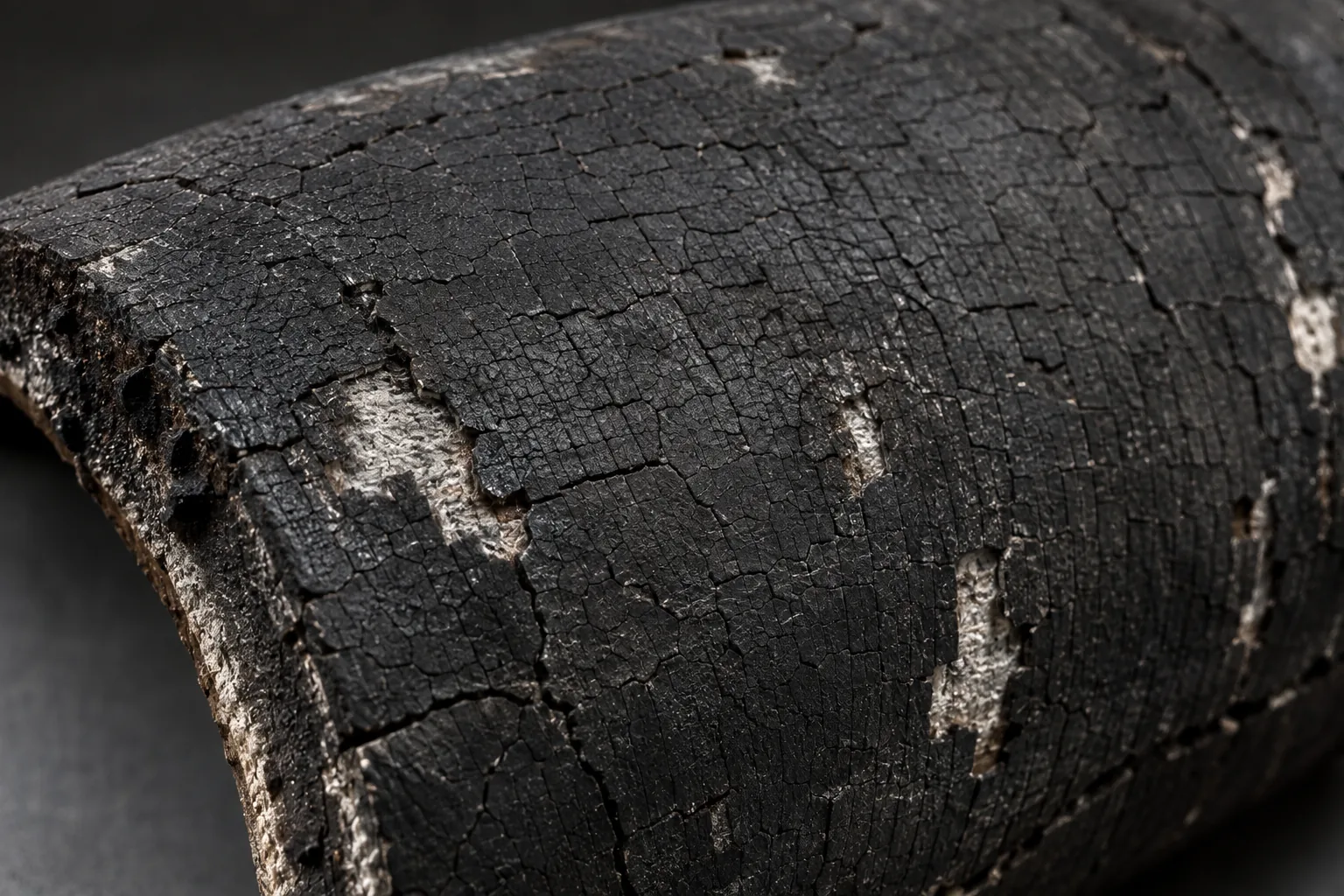
When Orion returned from Artemis I in December 2022, its heat shield did not perform as the models predicted. Charred material came off in pieces, in a number of locations, rather than eroding smoothly as designed.
NASA investigated and published a root cause. The shield’s outer layer is an ablative material called Avcoat, which protects by charring and carrying heat away as it degrades. During the return, gases generated inside the material were unable to vent and dissipate as expected. Pressure built up within the layer, cracking followed, and pieces of char detached.
Two things should be said about that finding and they pull in different directions.
It is a good finding. A root cause identified to that level of specificity, with a physical mechanism rather than a statistical association, is what an investigation is supposed to produce and many do not manage it.
And the response was a mitigation rather than a repair. The shield flying on Wednesday is of the same design and material. What has changed is the entry profile: the trajectory through the atmosphere has been adjusted to alter the heating and pressure history the material experiences, so that the conditions that trapped the gases are less likely to arise.
What a successful entry would and would not show
This is where I want to be careful, because the reporting after Wednesday will not be.
If Orion returns and the shield performs, that demonstrates that this material, in this configuration, on this modified entry profile, behaved acceptably on one occasion. That is meaningful and it is worth having.
It does not demonstrate that the root cause is resolved, because the mitigation works by avoiding the conditions rather than by changing the material’s response to them. It does not establish a margin, because a single entry tells you the outcome at one set of conditions and nothing about how close to a boundary it passed. And it does not directly validate later missions, which return from different trajectories at different energies and will therefore present the shield with a different history.
A material model is validated by a distribution of results, not by an instance. One flight moves the evidence; it does not settle it.
The part that does not resolve
Which leaves a question that is not really technical.
The decision to fly the existing shield with a modified entry, rather than to rebuild it, was made by people with access to test data I have not seen, and it may well be correct. Rebuilding would have cost years, and a program that stops for every anomaly does not fly, and there is no such thing as a spacecraft with no accepted risks.
But the structure of the decision is worth naming plainly. An anomaly was found, its cause was identified, the cause was not eliminated, and the mission proceeds on an operational workaround with four people aboard. Every part of that sentence has been publicly stated by the agency. None of it is concealed.
Whether that is prudent engineering or accepted risk sitting slightly too close to the edge is not a question that Wednesday will answer, and it is not a question that a good outcome would answer either. Programs of this kind have historically discovered which it was several flights later, and usually not from the flight that went well.