The figure in every account of yesterday is ninety five billion dollars, and it is not a price anybody paid for anything.
Cerebras listed on Nasdaq on Thursday under CBRS. Shares were sold in the offering at $185. They closed the first day at $311.07, up 68 percent, and the company raised $5.55 billion, which is the largest technology offering of the year and roughly a quarter of all American IPO proceeds so far in 2026.
The ninety five billion comes from multiplying that closing price by every share in existence, including the enormous majority that were not for sale, have not traded, and in many cases cannot be sold for months. It is a real number in the sense that it is arithmetically correct. It is not a valuation in the sense of a sum at which the company changed hands, because the company did not change hands; about six percent of it did.
Set the number aside. The object underneath it is considerably more interesting.
The thing itself
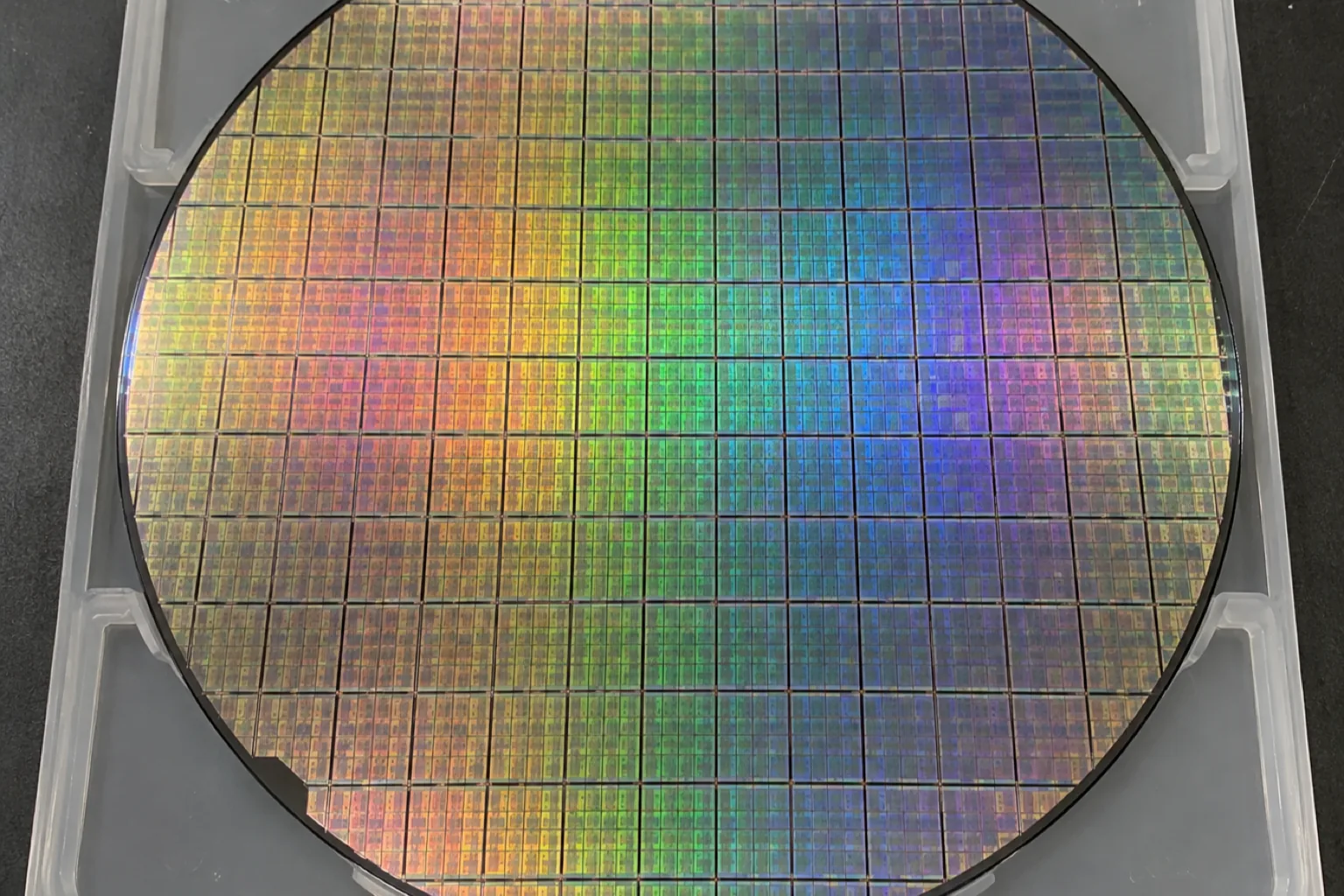
A conventional processor is made by printing many identical copies of a design onto a circular slice of silicon roughly three hundred millimeters across, then cutting the slice into individual chips and packaging them separately. Everything about semiconductor manufacturing assumes that cut.
Cerebras does not make the cut. Its product is the wafer, whole: a single piece of silicon about the size of a dinner plate, carrying an entire processor, with the communication that would normally travel between chips happening instead across the surface of one.
It weighs a fraction of what the cooling and power delivery around it weigh. It cannot be dropped in to a standard server, so the company sells the system rather than the part: the wafer, the frame, the power, and a liquid cooling arrangement built around the fact that a component that size dissipates heat over an area nothing else in a data center dissipates heat over.
Why anyone would do this
Because of where the time goes.
Training a large model is not principally a calculation problem any more. It is a movement problem. The arithmetic is distributed across thousands of processors, and those processors have to exchange intermediate results constantly, and the exchange happens over links that are slow and power hungry compared with the operations they are feeding. A very large share of the energy in a modern training run is spent moving numbers rather than adding them.
Keeping everything on one piece of silicon removes a layer of that. Data that would have crossed a network crosses a few millimeters of the same wafer instead, which is faster and cheaper in power by a wide margin.
That is the entire thesis, and for certain workloads it is straightforwardly correct.
The problem the industry said was insurmountable
Nobody built wafer scale processors for decades and the reason was yield.
Manufacturing defects are unavoidable and they are distributed roughly randomly across a wafer. When the wafer is cut into hundreds of chips, a defect ruins the one chip it lands in and the rest are sold. When the wafer is one chip, a single defect in the wrong place ruins the entire thing, and the probability of a large area being defect free falls away sharply as the area grows.
The answer is redundancy. The design includes far more cores than it needs and a routing fabric that can be configured after manufacture to work around the parts that failed, so a wafer with defects is still a working product with slightly fewer usable cores. That is not a new idea in principle. Doing it at this scale, reliably, is the company’s actual achievement, and it is a manufacturing achievement rather than an architectural one.
What the listing is actually a bet on
Three things, in descending order of how much they are discussed.
The first is demand for anything that trains models, which at the moment is close to unlimited and is the reason the book was covered many times over.
The second is the proposition that a customer will buy a system rather than a chip. That is a harder sale than it sounds. A data center operator has standardized on racks, power densities, cooling loops and a software stack, and a machine that does not fit any of those is a special case, and special cases are expensive to operate even when they are faster.
The third, which nobody puts in a prospectus, is concentration. A company of this kind typically has a small number of very large customers, and the loss of one is not a bad quarter, it is a different company. The filings disclose this in the risk factors and almost nobody reads past the first two pages of those.
What a lock up does to the number
Back to the ninety five billion for a moment, because there is a mechanism that makes it temporarily meaningless and then meaningful.
Insiders, early investors and employees almost always agree not to sell for a period after a listing, conventionally around six months. That is the lock up, and it exists to stop the people who know most about the company from exiting into the enthusiasm of people who know least.
Its side effect is to make the first months of trading a market in a small fraction of the shares. Demand from anybody who wants exposure has to be satisfied out of that fraction, which pushes the price up in a way that tells you very little about what the whole company is worth.
The honest test arrives when the lock up expires and a much larger quantity of stock becomes sellable at once. Some holders sell, the float widens, and the price finds a level set by a market with actual supply in it. That level, not this week’s, is the first number worth calling a valuation.
It is also why the calendar matters more than the debut. Six months from now is November, and a great many people currently quoting ninety five billion will not be watching.
The listing wave behind it
One more piece of context, because this offering is being read as a signal and signals are what it was partly for.
Several much larger private technology companies are expected to come to market later in the year, and every one of them was watching this. A first day close up 68 percent tells them the window is open and tells their bankers what to price at. A flat debut would have told them something else, and the next set of offerings would have been smaller, later or both.
Which means the interesting number from yesterday is not the ninety five billion. It is the 68 percent, because a first day pop of that size is money that went to the buyers rather than to the company, and a company that raised $5.55 billion while its stock rose that far on day one has a reasonable argument that it sold too cheaply.
That argument will be had in every boardroom preparing a listing this summer, and the conclusion they reach about it will shape what those offerings cost and who gets the allocation.