Real Madrid have fifteen as of Saturday night, and the total is presented everywhere as a single achievement in a single competition.
It is not. Six of the fifteen were won in a tournament that no longer exists, under rules that bear almost no resemblance to the one played at Wembley, and the gap between those two things is wide enough that treating them as one number requires some care.
Dortmund lost 2-0, to a header from Dani Carvajal in the seventy-fourth minute and a finish from Vinícius Júnior in the eighty-third. What follows sets the two competitions beside each other, because the comparison is the only way to understand what a fifteen actually represents.
The first competition
The European Cup ran from 1955 and was, structurally, a small knockout tournament. Entry was restricted to the champion of each national league, plus the holder. One club per country, essentially, and a straight knockout from the first round to the final.
The arithmetic of that format is the thing to hold. A club entering it played perhaps eight or nine matches to win it, against opponents drawn without seeding, in an era when a team could be eliminated in October by a side it would beat nine times in ten.
It was a tournament with enormous variance. A single bad night in the first round ended a season, and there was no group stage to absorb it. Winning it repeatedly required being very good and being lucky repeatedly, and the second requirement is not a small one.
Real Madrid won the first five editions, from 1956 to 1960, and a sixth in 1966. That is the six.
The second competition
The Champions League from 1992 is a different instrument. A group stage was added, then expanded. Entry was widened from national champions to multiple clubs from the strongest leagues, so that a country could send three or four.
Each of those changes cuts the same way: it reduces variance. A group stage means an early defeat is survivable. Seeding means the strongest clubs avoid each other until later. Multiple entrants per league means the best teams are almost never absent.
A format that reduces variance rewards the consistently strongest club, which is what a format is supposed to do and which also means the winner is less surprising. Real Madrid have won it nine times in that era, including six since 2014.
What the difference teaches
That the two halves of the fifteen are not commensurable, and that the incommensurability runs in both directions.
The six are harder in one specific sense: they were won in a format where being the best team was not sufficient, because a knockout draw could remove you regardless. Six titles under those conditions is a run that current arithmetic would call improbable.
The nine are harder in a different sense: the field is deeper, every opponent is a national champion or close to it, the money and the medical and analytical resources are distributed across far more clubs, and the schedule is far heavier. Winning a modern edition means beating four or five clubs that would have been favorites in most seasons of the old tournament.
Neither set is diminished by the other. What is diminished is the sentence that adds them up, because addition requires the units to be the same.
Why the number is used anyway
Because UEFA counts it that way, and because a governing body’s ledger is the only authority available.
That is not a criticism. A competition that changes its format has to decide whether it is the same competition, and every sport that has ever restructured anything has answered yes, because answering no means declaring your own history void. The alternative is a record book with a discontinuity in it, which nobody wants and which would be argued about far more than the current arrangement is.
So the fifteen is a real number produced by a defensible convention, and the convention hides the thing that is actually interesting, which is that one club has been the best in Europe under two completely different sets of rules seventy years apart.
What the change did to everybody else
One consequence of the restructuring belongs here because it cuts against the club at the center of it.
The old format’s variance was what let a club from a smaller league win. Celtic, Feyenoord, Steaua Bucharest, Red Star Belgrade, Nottingham Forest twice: all champions of a competition in which one good fortnight could decide everything. None of those clubs has come close since the format changed, and none is likely to.
So the same reform that makes modern titles a truer measure of the strongest side is the reform that ended the possibility of the other kind of winner. A record of fifteen is partly a record of a competition that stopped producing surprises, which is not something the number can say about itself.
What the modern run is made of
Worth being precise about the recent record, because the pattern in it is unusual and is not really about dominance.
Real Madrid’s Champions League era is not a story of a team overwhelming a competition. It is a story of a team repeatedly surviving ties it was not winning: late equalizers, extra time, comebacks from two goals down in semi-finals. The 2022 run in particular was a sequence of escapes rather than a procession.
Saturday was the opposite of that, which is why it felt anticlimactic to people who had watched the earlier rounds. Dortmund had the better of the first half, did not score, and were beaten by two set-piece and counter moments in the last twenty minutes. A final that goes that way is the format working exactly as designed.
What is in the cabinet
The trophy lifted at Wembley is not the one from 1956, and the reason is the six.
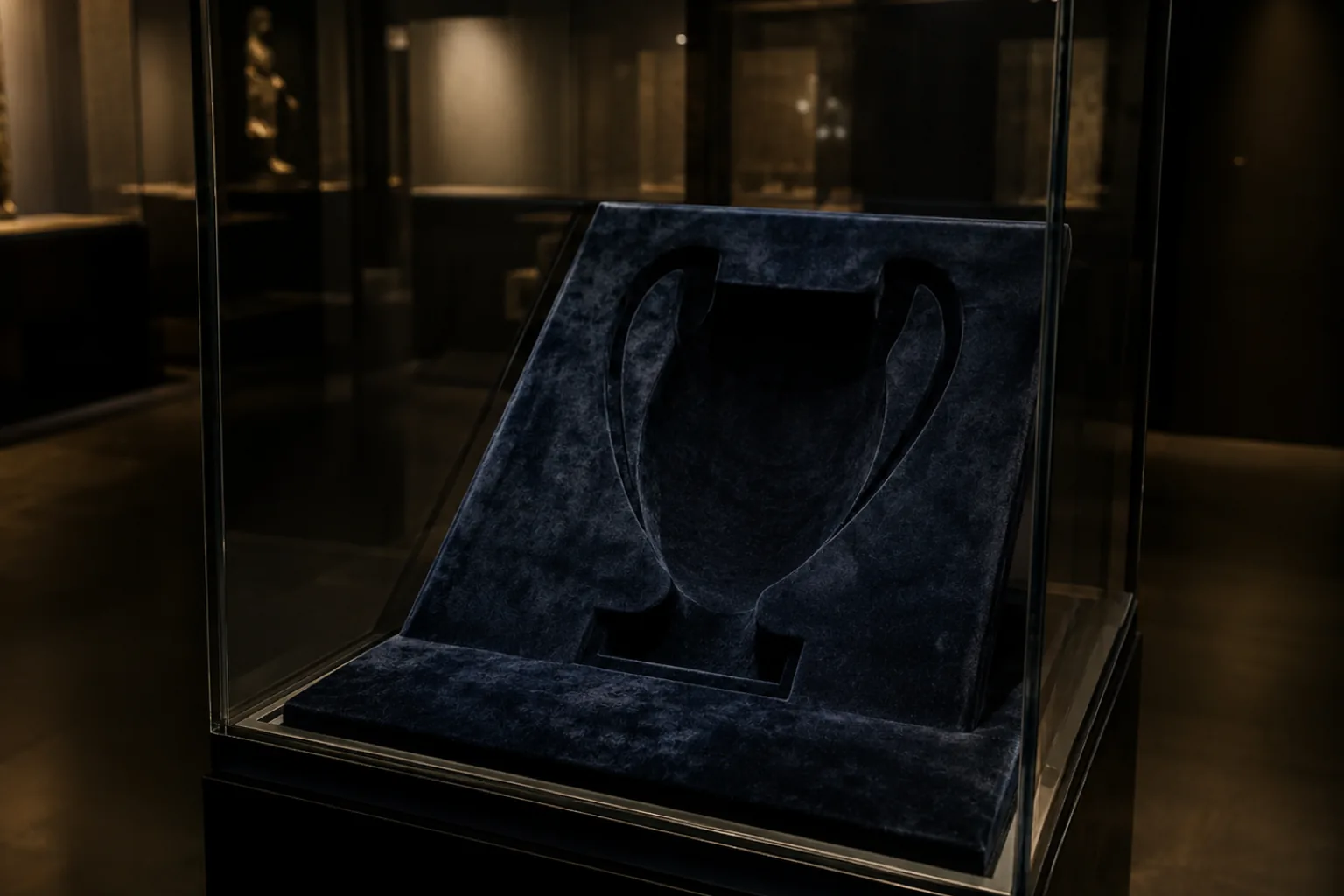
The original cup was donated by a French newspaper and, in March 1967, awarded permanently to Real Madrid under a rule rewarding six wins. It is in the club’s museum. UEFA commissioned a replacement from a Bern jeweller named Jörg Stadelmann for ten thousand Swiss francs: silver, seventy-four centimeters, eleven kilograms, with the large curved handles everybody now recognizes. Celtic were the first to win it, later that year.
And even that one does not travel. The cup a captain lifts at the final goes back to UEFA within weeks; the winning club keeps a full-size replica. So the fifteen is not fifteen liftings of one object. It is six of a trophy that was won outright and kept, and nine of a trophy that was handed back every summer, and the reason the second trophy exists at all is that the first six happened.