The rule, and it is close enough to a rule that players talk about it as one: you do not lose a Grand Slam final from two sets to love up. Best of five means the first to three, so a two set lead leaves you needing one from the remaining three, against an opponent who must win all of them. The arithmetic is overwhelming and the history matches it.
The exception is that it happens, rarely, and it happened on Sunday night at Rod Laver Arena, where Daniil Medvedev led Jannik Sinner by two sets and lost three six, three six, six four, six four, six three.
What follows is an accounting of that, because a match of this shape is best understood as a ledger: what the early sets cost, who was paying, and when the bill arrived.
The asset Medvedev built
Two sets, taken 6-3 and 6-3, in a manner that by every account was close to his best. Aggressive, on the front foot, refusing the long rallies that his own game is usually accused of preferring.
That is a real asset and it should be valued properly. At two sets to love in a major final, a player is in a position that has been converted the overwhelming majority of times it has occurred. Medvedev had not merely been ahead. He had constructed a lead in the way you would want to construct one.
What it cost to build
Here is the entry that does not appear on the scoreboard.
Playing a high intensity, forward pressing game against a twenty two year old is expensive. It requires holding a court position that is physically demanding, taking the ball early, and covering ground to recover from doing so. It is a style you can sustain for a period and not indefinitely.
Medvedev also arrived at that final having spent an enormous amount of time on court over the fortnight. He had come through several very long matches to reach it, which is a cost incurred before the final began and carried into it.
So the two sets were bought with resources drawn from a reserve that had already been depleted, and that could not be replenished during the match. The total running time on Sunday was three hours and forty four minutes, and the great majority of what Medvedev had to spend was spent in the first ninety minutes of it.
The moment the debt was called
The third set went to Sinner 6-4. The fourth went to Sinner 6-4. The fifth went 6-3.
The margins are the interesting part. Those are not collapses. A set lost 4-6 is a set decided by one break of serve, and a player losing three consecutive sets by those margins is not falling apart; he is being outlasted at close quarters.
What changes in that situation is not shot quality in any obvious way. It is the length of the rallies a player is willing to commit to, and how often he goes for a winner a shot earlier than he would have in the first hour. Every one of those slightly early attempts is a small withdrawal against a balance that is already low.
Sinner’s contribution was to make the withdrawals necessary. His fourth consecutive win over Medvedev at tour level, which suggests a matchup he had already worked out before Sunday.
The historical ledger
Set this against the record and the rarity is easier to feel.
Sinner is only the second man in the Open Era to win the Australian Open final from two sets down. The other is Rafael Nadal, in 2022, also against Medvedev.
Six instances in the whole Open Era, then, across all four majors and more than fifty years of best of five finals. That is the denominator worth holding when anybody calls a two set lead in a final safe. It is not safe in the sense of guaranteed. It is safe in the sense that the exceptions are individually famous, which is a different and much weaker claim, and it is the sense in which most sporting certainties turn out to be meant.
Widen it to first titles and the list is five men across half a century: Bjorn Borg at Roland Garros in 1974, Ivan Lendl there in 1984, Gaston Gaudio there in 2004, Dominic Thiem at the US Open in 2020, and Sinner on Sunday. Four of the five were on clay, where longer rallies and slower conditions make a physical reversal more available. Sinner did it on a hard court.
That Medvedev is on the losing side of two of the six is a statistical curiosity and probably nothing more, though it is the sort of thing that becomes a story attached to a player whether or not it means anything.
What Italy collects
The other column in this ledger is national and it has been open for a long time.
Sinner is the first Italian man to win a Grand Slam singles title since Adriano Panatta at Roland Garros in 1976, and only the third ever. Forty eight years is long enough that the drought had become part of how Italian tennis described itself, in a country where the men’s game has produced excellent players who kept not doing this.
A first major by a twenty two year old tends to be discussed as the beginning of something, which is a prediction rather than an observation, and it should be left as one. What is not a prediction is that a generation of Italian players who grew up without a reference point now has one, and that changes the arithmetic of what a junior in Bolzano believes is available.
What the balance sheet shows
Medvedev played the better tennis for ninety minutes and lost. Sinner played worse for ninety minutes and won. Both of those statements are true and neither is the point.
The point is that a five set match is not scored in sets. It is scored in what remains, and the player who wins is the one with something left at the end of the fourth hour, which is decided partly on the night and partly a fortnight earlier by a draw nobody chose.
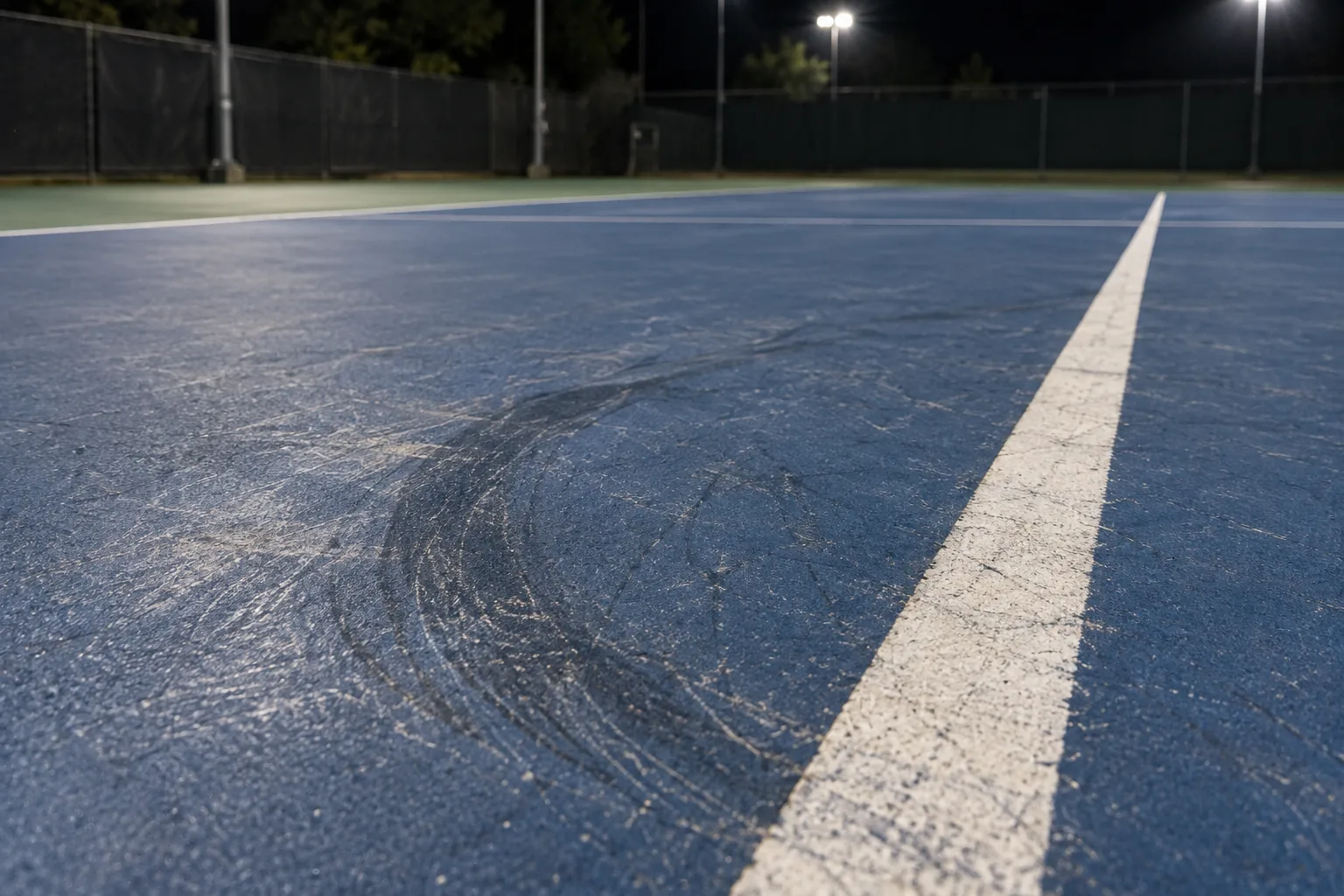
A trophy gets handed over, photographed, and taken away again within about twenty minutes. What a hard court holds onto for longer is duller and more specific: the two dark arcs that build up behind each baseline over a long match, where a player stands and turns and stands again. Three hours and forty four minutes leaves a deep pair of them. The crew brushes the surface before the next session and they go.