
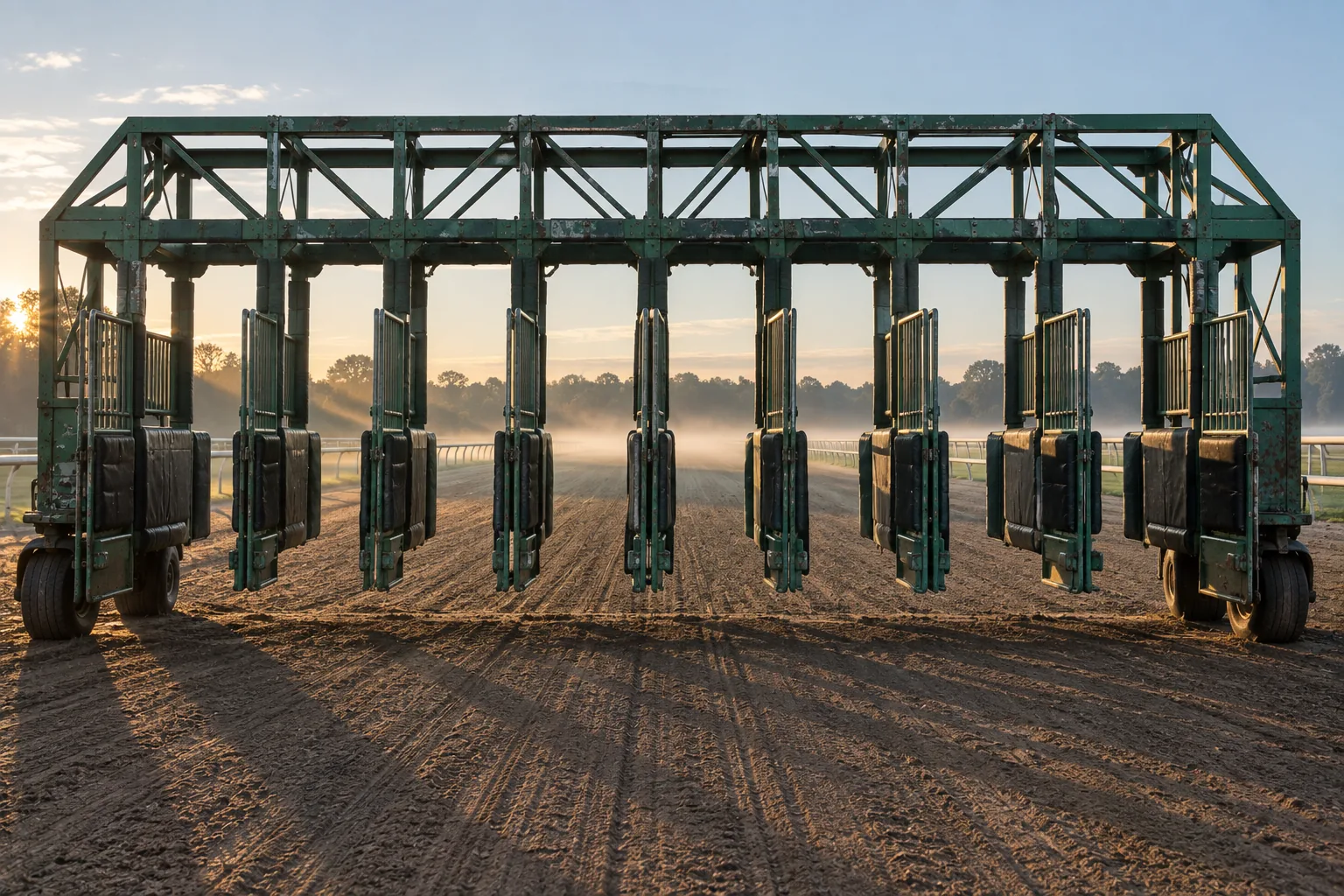
Coming out of the final turn at Churchill Downs on Saturday, Golden Tempo was eighteenth. Jose Ortiz took him wide, off the rail and away from the traffic, and the horse began to pass other horses in a way that stopped looking like a recovery and started looking like something else entirely. He came down the outside and caught the co-favorite at the wire at 23-1.
His trainer is Cherie DeVaux, and she is the first woman to train a Kentucky Derby winner in a hundred and fifty two runnings.
What everybody said about it
Within an hour the framing had settled: a barrier broken, a glass ceiling in one of the most traditional corners of American sport, a first that took a century and a half.
All of that is true as description and none of it explains anything, because it locates the obstacle in the wrong place. The barrier was not that women could not train racehorses, and it was not that the sport would not license them.
What the record actually shows
Women have held trainer’s licenses in American racing for more than half a century. They have run public stables, won graded stakes, developed champions, and been elected to positions in the sport’s institutions. There is no shortage of women who have demonstrated, on the record, that they can prepare a horse to win at the highest level.
What almost none of them has had is a Derby horse.
And this is the part that the barrier language obscures. A trainer does not acquire a Derby contender by being good. A trainer receives one, from an owner, who bought it at a yearling sale for a sum that is frequently seven figures, and who then decides which barn it goes to.
That decision is the actual gate. It is made privately, by a small number of very wealthy people, on the basis of relationships, reputation and a completely reasonable desire not to entrust an enormously expensive animal to somebody unproven. And the definition of proven is circular: you prove yourself with good horses, and you get good horses by having proven yourself.
Which makes it a capital allocation problem
Look at where the top of this sport is concentrated. A very large share of the Derby field in any given year comes from a handful of barns, and those barns are the ones that have had the best stock for years, which is why they produce the best results, which is why they get the best stock.
That is not a conspiracy and it is not specific to gender. It is what happens in any field where the raw material is scarce, expensive, and allocated by incumbents on the basis of past performance. New entrants of any description struggle to break in, and the struggle is worse for anyone who does not already resemble the people currently receiving the allocation.
DeVaux’s route through it is instructive precisely because it is so conventional. She grew up in Saratoga Springs, learned under Chuck Simon and then Chad Brown, and set up on her own in 2018. That is an apprenticeship in the most established part of the sport, followed by eight years of building a record good enough that an owner would hand her something worth running in May.
Eight years is fast. It is also eight years of demonstrating a competence that was never actually in question.
Why the distinction matters
Because the two accounts imply completely different things about what happens next.
If the barrier was prejudice inside the profession, then the first is a threshold and the second and third follow quickly, because the thing preventing them has been shown to be unfounded.
If the barrier is capital allocation by a small number of owners, then one result changes very little on its own. It gives one trainer a credential that makes the next allocation easier for her specifically. It does nothing structural about how the horses are distributed, and the concentration that produced a hundred and fifty two years of this outcome is still concentrated on Sunday morning.
The useful measure will not be whether another woman wins the Derby. It will be how many women are saddling horses in the race at all, five years from now, which is a question about yearling sales and owner relationships rather than about anything that happens on the first Saturday in May.
The horse
One more thing about the race itself, which nobody will remember in a month because the story attached to it is larger.
Eighteenth to first in a twenty horse field is an extraordinary way to win a Derby. It requires a horse with a finishing kick, a jockey willing to give up ground to find clean air, and a pace up front fast enough to leave the leaders empty. Every one of those has to happen, and the trainer controls exactly one of them, which is having the horse fit enough to produce the kick when it is asked for.
That is the job, and it was done, and the reason to say so plainly is that a great many accounts this week will treat the result as a symbol and forget that it was also a race. Golden Tempo went off at 23-1 because almost nobody thought he could do it, which is its own quiet verdict on how much of this anybody sees coming.