
Here is a question worth holding back, because the answer is stranger than the question sounds. What, exactly, is the Triple Crown? Not which races. Who owns it, who runs it, and where is it written down.
Hold that. On Tuesday the New York Racing Association and Churchill Downs Incorporated announced a six race series for three year olds called the Thoroughbred Championship Series. It opens with the Kentucky Derby on 2 May and the Belmont Stakes on 5 June, continues to the Matt Winn at Churchill in early July and the Jim Dandy and the Travers at Saratoga through the summer, and finishes with a newly created race at Churchill in September. Points are awarded across the six, and a five million dollar pool is distributed by the final standings. It begins in 2027.
The Preakness is not in it.
1919, and then 1930
The three races that became the Triple Crown were not founded as a set and did not know about each other. The Belmont Stakes was first run in 1867, at Jerome Park in the Bronx. The Preakness followed in 1873, at Pimlico in Baltimore. The Kentucky Derby came last, in 1875, at a track in Louisville built by a man who had been to Epsom and wanted one.
Three cities, three sets of owners, three separate commercial propositions, run at different distances on different surfaces in different months. Nobody convened them.
In 1919 a colt named Sir Barton won all three in the same season, which was noticed but not named. The naming came about a decade later, from Charles Hatton, a writer at the Daily Racing Form, who used the phrase Triple Crown in his copy and kept using it until everybody else did. There is no founding document. There is no governing body. There is a sportswriter’s shorthand that became so durable that most people assume it must be an institution.
That is the answer to the question, and it is worth sitting with before deciding what this week means. The Triple Crown is a phrase. It has been held together for a century by the fact that three companies who compete with each other all benefited from people believing it was a thing.
What actually broke it
The pressure that produced Tuesday’s announcement is not commercial in the first instance. It is veterinary, and it is about a gap of two weeks.
The Derby is the first Saturday in May. The Preakness is two weeks later. That interval was set when horses raced far more often than they do now, on a training philosophy that has been steadily abandoned. Modern trainers space runs further apart, believing that recovery time reduces injury and lengthens careers, and the evidence has moved in that direction for years.
The consequence is that the Derby winner, the one horse whose participation makes the Preakness a Triple Crown attempt rather than an ordinary Grade 1, increasingly does not turn up. When the Derby winner skips Baltimore, the middle leg becomes a very good race with the story taken out of it, and it happened recently enough that everyone involved understood the direction of travel.
So a series held together by a phrase ran into a schedule that the horses stopped fitting, and the two owners of four of the six races in the new calendar did the arithmetic.
What is being gained and what is being given up
The new series solves real problems and it is worth being fair about that. Spacing races from May to September lets a horse contest all six without running on two weeks rest. A points structure means a horse that runs well four times has something to show for it, which is a better description of a season than a binary that almost always ends in failure. Five million dollars distributed by standings rewards campaigning rather than a single result.
From a stable’s point of view this is straightforwardly better. It is designed, by people who know the sport, to fit how the animals are actually trained now.
What it gives up is the thing the phrase was doing. The Triple Crown was almost impossible, which was the whole of its appeal. Thirteen horses have done it in more than a century. A points championship cannot be almost impossible, because points accumulate and somebody finishes first every year by definition. Making the achievement reliably achievable removes the reason anybody outside racing ever looked.
The three races also carried their cities. Louisville in May, Baltimore in the middle, New York in June, is a route as much as a competition, and the new calendar runs Louisville, New York, Louisville, Saratoga, Saratoga, Louisville. That is a tidier business and a smaller map, and Baltimore is simply not on it.
The Preakness, which still exists
Nothing announced this week cancels the Preakness. Pimlico will run a race on the third Saturday in May in 2027, and it will be a Grade 1, and good horses will contest it.
What it will not be is the middle of anything. A race whose meaning came from its position in a sequence, once the sequence is gone, is a race. That is not nothing. It is a great deal less than it was, and the change was made by other people, in an announcement it was not party to.
What the object actually is
So: there is no Triple Crown trophy in the sense people imagine. A physical trophy exists, commissioned decades after the fact, and it is handed over when somebody wins all three. But the thing itself has no charter and no address. It cannot be abolished, because there is no one with the standing to abolish it, and it cannot defend itself, for the same reason.
It can only be left. Which is what happened on Tuesday: two of the three owners built a different calendar and did not invite the third, and the phrase that held the old arrangement together is still there, still unowned, now describing a thing that the sport has stopped organizing itself around.
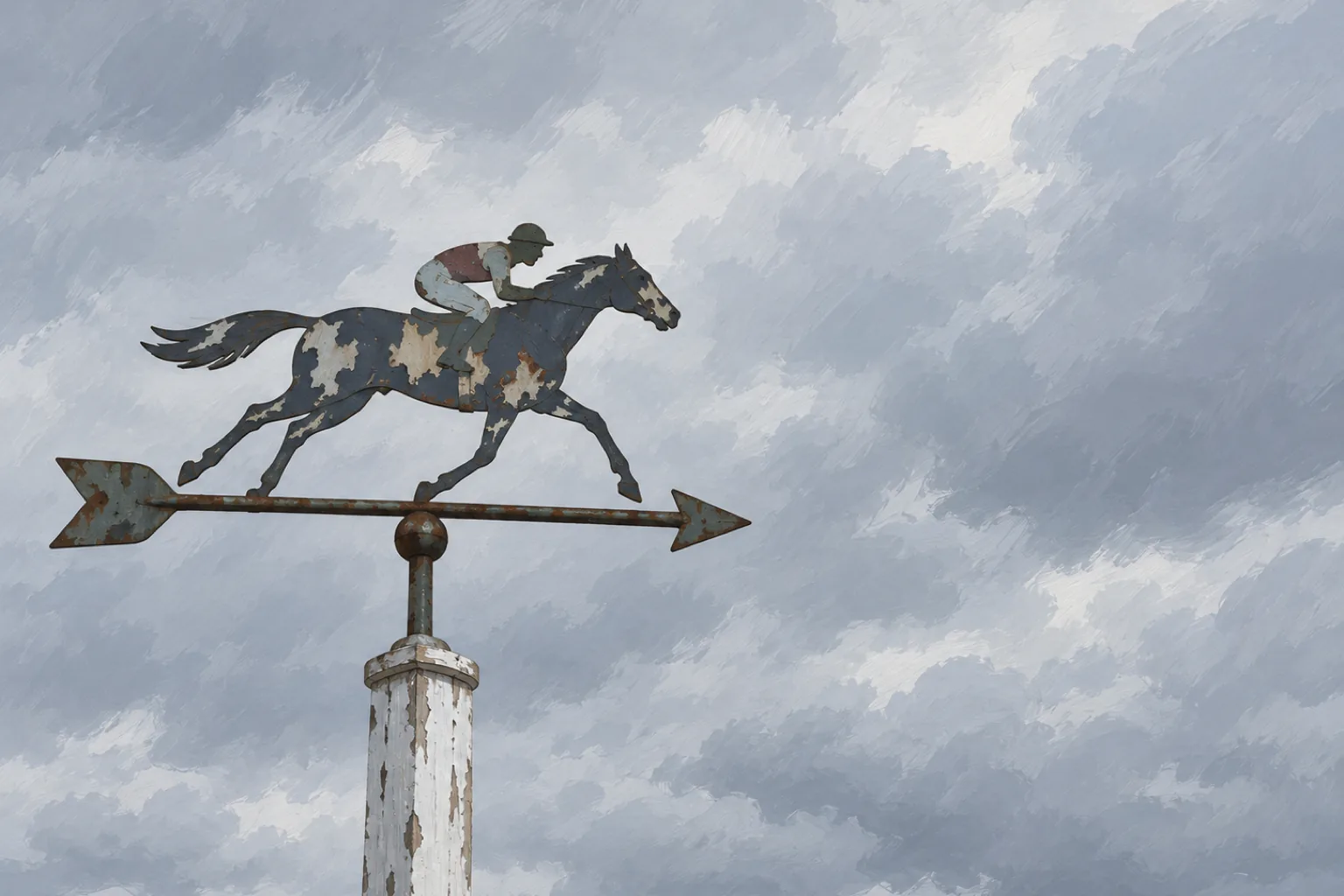
At Pimlico there is a weathervane carrying a horse and rider, and the tradition is that after each Preakness a painter goes up and repaints them in the winning stable’s colors, where they stay until the following year. They will be painted again next May, in whatever colors win, and they will stay that way all year, turning in the wind above a race that is no longer the middle of anything.