“You’re at war when you get attacked. We got attacked.” That was Mark Carney on Saturday, at a press conference in Ottawa, after the United States imposed fifty percent tariffs on about twenty billion dollars of Canadian goods.
The language is the loudest thing about the week and the least informative. The argument here is that the measures announced on Friday are better read as a negotiating instrument than as trade policy, that the evidence for this is in the product list rather than the rhetoric, and that the mechanism which made it possible is the one put in place in July when Washington declined to extend the North American agreement.
The first test: what is actually on the list
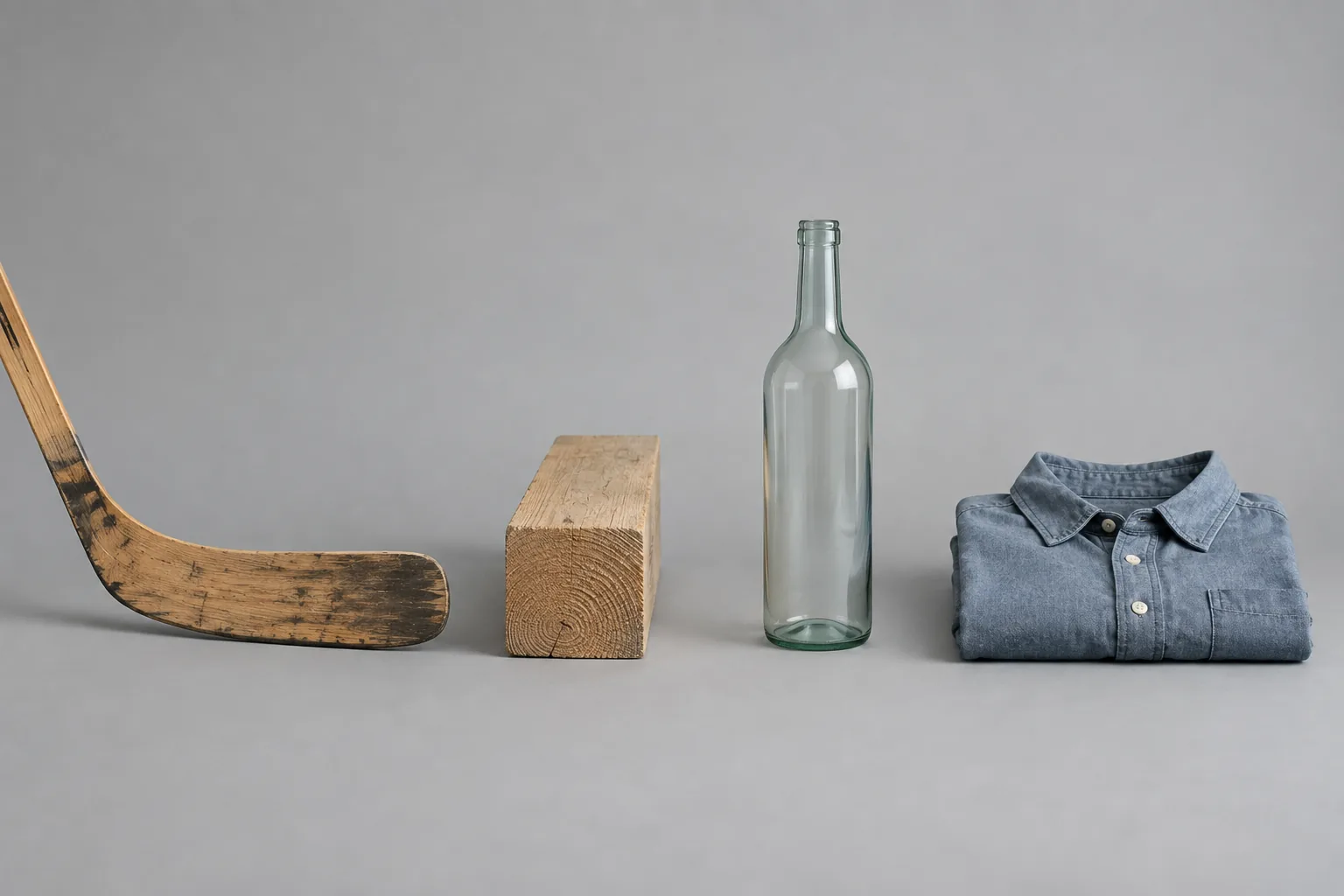
The tariffs cover hockey sticks, building materials, liquors and certain categories of clothing.
Read that list as an economist and it is incoherent. Those categories have almost nothing in common: different industries, different supply chains, different buyers, no shared strategic characteristic. They are not inputs to a sector anyone is trying to protect. They are not technologies anyone is trying to onshore.
Read it as a message and it resolves immediately. Hockey sticks and liquor are not economically central to a relationship measured in hundreds of billions of dollars a year. They are symbolically central. They are the goods a person outside the trade would name if asked what Canada sells.
Twenty billion dollars is likewise a number chosen to be visible rather than decisive. It is large enough to be reported everywhere and small enough that the aggregate effect on either economy is modest against the size of the flows that continue untouched.
The second test: where the measures sit legally
This is the part that connects to July and it is the part almost nobody has mentioned.
The United States, Canada and Mexico remain parties to an agreement that is fully in force and runs until 2036. Nothing about it lapsed on 1 July. What happened then was that Washington declined to extend it for a further sixteen years, which converted a once a decade review into an annual one and changed nothing about the terms.
Tariffs of this kind do not operate under that agreement. They are imposed under domestic authorities that sit alongside it, and the fact that a preferential agreement exists does not by itself prevent a government from acting under a separate statute.
So the position is genuinely odd and worth stating precisely. The agreement governing most of the trade between the two countries is in force, functioning, and unamended. Alongside it, fifty percent duties now apply to a selected list, imposed under a different legal instrument, with a retaliation schedule attached. Both things are true simultaneously and neither is a breach of the other.
July’s non extension did not cause this. What it did was establish that the relationship would be renegotiated annually rather than settled for a generation, and a relationship that is permanently under negotiation is one in which measures like Friday’s are a normal move rather than a rupture.
The third test: how the other side answered
Canada’s response is the strongest evidence for the reading, because it is built the same way.
Carney said Canada would match the measures dollar for dollar from 8 September, with tariffs concentrated in steel, dairy, appliances, agricultural equipment, pulp and paper, and electronics.
That is not a list assembled to minimize harm to Canadian consumers or to maximize economic pressure in the abstract. It is a list of sectors, and sectors have geography. Steel, appliances and agricultural equipment are made in identifiable places, and the people who make them vote.
The delay is the other tell. Two and a half weeks between announcement and effect serves no administrative purpose; customs systems can implement a tariff schedule faster than that. What a delay does is create a window in which the measures can be withdrawn if talks resume. Carney has announced a penalty and simultaneously left it unexecuted, which is the behavior of a party that intends to negotiate rather than to punish.
Both governments, in other words, chose lists designed to be felt politically and calibrated to be reversible.
Before the verdict, one mechanical point that the rhetoric on both sides obscures. A tariff is paid by the importer, which is to say by a company in the country imposing it, at the point the goods clear customs. It is not paid by the exporting country and it is not paid by the foreign manufacturer.
What happens next depends on who has the weaker position. If the importer can find the goods elsewhere, it stops buying and the exporter loses the sale. If it cannot, it either absorbs the duty or passes it to its own customers. In practice the cost is split along the chain in proportions nobody controls and nobody publishes, which is why both governments can describe the same measure as a cost imposed on the other side and neither is being straightforwardly dishonest.
The verdict, and its limits
The measures are an instrument of negotiation. That is the argument and the three tests support it.
But it would be wrong to conclude from this that the consequences are symbolic, and the distinction matters to anyone actually in these industries.
A fifty percent duty does not reduce a business’s margin. For most goods it removes the business entirely, because there is no consumer product whose supply chain absorbs fifty percent. A Canadian firm selling building materials into the United States has, as of Friday, either lost that market or is selling at a loss while it waits to see whether the measure survives the autumn.
That firm cannot wait indefinitely. It has payroll, it has inventory, and it has customers who need certainty about the next quarter. Its rational response is to find other buyers, and finding other buyers takes months and, once done, is not quickly undone. Trade relationships that break under a temporary measure do not automatically reassemble when the measure is lifted.
So the instrument is reversible and its effects are not, entirely. A negotiation conducted through tariffs imposes real and partly permanent costs on a specific group of firms as the price of creating pressure at a table those firms are not sitting at.
That is the honest description. The measures are a message, the message is aimed at a negotiation, the negotiation may well produce an agreement in the autumn, and the maker of hockey sticks who loses a distributor in September will not get that distributor back because a communique in November says the matter is resolved.