
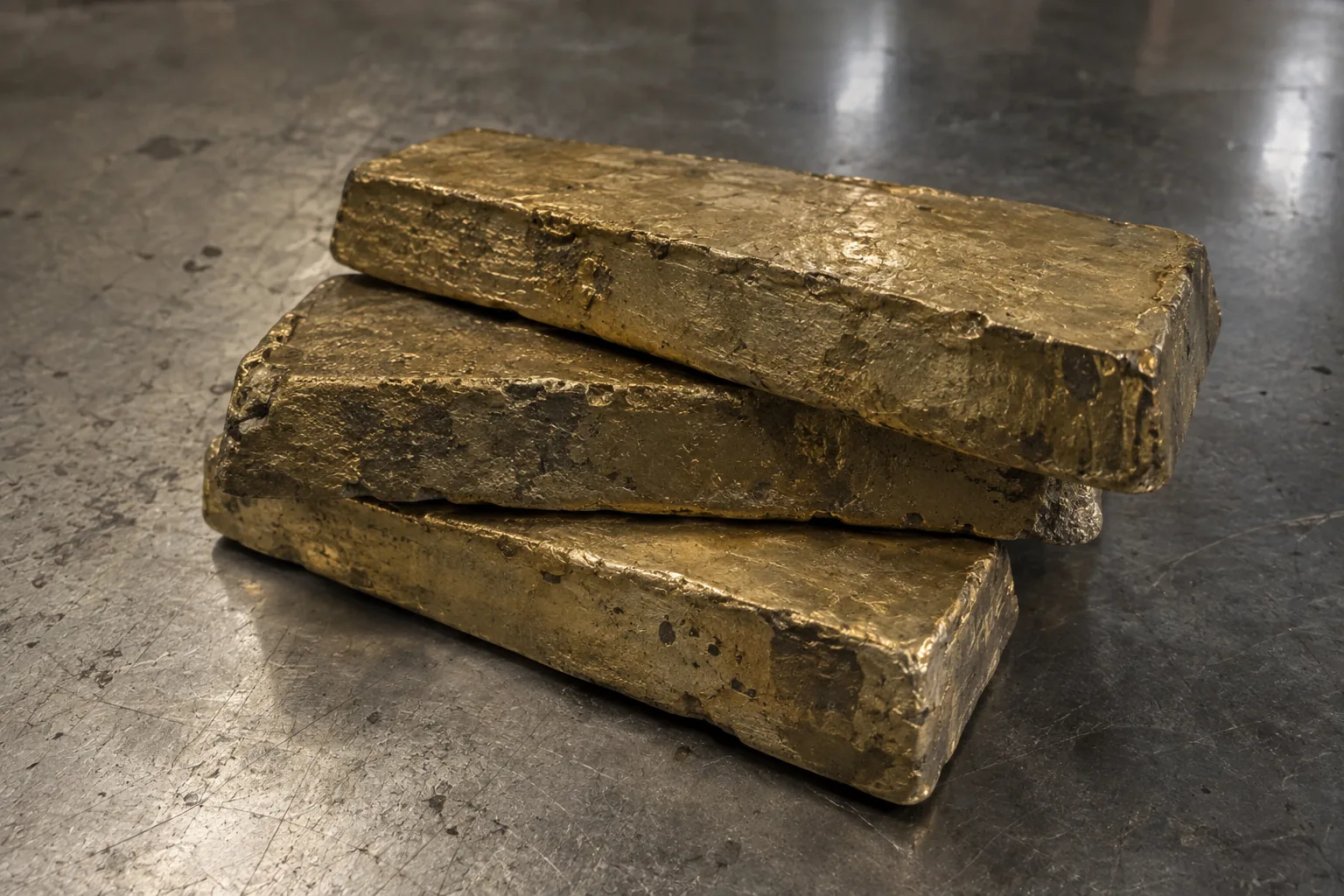
A doré bar is an ugly object. It is cast at or near the mine, in a mold that does not much care about appearance, and it comes out as a dull brick with a rough surface and a seam where the metal cooled unevenly. It is mostly gold, commonly somewhere between seventy and ninety percent, with silver and copper and whatever else was in the ore making up the rest. It is heavy, it is worth a great deal, and until yesterday a particular class of Ghanaian trader could put one on a plane.
As of 1 September they cannot. The date is worth holding, because what it turns out to mean is a question about refining capacity rather than about law.
What the rule says
Ghana’s compliance notice, issued on 24 August and effective on the first of this month, requires that artisanal gold bought by self financing aggregators be refined inside the country before any of it is exported.
A self financing aggregator is a licensed buyer that purchases gold using its own money rather than a state facility. Those firms and their approved offtakers had until 31 August to amend existing agreements to reflect the change. Gold they buy must now be processed at a refinery approved or designated by the Ghana Gold Board, and an export application will not be considered until that processing has happened.
Failure to comply carries refusal or suspension of export approvals, suspension or revocation of a license, and administrative penalties under the Gold Board Act.
That is the whole instrument. It does not tax anything, it does not ban exporting gold, and it does not nationalize anything. It changes the form in which the metal is allowed to cross the border.
Why a country would do this
The logic is value capture and it is entirely standard, which is why versions of it appear across resource exporting economies.
Refining is the step that turns doré into bullion of known purity, and it carries a margin. It also carries employment, a skilled workforce, an assay capability, and an industry that buys services locally. A country that exports doré exports all of that along with the metal, and imports the refined product back at a price that includes somebody else’s margin.
Indonesia did a version of this with nickel and built a processing industry that did not previously exist. Others have tried it with bauxite and copper and had a harder time. The policy is not exotic. The question is never whether the reasoning is sound; it is whether the capacity exists to absorb the flow the rule redirects.
The constraint the notice does not mention
Here is where the retrospective view matters, because the interesting thing about 1 September is what it reveals about the plants.
Refining capacity is a physical quantity. A refinery has a throughput, measured in kilograms or tonnes per period, set by its equipment and its staffing. You cannot increase it by directing more material at it. Direct more material than it can take and the material queues.
Ghanaian refineries have in the past run below capacity for the opposite reason, which is that they could not get enough feed: the doré went abroad, because the aggregators had relationships and prices there. A rule that redirects the feed solves that problem at a stroke.
It solves it only if the arithmetic works in the other direction too. If the volume now compelled homeward exceeds what the approved plants can process, then gold that used to move in days sits in a queue, and the cost of that queue falls on the aggregator, who has already paid for the metal with its own money. That is the specific vulnerability of a self financing buyer: its capital is tied up in the commodity, and every week the bar waits is a week of financing cost against a position that cannot be sold.
There is a second reason the doré step matters more than it looks. A bar of uncertain purity has to be assayed before anybody will pay for it, and whoever performs the assay is in a position to tell the seller what the seller has. A producer who exports unrefined metal is therefore taking a price on somebody else’s measurement of his own product, which is a weak position in any trade and a particularly weak one when the buyer is also the assayer.
Who bears what
Work through the chain and the incidence becomes clear, and it is not where the rhetoric usually puts it.
The artisanal miner at the top of the chain is the party this kind of policy is usually said to be for, and is the party least affected in the short run. A miner sells to an aggregator at a price set against the world market. The refining requirement sits downstream of that sale.
The aggregator carries the change. Its working capital cycle lengthens by however long the refining queue turns out to be, and its costs rise by whatever the domestic refining charge is against the foreign one it was previously paying. If the domestic charge is competitive, this is a modest administrative change. If it is not, the aggregator’s margin absorbs the difference, and margin compression in a licensed trading business has a predictable consequence: the smaller operators exit and the trade concentrates.
The refineries collect, which is the intended effect. They also acquire something more valuable than the margin, which is a guaranteed feedstock, and a plant with guaranteed feed can justify investment in capacity that a plant competing for supply cannot.
And the state collects visibility. Gold that must pass through an approved refinery before it may be exported is gold that has been weighed and assayed at a point the government controls, which is a substantial change in a trade where the persistent problem has been metal leaving without appearing in anybody’s records.
What 1 September will have meant
The measure that will settle this is not the export figure, which will fall in the short term simply because doré no longer counts.
It is throughput: how many kilograms the approved refineries actually process per month, against how many kilograms the aggregators are buying. If those two numbers converge, the policy has done what it was designed to do and Ghana has moved a step of the value chain inside its own borders. If the second runs consistently ahead of the first, the queue lengthens, financing costs accumulate, and the pressure to move metal outside the licensed channel goes up rather than down.
That second outcome would be the reverse of the intention, and it is not a hypothetical risk. It is the ordinary failure mode of a rule that changes where a thing must go before checking how much the destination can hold.
A stack of rough yellow bricks that was a shipment three weeks ago is an inventory position now, sitting in a vault at somebody’s financing cost, waiting for a slot at a refinery. How long it waits is the only number in this story that matters.