Start with the object, because everything else follows from it and almost nobody looking at this story has looked at the object.
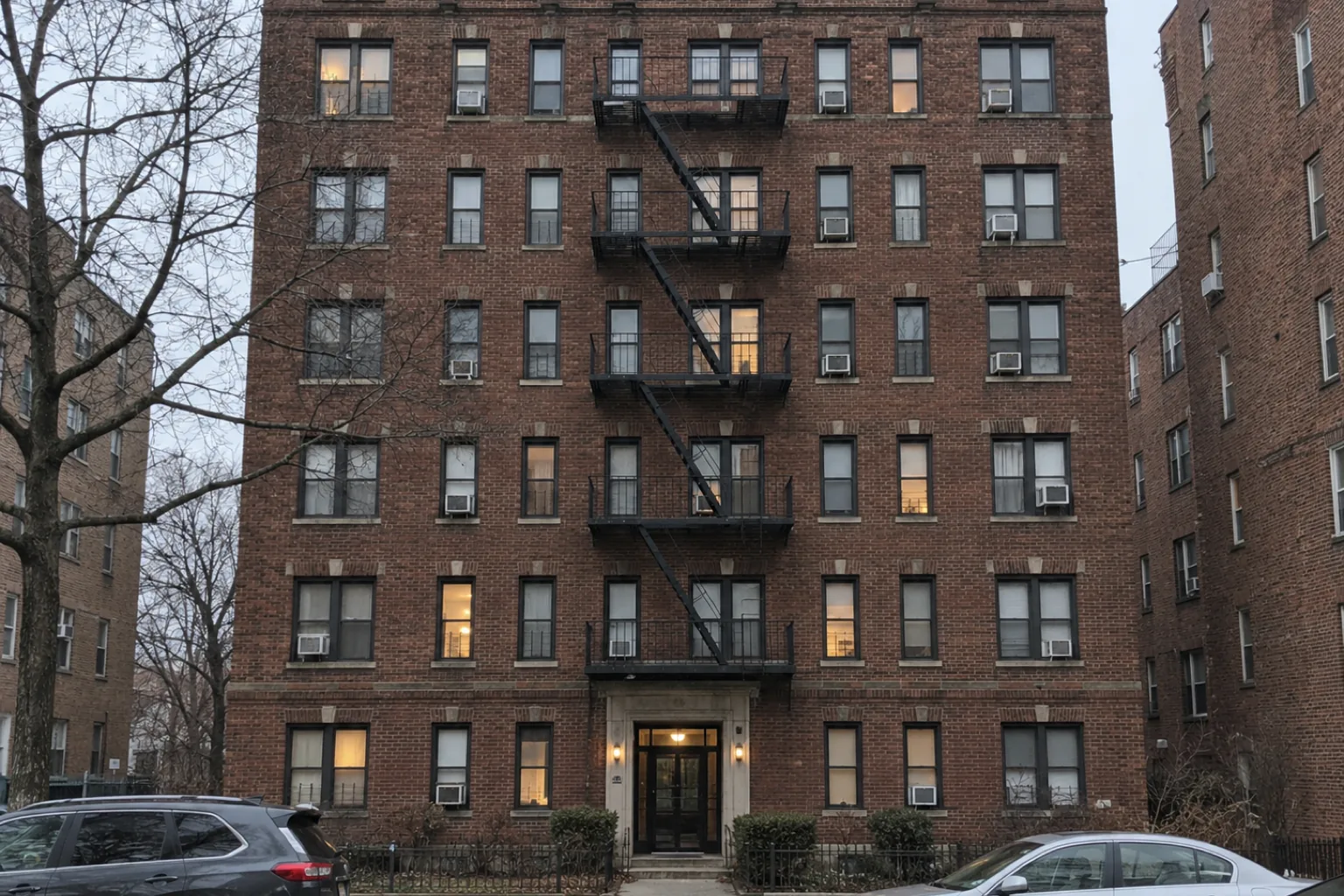
It is an apartment building. Six stories of brick, somewhere in Queens or the Bronx, put up between the wars, sixty or ninety units, a super in the basement, a boiler that is older than most of the tenants. It is not distressed and it is not glamorous. People live in it, pay rent on the first, and mostly stay, because a large share of the units are rent regulated and moving would cost more than staying.
That building is the asset underneath this week’s banking story, and this is a primer on how a boring, occupied, rent-paying building turned into a credit event.
What a bank like this is
New York Community Bancorp is not a bank in the sense most people picture. It is a lender against multifamily housing in New York City, and it has been one for a very long time.
Its own filings are the clearest statement of what that means. At the end of 2023 the multifamily book stood at roughly thirty-seven billion dollars, the majority of it in the five boroughs, with about half of it touching rent regulation in some form.
Concentration like that is not a mistake in the ordinary sense. It was the strategy, and for thirty years it was a good one. Lending against occupied apartment buildings in a supply-constrained city is about as close to a safe loan as commercial real estate offers: the collateral is in use, the tenants are stable, the cash flow is dull, and dull is exactly what a lender wants.
The bank was not chasing office towers. This is worth saying plainly, because the phrase used everywhere this week is commercial real estate, and most readers hear that as empty office floors after the pandemic. That is a real problem and it is a different one.
What changed underneath the collateral
The value of a loan against a building is the value of the building, and the value of a building is the money it can be made to produce.
For a rent regulated apartment building in New York, the amount it can be made to produce is set by law rather than by the market, and the law changed in 2019. The two routes by which an owner had previously been able to raise a regulated rent were both spending routes: money into an individual apartment, or money into the building as a whole.
The Housing Stability and Tenant Protection Act narrowed both. Improvements to a single apartment were capped at three of them, totaling fifteen thousand dollars, across any fifteen year period, and the resulting increase now comes back off the rent after thirty years instead of staying on it. Building-wide improvements were capped at a two percent annual increase, down from six in the city, and amortized over a longer schedule.
Consider what that does to a valuation. Before, a buyer could underwrite a building at a price that assumed rents would climb toward market over fifteen years, because there was a mechanism to get them there and the increases were permanent. After, the mechanism is capped and the increases expire, so the building is worth roughly what it produces now, which is a materially smaller number.
So the collateral repriced in 2019. The loans did not, because a loan is a contract and it runs to its maturity at the rate it was written.
Why the loss shows up five years later
This is the part that confuses people, and it is not complicated once the timing is laid out.
A commercial mortgage does not amortize away like a home loan. It runs for a term, often five or ten years, and at the end the borrower refinances. That refinancing is the moment the world gets repriced: a new appraisal, a new rate, a new loan-to-value test.
A loan written in 2018 at low rates against a building appraised on pre-2019 assumptions comes up for refinancing now, into a rate environment several points higher, against a building that is worth less than it was. The borrower has to find equity that may not exist. The lender has to decide whether to extend, restructure, or take the loss.
Nothing about the building has changed. It is the same brick, the same boiler, the same tenants. What changed is the number a lender is willing to write against it, and that number only becomes real on the day somebody has to write it.
What a downgrade actually does
On Tuesday evening Moody’s cut the company’s long-term issuer rating two notches, to two steps below investment grade. The agency pointed at the surprise loss on the property book and described the bank’s funding and liquidity as a relative weakness against its peers.
A rating is not an opinion about whether a bank will fail. It is a label that other institutions have written into their own rules. Pension funds, insurers and money market funds frequently cannot hold paper below investment grade, or can hold only a limited amount of it, and those constraints are not discretionary. So a downgrade does not persuade anybody to sell. It obliges some holders to.
The consequence is mechanical and it is expensive. Fewer permitted buyers means a higher yield demanded on any new borrowing, which raises the bank’s cost of funds, which compresses the margin between what it pays for deposits and earns on loans. A downgrade is therefore partly a forecast and partly a cause.
The agency also noted that a third of the bank’s deposits are uninsured. That figure belongs in a different column from the property losses and it is the one to watch, because uninsured deposits are the ones that leave quickly when depositors read a headline. The shares fell again on Wednesday, and the company named a new chairman the same day.
What this is not
Two things this is not, both of which have been asserted this week.
It is not last March repeating. The banks that failed in 2023 were killed by a run against securities portfolios marked at prices nobody had wanted to acknowledge. This is a credit problem, in a loan book, against collateral that exists and is occupied, and credit problems unfold over quarters rather than over a weekend.
It is also not a general verdict on regional banks. It is a verdict on a concentration, and the concentration is unusually specific: rent regulated New York multifamily, written at pre-2019 assumptions, coming up for refinancing now. Other lenders hold some of that. Very few hold that much of it.
Where this lands
For anybody actually working in this, the change is narrow and immediate. An underwriter pricing a regulated building this month is using a different set of assumptions than the one they were handed in 2018, and the difference is not a spread adjustment. It is a different view of what the asset is.
The building is still there. The boiler still needs replacing, and under the current rules there is no mechanism that lets an owner pass most of that cost through to a regulated rent, which is the reason the boiler does not get replaced. The bank’s loss and the tenant’s cold radiator are the same fact, arriving at two different desks about five years apart.