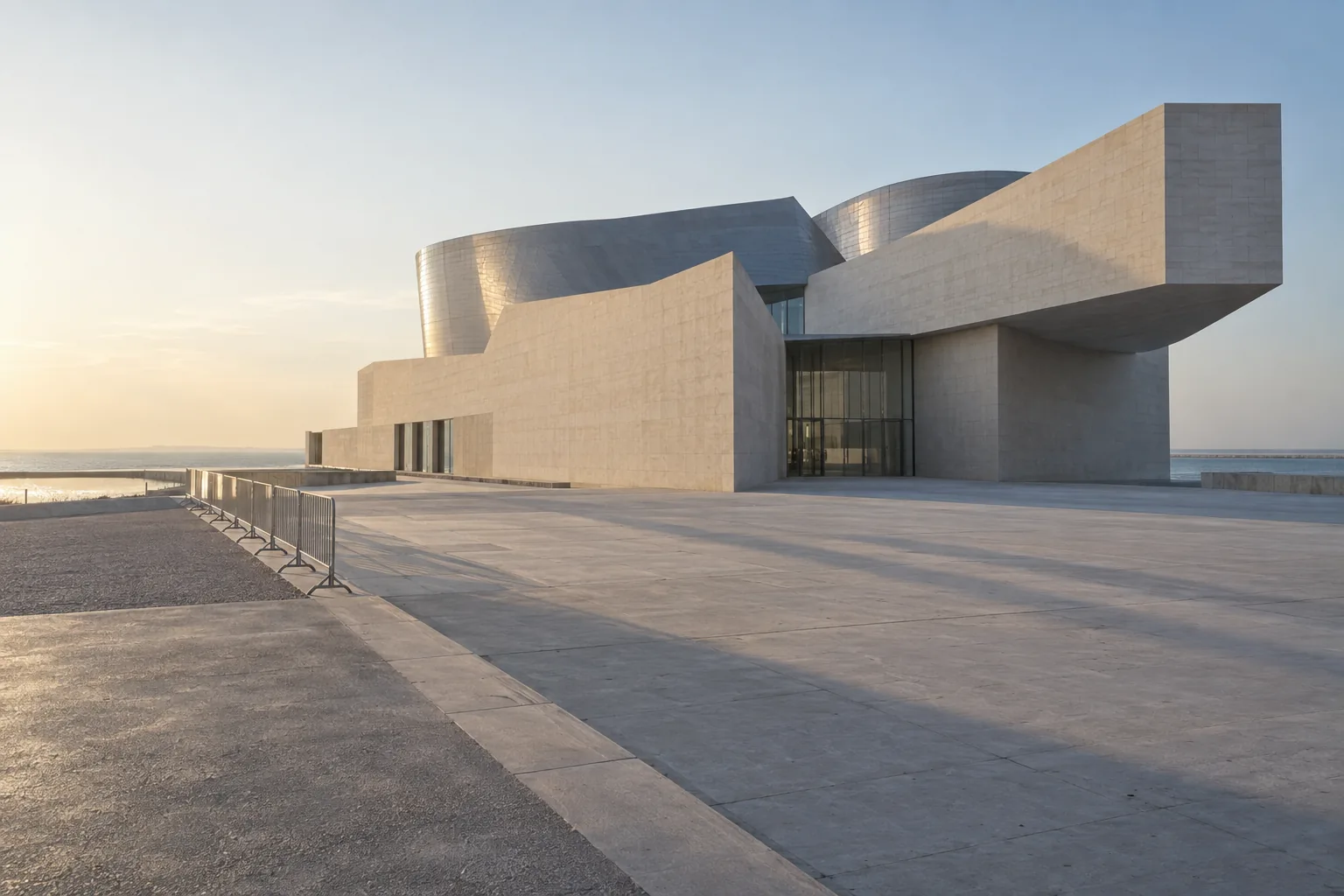
On 11 December, a Frank Gehry building on Saadiyat Island will open its doors to the public, thirteen years after it was first supposed to. The Guggenheim Abu Dhabi was announced in 2006 and projected to open in 2013. Then came the financial collapse of 2008, then construction costs, then the long institutional silence that settles over a project nobody wants to formally cancel. For most of a decade the site was a set of foundations and a rendering.
Judged as a construction schedule, that is a failure. Judged as what it actually is, the delay barely matters, because the building was never really competing against a calendar. It was competing against the idea that a country of this size and age cannot hold institutions of this weight. On that measure it arrives exactly on time, which is to say whenever it arrives.
What is worth examining is not the lateness. It is the ledger: what these buildings cost, who is paid, and what the money actually purchases.
What a name costs
The clearest number in the region belongs to the Louvre Abu Dhabi, because France published it. The 2007 agreement, authorized by an act of the French parliament, leased the Louvre name to Abu Dhabi for roughly 464 million dollars over more than thirty years. Add the loans of works, the curatorial expertise and the rest of the package and the figure rises to about 974 million euros flowing to French institutions. The building Jean Nouvel designed to hold all of it came to an estimated 650 million dollars, and opened in 2017 after five years of delay of its own.
Read that structure carefully. A significant share of the money did not buy art, or even a building. It bought a word. The Louvre sold the right to be called the Louvre, and the thing being traded was reputation, which France had accumulated over two centuries and could now convert into revenue without giving anything up.
This is not a criticism of the deal. It is a description of it. Both sides got what they came for, and the arrangement is unusual mainly because the price was written down where anyone can read it.
What the region spends
The Emirates are not the largest spender. Saudi Arabia’s culture ministry puts cultural infrastructure investment at more than 21.6 billion dollars since Vision 2030 began, covering restoration at Diriyah and AlUla alongside entirely new institutions. In May this year the Diriyah Company awarded a 490 million dollar contract for the Museum of Contemporary Art of Saudi Arabia, a building of some 45,000 square meters going up in the historical seat of the Saudi state.
Qatar, smaller than both, spends on the order of a billion dollars a year on museums, roughly half the Saudi rate but enormous against its population. It announced three institutions in 2022 and has since added Art Basel Qatar, which held its first edition in Doha this February.
Set those numbers beside the acquisition budgets of the institutions being emulated and the asymmetry is the whole story. The Gulf is not outbidding European museums for objects. It is building the rooms faster than anyone else can, and then working out what goes in them.
Saadiyat itself shows the pattern at close range. The Louvre opened there in 2017. The Zayed National Museum, by Foster and Partners, opened in December 2025. A natural history museum by Mecanoo and teamLab’s Phenomena hall have both been completed since. The Guggenheim makes five, on one island, none of them a decade old.
They have arrived faster than an audience with the habit of visiting them could plausibly have formed. That is the wager underneath all of it: the habit is expected to grow around the buildings, rather than the buildings being built to serve a habit that already existed.
Who collects
Follow the money out and it lands in familiar places. French institutions, for the name and the loans. Architects in Los Angeles, Paris and London. And, increasingly, a consultancy layer that has grown up specifically to serve this work: firms that write collection strategies, plan galleries and staff institutions for clients who are buying capability rather than growing it.
That last group is the genuinely new thing. A museum used to be the slow output of a collecting culture, accumulating for a century before it needed a building. The Gulf inverted the order. The building comes first, and expertise is procured the way any other input is procured. Whether an institution assembled in that direction develops the instincts of one assembled in the other is a real question, and it will take longer to answer than any of these construction schedules.
What is being bought
Here the ledger stops balancing neatly.
One of the museums Qatar announced is the Lusail Museum, which will devote four floors to what is described as the world’s foremost collection of Orientalist art. That is not a small curatorial decision. Orientalist painting is largely a European genre: Western artists depicting an East they had mostly imagined, in pictures that shaped how Europe understood the region for a century and a half.
A Gulf state is therefore spending heavily to gather up the images the West made of it, and to hang them in a building of its own choosing, with its own labels on the wall. That can be read two ways at once. It is a reclamation, taking possession of a story told about you and insisting on the right to frame it. It is also, unavoidably, an enormous investment in Western pictures, which keeps those pictures at the center of the room.
The same doubleness runs through the region’s contemporary institutions, which have drawn renewed attention to the visual traditions of the Islamic world while also functioning as extremely effective invitations to the international art market.
The part that will not resolve
Every soft power argument about these projects assumes the audience is abroad, and the usual conclusion is that the buildings buy a reputational return in Washington, Paris and London. That is probably true and it is also the least interesting part.
The more consequential audience is domestic, and it is young. The institutions going up in Diriyah and AlUla will be the places where a generation encounters its own history as something curated and argued over, rather than simply inherited. What a state builds to explain itself to visitors, it also builds to explain itself to its own citizens, and the second effect outlasts the first.
Which leaves the question that the ledger cannot settle. A museum can be commissioned, financed, designed and staffed on a schedule. What it comes to mean is decided much later, by people who had no part in commissioning it, and who will walk into a Gehry building in December without knowing or caring that it was meant to open in 2013. The receipts for all of this are public. What was actually purchased will not be legible for another generation.