
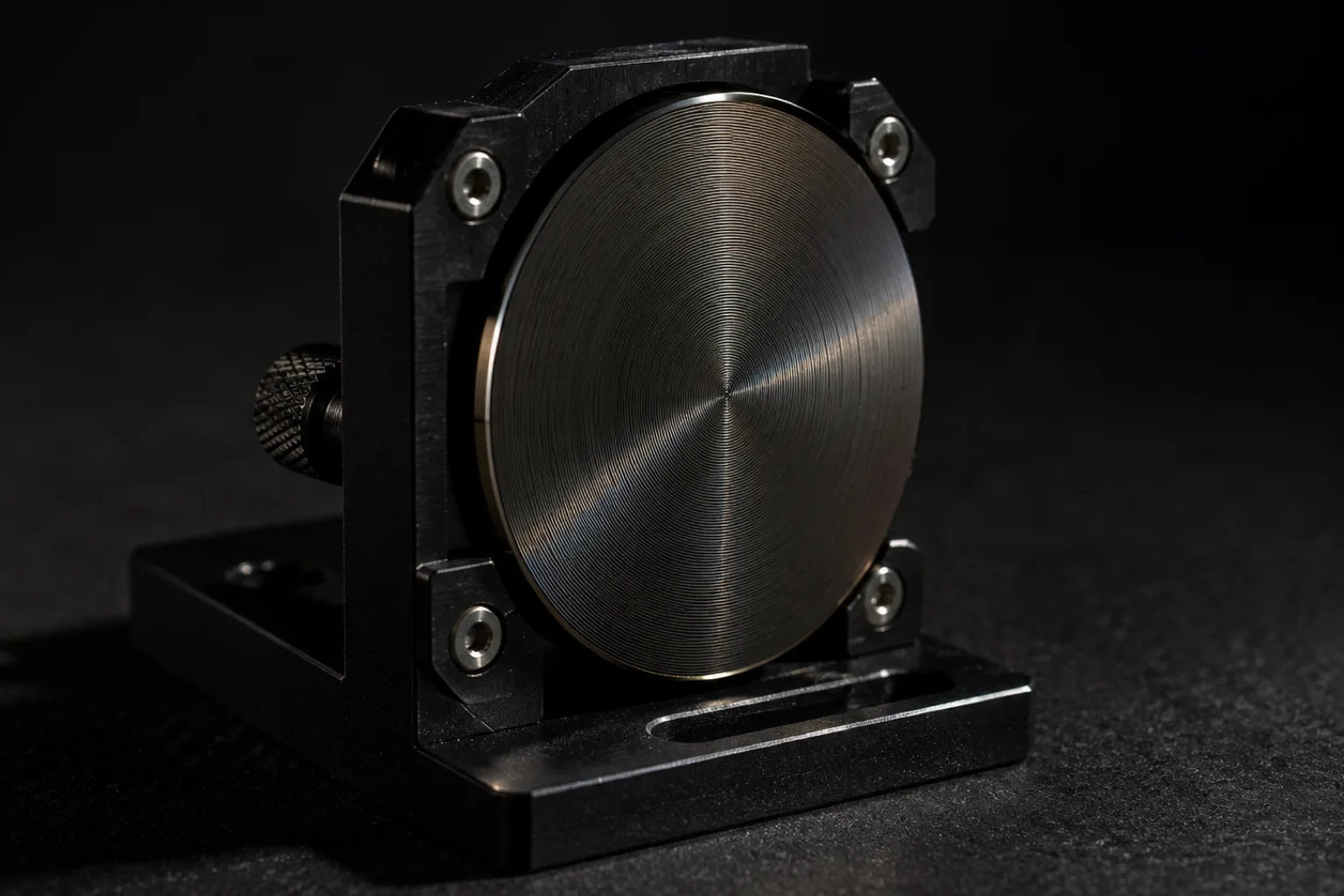
A coronagraph is, at heart, a small opaque shape. In the simplest version it is a disc of metal sitting in the light path at the point where the image of a star is focused, sized to cover the star and nothing else. Modern ones are more elaborate, etched patterns that shape the light rather than merely blocking it, but the principle has not changed since it was devised to look at the sun’s corona a century ago. Hide the bright thing. See what was next to it.
Nearly every planet ever photographed around another star has been found behind one of those. Beta Pictoris d, announced on 15 July, was not.
The problem the mask solves, and the one it does not
The difficulty in imaging a planet is contrast rather than distance. The star is overwhelmingly brighter than anything orbiting it, and the two are separated on the sky by a very small angle. Point a telescope at the pair and the star’s light floods the detector and the region immediately around it.
A coronagraph removes most of that light, which makes a planet detectable as what it appears to be: a faint point, slightly separated from a suppressed star.
The limitation is that suppression is never complete, and what survives is not smooth. Residual starlight leaves a field of speckles, and a speckle looks very much like a planet. It is a point, it is faint, and it sits at a plausible separation. Distinguishing the two has historically meant watching over years to see which points move with the orbit and which do not, and it is why direct imaging finds large, young, bright planets on wide orbits, and is nearly blind to anything fainter.
Beta Pictoris d is about a hundred times fainter than Beta Pictoris b, the planet in the same system that has been studied since it was imaged well over a decade ago. That is the regime where the speckle problem stops being a nuisance and becomes the whole obstacle.
Two instruments, two ways of looking
The announcement was made by two teams working independently, and the comparison between their methods is the most instructive part of this.
One team worked from the ground, using the ERIS instrument on the Very Large Telescope in Chile, doing infrared imaging through an atmosphere that has to be corrected for continuously. The other, led by Aidan Gibbs at the University of California, used the James Webb Space Telescope, above the atmosphere entirely.
Those are close to opposite approaches to the same contrast problem. A ground telescope has a large mirror and a hostile sky. A space telescope has a perfect sky and a smaller mirror, which sets a limit on how finely it can separate two things close together.
What matters here is not which won. It is that the detection was not made in the way either instrument’s imaging mode was primarily designed to make it. The planet was identified by the chemical signature of its atmosphere rather than as a point of light, through moderate resolution spectroscopy. This appears to be the first planet found principally that way.
Why a spectrum beats a point
The mechanism is worth following, because it explains why the method reaches into a regime the mask cannot.
A speckle is starlight. Whatever its brightness, its spectrum is the star’s spectrum, because that is where it came from. A planet’s light is not the star’s light. It has passed through or been emitted by an atmosphere containing molecules, and those molecules absorb at specific wavelengths, cutting narrow features into the spectrum at positions set by physics rather than by the observation.
So instead of asking whether a faint point is a planet, which is a question about brightness and position and is hard, you can ask whether the light arriving from a particular patch of sky carries molecular features the star does not have. That is a question about pattern rather than about signal strength, and patterns can be pulled out of noise that would defeat a brightness measurement, because you know in advance what shape to look for.
The practical effect is that the technique cares less about how faint a thing is and more about whether it is chemically distinct from the star. Those are different axes, and the second one was barely being used.
What the result does and does not establish
This is where I would ask for the usual care, with one unusual note.
Ordinarily a single detection of something this faint would warrant real caution, because the history of direct imaging includes candidate planets that later turned out to be background objects or artifacts. The appropriate response to one team’s announcement is interest rather than acceptance.
That is not the situation here. Two groups, using different telescopes, different detectors, different atmospheric conditions and different analysis pipelines, arrived at the same object and announced simultaneously. The failure modes of a ground based adaptive optics system and of a space telescope’s spectrograph have almost nothing in common, which means an artifact would have to appear in both, by coincidence, in the same place, with the same chemical signature. That is a considerably stronger position than most first detections occupy.
What remains genuinely uncertain is the planet’s properties. Mass, orbit and composition estimates at this stage rest on models of how young giant planets radiate, and those models carry known disagreements. The system is around twenty million years old, which is early enough that the object is still hot from formation, and how quickly such objects cool is exactly the parameter the models disagree about. A number quoted for its mass this month should be read as a model output with an error bar wider than the number suggests.
One more caution belongs with that. Simultaneous announcement is strong evidence of a real object and weak evidence about anything else, because the two teams were looking at the same system for the same reason and were aware of each other’s work. Independence of instrument is not the same as independence of expectation, and only the first of those is established here.
What this changes next
The specific result is one planet in a system sixty three light years away, which is scientifically interesting and not, by itself, important.
What may turn out to matter is the method. If a spectral signature can find a planet a hundred times fainter than the one the same system’s imaging found, then a considerable number of systems already observed contain planets in the archived data that nobody has extracted yet, because the analysis was looking for points rather than for molecules.
Reprocessing existing observations is slow, unglamorous work and it is where I would expect the next several results to come from. The instruments are already built. The photons were collected years ago and are sitting in archives, and the only thing that has changed is which question gets asked of them.